What is Agentic AI? Its Benefits, Use Cases & More

 Last updated:September 19, 2025
  21 Min Read
Artificial intelligence has long since taken over the digital landscape, and its grip is getting stronger with every advancement. It has revolutionized business workflow, redefined processes, and helped businesses achieve new heights.
These AI-powered solutions have taken the form of chatbots, assistants, tools, features, and so much more. The recent addition to this list is Agentic AI, a smarter, autonomous solution that adds value to the business and facilitates steady growth for large-scale enterprises.
Today, we will focus on this newly added technology, what it is, how it evolved, what distinguishes it from traditional AI systems, its benefits, use cases, and so much more. Through this in-depth guide, we will cover everything that one must know about Agentic AI. So, let us get started.
INTRODUCTION TO AGENTIC AI
Starting with the fundamentals, this section will cover the basics of agentic AI. topics covered would be:
What Is Agentic AI?
To define agentic AI in simpler terms, it is a multiple AI agent system that operates on large language models (LLMs). It combines the two prominent technologies, AI agents and LLMs, to design an autonomous system that can make decisions with minimal human supervision and generate output using natural language understanding.
Agentic AI strengthens generative AI using large language models, making it flexible enough to function in dynamic environments. The GenAI model creates engaging content, but agentic AI directs that generated output toward automatically completing a complex task.
The core features of agentic AI models are:
- They are autonomous and can function without any human supervision.
- The agentic AI has an active operational approach towards a goal it was designed to achieve.
- They are contextually aware and make informed decisions based on their understanding and interpretation of the input.
- Continually assesses, learns, and upgrades itself through machine learning and feedback loops.
Why is Agentic AI Important?
Agentic AI goes beyond autonomous operations. With its superior decision-making capabilities and adaptability, it can easily become a critical component of the entire workflow. Unlike traditional AI solutions, Agentic AI is capable of recognizing, handling, evaluating, and resolving a particular situation autonomously.
To explain this further, here is why businesses should integrate agentic AI systems
Complex Data Handling
Many industries, such as healthcare, financial services, logistics, etc., struggle with massive amounts of complex datasets and require work in dynamic settings where gathering real-time information is crucial. Agentic AI creates a secure channel for processing and analyzing large chunks of data in real-time. This accelerates the process and mitigates human errors.
Scalability
Agentic AI systems allow ample flexibility through autonomous adaptation capabilities to easily get used to new information influx and upscaling business. This ensures that your digital infrastructure is up to date with your upscaling business requirements while reducing the workload on human resources. Agentic AI in the eCommerce industry utilizes this to keep up with evolving market trends.
Improved User Experience
Agentic AI analyzes vast datasets, which helps it deliver tailored customer services and interact with users naturally. Digital assistants built on agentic AI understand the context, sentiment, and undertones in the input to generate relevant output. Industries like, retail, etc., that directly deal with clients benefit significantly from this feature of agentic AI.
Security & Risk Management
Agentic AI automates data analysis and pattern recognition to detect anomalies and take required measures immediately without any human assistance. Agentic AI systems are highly suitable for industries that work with large quantities of sensitive data, like financial services, healthcare, etc., as they ensure top-notch security through their advanced functionalities.
Evolution of Agentic AI - An Overview
Early Stage
Agentic AI was conceptualized in the mid-20th century. Alan Turing’s and Norbert Wiener’s work on machine intelligence and feedback mechanisms laid the foundation. The early AI systems developed between the 1970s and 1980s showcased advanced capabilities, though, as of today, they might be considered very limited.
Intelligent Agents in the 90s
With artificial intelligence on the rise, smart AI-powered agents and chatbots started gaining popularity among business giants. These AI solutions could perform rule-based tasks such as email filtering and scheduling with their thinking capabilities. The key innovation during this era was IBM’s Deep Blue which won a chess match against Garry Kasparov.
Related Read: How To Build an AI Agent?
The Era of Machine Learning
With the developments in machine learning, deep learning, and neural networks, AI’s capabilities were further refined. AI became more than just a digital tool. It became an AI assistant capable of understanding, analyzing, and contextualizing the dataset, learning from it, and improving the decision-making process. This was the foundation for the development of complex networks of AI agents or agentic AI systems.
Get a comprehensive understanding of AI assistants here.
The Rise of Autonomous Systems
The AI agents were further developed and put together as one whole system to create large-scale autonomous systems. This was a significant development, and it took the form of autonomous vehicles like Tesla and Waymo. It showcased the smart capabilities of AI agents and how they interact with the actual world.
The Generative AI & LLM-Powered Era
The 2020s witnessed exponential growth in AI development, with genAI being introduced to the market. ChatGPT started a chain of development across multiple avenues. These generative AI solutions, combined with LLM, made Agentic AI systems more versatile. The systems are integrated to automate content drafting, engage with customers like humans, and perform other mundane tasks.
Agentic AI has evolved through years of research and refinement into what it is today. Though it is still considered to be in a budding stage, the new technology is already revolutionizing various aspects of business across industries.
As it continues to evolve, it will continue to transform the digital landscape, making it a promising technology for steady yet long-term growth.
COMPONENTS AND TECHNOLOGY OF AGENTIC AI
In this section, know the key components, technologies, and how agentic AI combines them to optimize and automate business workflow. The topics covered here are:
How Agentic AI Works?
Agentic AI is designed to keep up with the current dynamic world. It auto-operates, independently makes decisions, and proactively takes steps toward achieving a set goal. It is built using a diverse set of technologies and amalgamates multiple components for optimal operability.
The different elements of agentic AI architecture work together as a collective whole to yield the desired results. To conceptually understand how the architecture operates, the following section is divided into core components, technologies used how the two components work together.
Agentic AI Core Components
Perception
Agentic AI systems learn from their environment through massive training datasets in textual, audio, and video format or through sensory data and real-time analytics. This helps the agentic AI models gain insights into repetitive patterns and data errors and a better conceptual understanding of the data.
Memory
Agentic AI maintains memory from previous interactions with long-term memory models. This helps the model retain user preferences to improve and make informed decisions. Agentic AI frameworks consist of a vector database for information retrieval and knowledge graphs to structure and connect new information with past ones.
Goal Defining
Agentic AI auto-defines goals and actively takes action to achieve them. The autonomous system determines the optimal plan and actions with the help of reinforcement learning, optimization algorithms, and self-adjusting logic. These three components allow Agentic AI to improve, determine, and dynamically update its course of action to yield maximum results.
Execution
Once the goal is defined, the agentic AI system systematically breaks down the whole plan into actionable tasks, delegates them, and monitors the system regularly to assess and refine its performance. All the tasks are completed without any human intervention, which further adds to its smart capabilities.
Feedback & Learning
Agentic AI employs a feedback loop to learn through reinforcement learning and fine-tuned training data. This feedback loop helps the model evolve its approach and adjust the strategies until it reaches its desired outcome. This continuous loop of learning and improvement ensures optimal performance and a high success rate, all thanks to its feedback management tools.
What Does Agentic AI Architecture Comprise Of?
Agentic AI’s effectiveness is based on its robust architecture. It comprises several complex components and is built on modern technologies that work as a cohesive whole to improve processes and business workflow and automate complex tasks.
The core technologies that make resilient agentic AI systems are:
Machine Learning (ML)
Machine Learning helps agentic AI analyze larger chunks of datasets, identify patterns, and predict possible actions based on the existing data. These ML algorithms also allow agentic AI to continually learn from the data and expand its capabilities to handle every possible outcome.
There are three types of machine learning practices used by Agentic AI:
- Supervised Learning – This method utilizes labeled datasets for training and helps the agentic AI models with data classification and generate output relevant to the input.
- Unsupervised Learning – This method helps the model understand patterns and data grouping by training it without labeled data. It makes the model capable of detecting anomalies.
- Reinforcement Learning – In this method, the model learns and improves through continual interaction with the user and their positive or negative feedback.
Natural Language Processing (NLP)
NLP makes agentic AI capable of understanding human language and conversing in the same. It works using machine learning and computational linguistics to interpret various nuances of human languages, analyze symptoms, and augment natural human-like conversations with customers.
Three ways how NLP facilitates effective communication between agentic AI models and users:
- Natural Language Understanding: NLP allows agentic AI models to understand human language, comprehend it, and interact in the same manner. It also allows machines to better understand the sentiment behind the input.
- Speech Recognition: NLP facilitates verbal communication with its speech-to-text and text-to-speech functionality. It converts the spoken language and generates output in the user’s preferred format, thus allowing users to interact with the agentic AI verbally.
- Natural Language Flow: Since NLP enables agentic AI models to understand and respond in natural language, it allows cohesive conversation flow independent of any keywords.
Large Language Model (LLM)
LLM, or large language models, are the crucial element of agentic AI as they easily handle multiple queries and complex large-scale datasets. These models are built using ML and NLP and enhance their capabilities by combining them.
Large Language Models can be categorized into the following categories:
Classified Based on Architecture:
- Autoregressive Models: These use preceding tokens to predict the next word or character for text generation. They generate contextually accurate output. An example of such a model is GPT.
- Autoencoding Models: These models use masked tokens to understand the context of words as connectors in a sentence, making them ideal for deep research, sentiment analysis, etc. An example of this model would be BERT.
- Seq2Seq Models: These models work best for cases where input and output are part of one sequence. They consist of an encoder (for processing the input sequence) and a decoder (for generating the output sequence). This type of model is perfect for summarization.
LLMs Based on Availability
- Open-Source Models: These models are available for people to access without any additional costs. Typically, open-source models are backed up by diverse communities that help improve the model through regular updates and developments. LLaMa and BLOOM are the two popular examples of open-source LLM
- Proprietary Models: These are paid models available as subscriptions. They offer restricted access, and the documentation is unavailable to the general public. These models generally offer more features and resilient performance compared to the open-source ones. Some examples of such LLMs are GPT-4, Claude, etc.
Decision-Making Frameworks
All the insights generated from the other components are combined and used to build a refined framework that assists agentic AI with autonomous decision-making. This allows agentic AI to maintain a streamlined workflow and accelerate disaster management recovery.
The two key components of this framework are:
- Rule-Based System: These combine machine learning insights and predefined rules for improved decision-making.
- Probabilistic Models: These models come in handy when multiple scenarios are involved. They assist the agentic AI in making informed decisions based on the different possible outcomes.
Here’s How Agentic AI Operates
User Input
The user begins the interaction by giving the agentic AI model an input in natural language. The system perceives, interprets, and understands the input using natural language processing and machine learning.
Task Coordination & Breakdown
The system breaks down and converts the inputs into simple manageable tasks. The tasks are then divided and allocated between the different agents with relevant knowledge and capabilities. Thus, systematically coordinate and get the tasks done.
Output Refinement
The system also refines the output using reinforcement learning to ensure that it is relevant and aligns with the user’s input. This can be done by asking the user more questions regarding the input and working constantly until the goal is achieved.
Execution
After perceiving, defining, and allocating the input into smaller tasks, agentic AI condenses everything into one. This is the final step, where agentic AI executes and responds and completes the task of resolving/responding to the user query.
WHAT MAKES AGENTIC AI DIFFERENT FROM OTHER AI SOLUTIONS
Since agentic AI is a comparatively newer concept, it is important to understand how it compares to other AI solutions. To resolve that, we have compared the agentic AI systems with traditional AI models, GenAI, and AI agents.
Agentic AI vs Traditional AI
How does agentic AI differ from traditional AI? A brief overview:
| Criteria | Agentic AI | Traditional AI |
| Autonomy | Fully autonomous, Intelligent, human-independent processes | Works on pre-defined rules or patterns, human input triggers action |
| Decision-Making Capabilities | Dynamic, adaptive approach to achieving goals | Static, rule-based algorithmic processes to complete fixed tasks |
| Adaptability | Retains past interaction for seamless integration in the new environment without retraining. | Limited or no memory, retrieval, requires retraining when integrating it in a new environment. |
| Interaction | Proactive, initiates actions and interacts with the user by itself | Responsive, responds to specific query or trigger action |
| Collaboration | Creates a collaborative ecosystem between agentic AI and other automation system | Standalone operating system, no collaboration with other components |
Generative AI vs Agentic AI
GenAI and agentic AI are growing technologies, but they differ in a lot of ways:
| Criteria | Generative AI | Agentic AI |
| Primary Functionality | Unique content generation in multiple formats | Autonomous operations and decision-making |
| Task Execution | Follows and generates responses based on the user’s prompt | Operates, manages, and collaborates based on predefined objectives |
| Autonomy | Reactive | Proactive |
| Memory | Session-based memory for easy context understanding | Long-term memory storage using vector database for effective decision-making |
| Use Case | Content creation, text generation, audio/video synthesis | Autonomous systems, self-learning agents |
Related Read: LLM vs Generative AI
Agentic AI vs AI Agents
For the final difference, we will see how agentic AI differs from AI agents:
| Criteria | Agentic AI | AI Agents |
| Basic Understanding | An autonomous system comprising multiple AI agents | Individual AI components are designed and trained to perform a specific task |
| Autonomy Level | Highly Autonomous – requires no human intervention or pre-defined conditions | Limited Autonomy – works on pre-defined rules and conditions |
| Leading Technology & Processes | Reinforcement learning, goal-driven planning | Rule-based logic, decision trees |
| Collaboration Capabilities | Work as a multi-agent system | Generally single task-oriented system |
| Use Case | Autonomous fintech fraud detection, AI healthcare system | Chatbots, recommendation engine, customer service assistant |
BENEFITS, USE CASES & CHALLENGES OF AGENTIC AI IMPLEMENTATION
Now that there is clarity on different aspects of Agentic AI, let us have a look at the advantages and pain points of Agentic AI along with some real-life use cases. In this section, we will cover:
Benefits of Agentic AI for Businesses
Agentic AI offers many benefits that businesses can utilize. It creates a sophisticated system that operates with minimal to no disruption within the organization. While there are many industries and businesses that can benefit from this, they are:
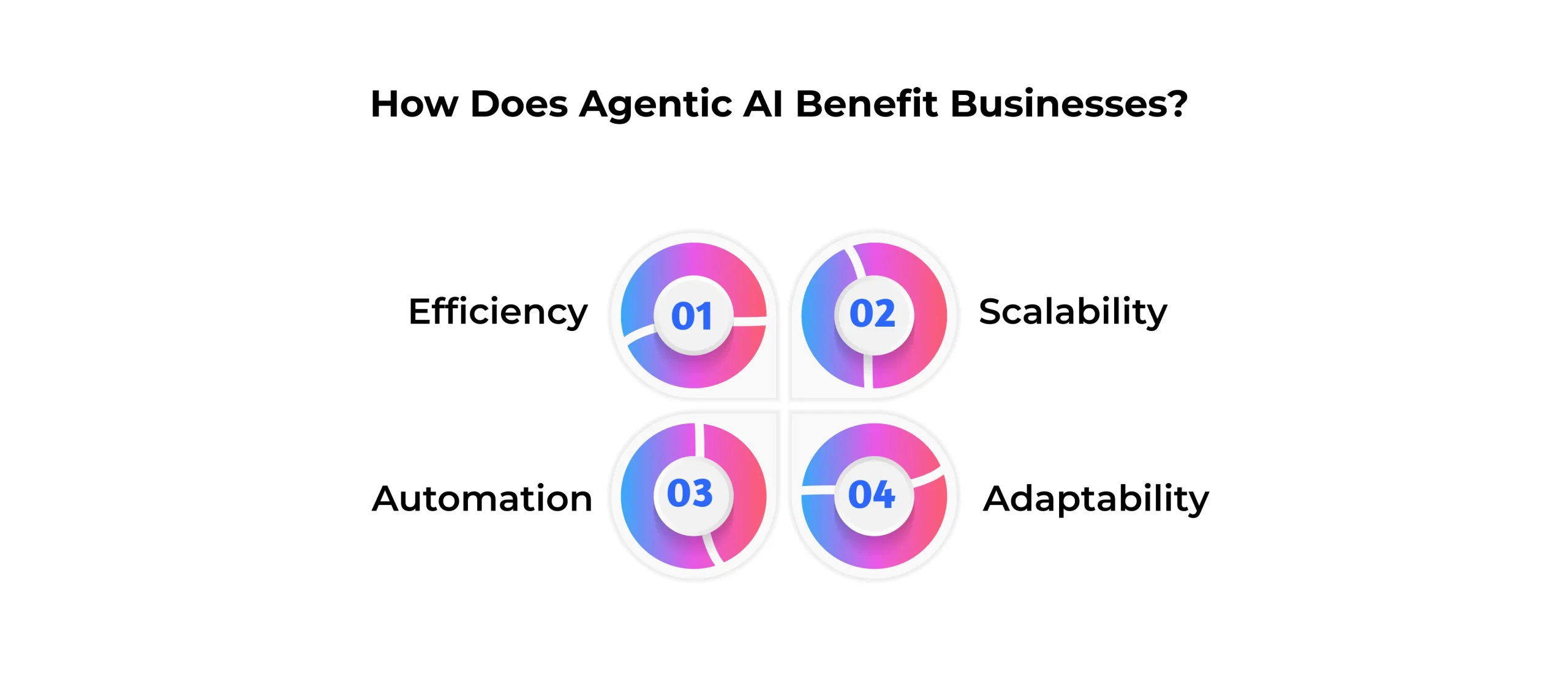
Improved Efficiency
- Agentic AI platforms mitigate the need for human intervention while mechanizing complex business workflows. They continually learn and improve themselves based on user feedback and minimize disruptions by refining the algorithm. They utilize reinforcement learning to align their updates with users’ preferences.
Ensured Scalability
- Since agentic AI systems are designed to match the pace of the current dynamic environment, they become the perfect assistant for steady upscaling. These solutions easily adapt to complex workflows, reducing errors, accelerating processes, and streamlining business scalability.
Workflow Automation
- Another and the most significant benefit of agentic AI is its autonomous operability. Human-independent processes and decision-making further enhance the workflow. These agents perform accurate analysis to identify performance gaps and take appropriate actions to overcome them.
Faster Adaptability
- Agentic AI combines responsiveness with adaptability through real-time data assessment, self-learning, and automation. This facilitates accelerated decision-making without any human intervention. It manages new data, connecting it with the existing ones to better understand and recalibrate strategies to align with fluctuating scenarios.
Industry-Specific Agentic AI Use Cases
The next question is, “What are some real-world applications of agentic AI?” The question is also valid considering the utilitarian approach behind digital advancements, where a technological solution is designed to resolve an operational roadblock.
Here are some agentic AI use cases across multiple industry verticals to showcase its advanced capabilities and potential.
Fintech
Fraud Detection
- Agentic AI systems regularly monitor transactions. They identify anomalies through extensive behavior analysis and block any suspicious activities without requiring human assistance. They also quickly adapt to evolutionary fraud patterns, thus ensuring secure transactions.
Wealth Management
- Agentic AI also helps financial institutions provide custom investment portfolios for their clients after doing a thorough risk assessment. These agentic AI also balance out the financial assets based on market shifts and provide round-the-clock personalized financial advice.
Read More: AI in Wealth Management
Credit Scoring
- Agentic AI simultaneously analyzes multiple data formats, including transaction patterns, social activities, cash flow, etc., to determine customer’s credit scores and risk factors before approving or disapproving loans. This gives a comprehensive view of a person’s credibility.
Automated Regulatory Compliance
- Agentic AI models make a reliable system to automatically audit and constantly monitor industry compliance protocols. AI in fintech to deliver secure, transparent services by staying updated with the latest regulatory compliance protocols.
Healthcare
AI-Driven Diagnostic Systems
- Agentic AI in healthcare accelerates diagnostic processes with faster assessments. It analyzes patient symptoms, test results, medical images, and other related documents to provide relevant insights into patient health, followed by a treatment plan recommendation.
Autonomous Drug Discovery
- Agentic AI systems accelerate medical research by analyzing multiple possibilities and combinations to predict successful molecular combinations. This eliminates the trial and error stage, thus shortening the research process and making drug development more efficient.
Related Read: GenAI in Drug Discovery
AI-Powered Surgery Assistants
- Agentic AI also finds its use cases in surgical procedures, as these smart assistants can easily mimic and improve human hand movements. These solutions capably perform complex surgical procedures by adjusting to the patient’s conditions in real time.
Virtual Nursing Assistants
- One of the most beneficial agentic AI use cases in healthcare is developing an AI-powered system to assist the nursing staff. These agents perform all the required tasks, including round-the-clock patient assistance, real-time alerts in emergencies, answering FAQs, etc.
Logistics
Self-Improving Supply Chain
- AI in logistics improves supply chain operations by providing data-driven insights on demand fluctuations and accordingly making necessary adjustments. It also manages fleet routes in real-time and automatically reroutes in case of disruptions.
Smart Warehouse Robots
- Agentic AI system takes care of the heavy load when managing a warehouse in the logistics industry. These robots reorganize inventory based on product demand, coordinate with other robots for streamlined packaging, and provide optimal goods maintenance.
Last-Mile Delivery Optimization
- Agentic AI automates delivery methods (drones/trucks/robots) based on package size and convenience. It also reschedules failed deliveries and provides real-time updates on estimated deliveries. All these features increase customer satisfaction.
Predictive Fleet Maintenance
- Agentic AI continually monitors various data sets in the logistics industry, including vehicle health. It assesses and predicts potential failures and schedules maintenance, reducing breakdowns and downtime and thus saving time and operational costs.
Related Read: AI Agents Examples
Education
Personalized AI Tutor
- AI analyzes students’ past records and current performances to better understand their strengths and weaknesses. This helps the system design a perfect study plan based on the data for each student individually.
Auto Grading & Feedback
- Agentic AI also reduces the efforts and hours spent checking the answer sheets by automating the process, which is beneficial for both students and instructors. The AI-powered system reduces biases and has a built-in plagiarism detector to identify any unoriginal content, thus improving the results and assessment.
Related Read: Role of AI in Education
Adaptive Learning & Curriculum
- Agentic AI allows instructors to design a curriculum that meets current requirements and accommodates students’ preferred learning pace and methods. This fosters accessible education for everyone, including people with disabilities.
Virtual Campus Assistants
- Agentic AI can also become a virtual campus assistant that helps new students familiarize themselves with the new environment by giving them a tour, answering their queries, etc. These assistants also help with paperwork, extracurricular activities, schedules, and more.
For Agentic AI Solutions That Cater To Both Your Business And Your Industry
Challenges of Agentic AI Integrations & Best Practices
Agentic AI platforms are taking over mainstream operations with their versatility. However, it is important to note that these solutions, no matter how beneficial, can become a challenge if they are not incorporated well into the present-day business process.
Here are some of the top challenges and best practices to mitigate them:
Challenges of Agentic AI Integration
Insufficient Human Oversight
Agentic AI functions autonomously, which is beneficial for organizations as it frees up time otherwise spent doing or supervising tasks. However, AI still requires human intervention to ensure that it is used ethically, doesn’t use inaccurate data, and complies with all legal requirements.
Lack of Transparent Practices
Agentic AI architecture is really complicated, so many people aren’t able to understand how it operates. The developers’ lack of transparency in documentation and other datasets reduces trust and adds to concerns regarding its reliability. This is why they should keep the clients and stakeholders in the loop during the process.
Security & Privacy Concerns
Security and privacy issues are always the primary concerns with the advent of new technologies. This is especially true for the healthcare and fintech industries, which are data-intensive and contain a lot of sensitive information. With autonomous operating systems, the chances of data breaches also increase, so it’s important to implement a high-security system.
What Are The Best Practices
Strict Regulations
Governing bodies, industry leaders, and legal teams must formulate strict guidelines for companies to follow when developing agentic AI systems. This creates a baseline for how human-machine dynamics would work and how much access these AI systems would be allowed.
Rigorous Testing
Conduct thorough testing across multiple scenarios to check the accuracy and reliability of agentic AI. It is advised to rigorously test the model for any potential flaws, identify the root cause, and eliminate all issues before deployment.
Continuous Monitoring
Regularly monitoring agentic AI systems is important for updates and maintenance (if needed). Establishing multiple performance metrics, feedback loops, etc., is a good way to get deeper insights into model performance, any gaps, and how to mitigate them.
Multiple Layers of Security
Secure the agentic AI system with a multi-layer security system. Many measures, such as data encryption, access control, timely assessments, etc., can be taken to check for vulnerabilities. These practices maintain integrity, privacy, and ethical standards.
HOW TO BUILD AGENTIC AI, AND WHAT ARE ITS FUTURE IMPLICATIONS?
Secure development is the key to successful agentic AI integration and its optimal utilization. This concluding section will primarily focus on optimal agentic AI development and its future trends. The key topics covered are:
How To Build Agentic AI Systems?
Building an enterprise-grade agentic AI platform is a complex process. It requires a detailed understanding of artificial intelligence, clarity on what one wants to achieve with agentic AI, and a structured development approach.
To explain it in five steps, here’s how one builds a robust agentic AI platform:
Step 1: Set Clear Objective
Agentic AI development requires clarity. The crucial step is to answer the question, “What must this agentic AI system resolve for the business?”
Start by identifying the pain points and operational gaps in the current workflow. The next step is to identify how agentic AI would address the workflow issues and to what extent. Clarity on the extent of automation (fully automated system or partial automation) is important to avoid any complications later.
Another thing to keep in mind is industry-specific requirements and regulations. It is crucial to ensure that the AI solutions are backed by the latest security measures and comply with all industry-specific requirements.
For example, developing an agentic AI for a fintech company would require it to comply with financial compliance requirements and advanced technology to secure transactions and other economic datasets.
Step 2: Select The Right TechStack
Once the objective is defined, the next question to answer is, “How to build a robust architecture for developing a strong agentic AI system?”
Since agentic AI works proactively towards a set goal, it is important to have a robust architecture powered by the relevant technologies. Integrating APIs, IoT sensors, and company-specific data sources for data ingestion.
Then come various other components, including a vector database and knowledge graphs for memory retention, a decision-making system for independent operability, and automation tools. Additionally, for large-scale organizations, integrating a multi-agent system is also needed for seamless coordination and collaboration.
Continuing the same example from step 1, agentic AI tools for a Fintech company would require banking APIs for transaction logs, credit scores, etc., and data anonymization to ensure confidentiality. It would also require a vector database to store past data and a resilient fraud detection system.
Step 3: Development & Training
Development and AI model training are complex steps and require a thorough understanding for a streamlined process moving forward. The key question to ask here is, “Which AI development company to partner with?”.
A reliable agentic AI platform can provide long-term assistance by learning, adapting, and modifying its strategies over time. This is why it is important to choose the right AI model based on the primary requirement. For instance, LLMs work best for conversational agents, and Reinforcement learning agents are best for building dynamic agents.
Once the foundation is done, the next step is to train the AI model and implement self-learning mechanisms, so it seamlessly integrates into the current workflow. Once the development is done, the final product is deployed in the simulation environment to test for and refine any gaps and bugs.
For the fintech industry, the data collected would include customer details, transaction history, credit score, bank policies, terms & conditions, etc. Based on the primary use case, the institution can choose its preferred AI model and test it against multiple scenarios, like anomaly detection, credit scoring, etc.
Step 4: Agentic AI Deployment
The question that follows the development & testing stage is, “How to securely integrate the designed agentic AI platform in the system?”
The development company generally uses leading cloud platforms like AWS, GCP, or Azure for secure deployment. The agentic AI is connected to the company’s existing CRM/ERPs/database via APIs for the least disruption.
Next, security compliances, such as access controls, encryption, etc., are enforced to protect data against theft or distortion during the process and ensure ethical AI usage. The solution is monitored for any performance issues via automated feedback loops.
For example, to securely deploy agentic AI in a fintech company, it is advisable to use Docker and Kubernetes for scalable architecture and a cloud platform for flexibility. Relevant APIs to connect the model with the banking system and payment processes are also needed, along with secure channels for communication and processes.
Step 5: Monitoring & Scaling
The last step tackles the post-development questions, “How to maximize the gains and ensure the longevity of the agentic AI solutions?”
It is done through regular monitoring and optimization. Advanced observability tools should be utilized to track AI behavior and refine it with A/B testing, real-time analytics, and feedback loops. With time, the system is updated with additional functionalities to enhance collaboration and automation.
Another must-do is periodic security audits. These are to ensure that the agentic AI systems continue to evolve without compromising on industry-specific ethical protocols and regulations. Doing so helps businesses improve their performance while ensuring there are no security loopholes.
For example, for the same agentic AI platform in fintech, regular monitoring ensures a seamless customer experience and allows the team to add more functionalities if needed. It is also needed to make sure that the system operates well and that customers’ financial information is protected.
Want To Build A Resilient Agentic AI For Your Business? Discuss Your Ideas With Our Team Today!
The Future of Agentic AI: What To Expect?
Agentic AI is an innovative digital breakthrough that can revolutionize processes at the enterprise level, improving process agility and speed. Its proactive approach toward goal completion and intelligent task allocation sets it apart from other advanced AI solutions.
The coming year will witness agentic AI going beyond the predefined parameters. It will proactively assist specific tasks and evolve into multi-domain agents that automate complex tasks as well. With improved NLP capabilities, enhanced ML algorithms, and more developed frameworks, agentic AI will transform into a collaborative ecosystem.
The developments in AI will also lead to more defined regulations and ethical protocols, thus fostering responsible AI solutions. These solutions would display extensive automation capabilities and accountability towards their actions.
The fast-paced technological development will turn the present-day concept of multiple agentic AI system collaboration into reality. Different agentic AI systems will align their independent operations to function as one cohesive whole.
Agentic AI‘s capabilities will continue to refine into autonomous workflows that will redefine business operations across multiple domains.
Openxcell: Your Partner For Seamless AI Powered Process Optimization
Since its inception, Openxcell has been at the forefront of technological innovation. From top-notch software development solutions to the cutting-edge AI-powered solutions of today, our team has continuously developed and delivered premium-quality digital solutions.
Our resources work diligently to design value-driven, modern AI-powered solutions. Our expertise spans a multitude of industries and technologies. We also understand how agentic AI platforms are the key to business success and aim to make this robust AI-powered solution accessible to our clients.
Our industry experts design comprehensive solutions with modern technologies and provide long-term assistance. This ensures that the agentic AI systems, once integrated, continue to facilitate business processes through automation, optimization, and seamless upscaling.
Get Custom Agentic AI Systems To Improve Your Business Workflow
A Philosophy student who knocked on the door of the technology, Vaishnavi is a writer who likes to explore stories, one write-up at a time. A reader at heart, she plays with words to tell the tales of the digital world.

