
AWS vs Azure vs Google Cloud: An Overview
Millions of dollars are spent each month on public cloud companies like Amazon Web Services, Microsoft Azure, and Google Cloud by companies of all sizes. These three cloud services are the most secure, adaptable, and dependable cloud services that dominate the public cloud market. Through AWS, Azure, and GCP’s respective cloud platforms, customers have access to a variety of storage, computation, and networking options.
Some of the features shared by all three systems include fast provisioning, self-service, autoscaling, identity management, security, and compliance. In comparison of AWS, GCP, and Azure’s capabilities and maturity, AWS is now significantly larger than both Azure and Google Cloud Platform. To demonstrate their superiority in the market, the other two are likewise developing more quickly.
Selecting a cloud vendor is an important challenge for technical decision-makers in organizations looking to implement the cloud. This AWS vs Azure vs Google Cloud services comparison will help you navigate this critical decision. In this blog, we will compare cloud providers across various aspects to assist you in selecting the ideal cloud solution for your company.
Google Cloud vs AWS vs Azure: Key Differences
Feature | AWS | Azure | Google Cloud |
|---|---|---|---|
Compute Services | EC2, Lambda, ECS | Virtual Machines, App Service, Kubernetes Service | Compute Engine, Cloud Functions |
Storage | S3, EBS, Glacier | Blob Storage, File Storage | Cloud Storage, Persistent Disk |
Networking | VPC, Route 53 | VNet, Azure DNS | VPC, Cloud DNS, Load Balancer |
Database | RDS, DynamoDB | SQL Database, Cosmos DB | Cloud SQL, Bigtable |
What is AWS Cloud Platform?
A cloud service platform offered by Amazon, known as AWS or Amazon Web Services, provides users with a range of services, including computation, storage, analytics, databases, networking, mobile, developer tools, management tools, and IoT. In 2006, it was the pioneer of public cloud computing and started supplying businesses with web services for their IT infrastructure.
The market for cloud computing is dominated by AWS ever since. It boasts a huge community of partners and customers, including businesses, startups, and governmental organizations. You can opt for AWS DevOps services for AWS configurations, migrations, and integrations to scale your business applications, up or down, to match high or low-velocity demand.
AWS Strengths | AWS Weaknesses |
|---|---|
Unlike other providers, AWS supports all popular operating systems, including macOS | Relatively high cost |
Offers a wide range of services in almost every technology sector | Extra charges for essential services |
Maturity and accessibility | Extra cost for technical customer support |
Constant expansion of service options | Resources limits |
Huge community and contributors | Acute learning curve after startup |
Simple launching | – |
What is Google Cloud Platform?
The Google Cloud Platform (GCP) is a collection of cloud computing services provided by Google. The Platform was first made available in 2008, but it is, only now, starting to give strong competition to both AWS and Azure. Besides IaaS and PaaS, Google Cloud Platform provides serverless options, including computation, databases, storage, networking options, and database management.
Google Cloud is used by a lot of top businesses from various industries to address their business difficulties. Computing, data analytics, data storage, networking, the Internet of Things, and machine learning are some of its well-known cloud services. GCP DevOps services can help you plan, design, deploy, maintain, and train for Google Compute Engine, based on the Google Cloud Platform.
GCP Strengths | GCP Weaknesses |
|---|---|
Superior scalability | Lacking latest features |
Simple setup and configuration | Fewer choices in features |
Generous sustained-use discounts | Fewer services offered |
Widely utilized for Data Analysis and Machine Learning | Fewer data centers worldwide |
Strong support for Containerisation technology such as Docker and K8s | – |
What is Azure?
Windows Azure is another name for Microsoft Azure. It is a global cloud platform that is employed for the development, deployment, and management of services. Numerous programming languages, including Java, Node.js, C, and C# are supported. Utilizing Microsoft Azure offers the benefit to access a large range of services without having to arrange and buy extra physical components.
Servers, storage, databases, software, networking, and analytics are just a few of the computing capabilities offered by Microsoft Azure through the Internet. Together, the platform gives companies the ability to manage and deploy cloud-based apps and other services. Using the best Azure DevOps Services, you can quickly deploy a wide range of languages across numerous platforms.
Azure Strengths | Azure Weaknesses |
|---|---|
Configuration of the Microsoft software family is simple. | Lack of data management |
Discounts on Microsoft cloud computing service contracts | Reports of difficulties regarding network management |
Seamless integration between on-premises infrastructure and the Azure cloud | More challenging to learn than other platforms |
Affordable on-demand prices | There may be a lack of professionalism in the design |
– | Reported issues with technical support |
Cloud Computing Market Share Worldwide 2017-2023
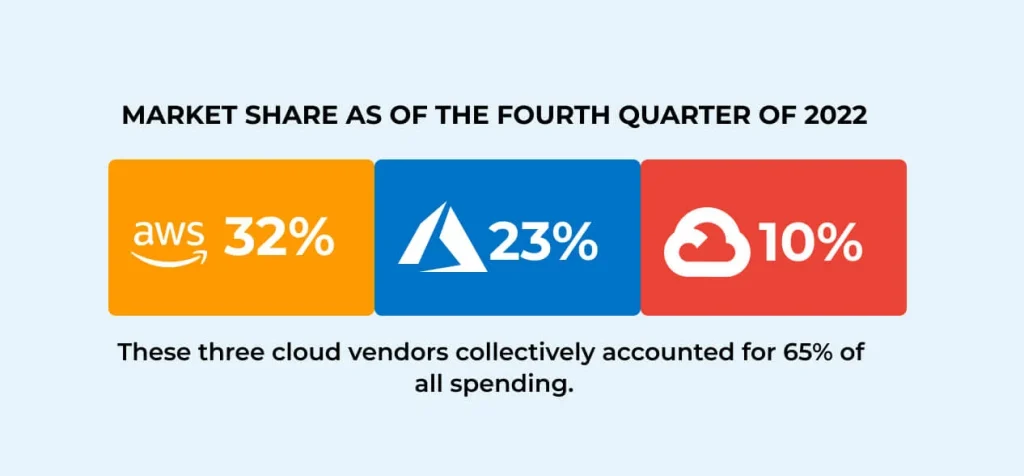
According to Statista, as of the first quarter of 2023, Amazon Web Services (AWS) had a 32% market share for cloud infrastructure services. Microsoft Azure comes in second place with a share of 23%, followed by Google Cloud with a share of 10%. In the first quarter of 2023, these three cloud vendors collectively accounted for 65% of all spending. Businesses use these providers’ cloud services to perform machine learning, data analytics, cloud-native development, application migration, and other tasks.
AWS vs Azure vs Google Cloud: Pricing Comparison
It can be difficult to compare prices between different cloud providers. Every provider has different plans, discounts, and features, making it difficult to compare prices. We will instead discuss how much an average user can expect to spend. The best way to cut cloud costs and maintain budgets is through effective cloud spend management.
The monthly cost for a small Amazon Web Services instance is estimated to be roughly $69. However, the cost of a large instance rises to about $3.97 each hour.
A small Azure instance will run you about $70 per month, which is almost the same price as the AWS option. The most expensive Azure instance, however, costs $6.79 per hour, almost twice as much.
You can get a basic instance from Google Cloud for about $52 per month. You will pay $5.32 per hour for a large GCP instance, which is right in the middle.
As you can see, due to the same free tier offer and extra price options, AWS and Azure generally have pricing that is practically the same. Due to its low computing price, Google Cloud typically offers serverless computing at a lower cost than the other two providers.
Google Cloud vs AWS vs Azure: Real-World Examples
Airline Lufthansa, gaming company Activision Blizzard, and SpaceX all use the Google Cloud platform.
Among Azure’s mega customers are AT&T, Coca-Cola, and Walmart.
Many large companies use Amazon Web Services. Due to its massive streaming infrastructure, Netflix is probably the most well-known. Media companies like Turner Broadcasting and the BBC, as well as online companies like Twitch, use the platform.
AWS vs Azure vs Google Cloud: How to Choose Best Cloud Provider
It can be difficult to choose the best cloud computing platform that fits your goals and budget. Read the following list to get an idea of what to choose.
Choose a cloud computing platform that is reliable – Don’t just focus on name recognition; emphasize customer feedback and security as well.
Evaluate stability – A regular release schedule, continuous performance, dispersed platforms, and load balancing are key components of a successful and stable platform deployment.
Compare pricing – Compare the cost of running an in-house server with using enterprise cloud resources.
Ensure that the service is standardized – Does the cloud service provider offer cost-effective bundles of apps and resources? It is possible to save 40% by bundling services such as IaaS, SaaS, and other digital products rather than purchasing them separately.
Flexibility should be evaluated – The cloud platform you choose should be flexible and adaptable, which boosts growth and scalability.
AWS vs GCP vs Azure Services Comparison on Important Parameters
Every cloud option has a unique mix of benefits and drawbacks. You must quickly comprehend each cloud solution’s capabilities if you want to choose the ideal one for your company. Here is a quick comparison of AWS, GCP, and Azure for your information.
Parameter | AWS | GCP | Azure |
|---|---|---|---|
Pricing | Per hour | Per minute | Per minute |
Marketplace | AWS | G suite | Azure |
API management | AWS API gateway | Cloud endpoints | Azure API gateway |
Content delivery networks | CloudFront | Cloud interconnect (CloudCDN) | Content DeliveryNetwork |
File Storage | EFS | ZFS and Avere | Azure files |
Load balancing configuration | Elastic Load Balancing | Cloud Load Balancing | Load Balancer Application Gateway |
Managed Data Warehouse | RedShift | Big Query | SQL Warehouse |
Virtual Network | VPC | Subnet (Cloud Virtual Network) | Vnet |
Block storage | EBC (EBS, EFS) | Persistence Disks | Page Blobs, Managed Disk |
Storage of object | S3 | Google Cloud Storage | Block Blobs and Files |
Caching | ElasticCache | CloudCDN (Memorystore) | RedisCache |
Git Repositories | AWS source repositories (AWS CodeCommit) | Cloud source repositories | Azure source repositories (Azure DevOps) |
Kubernetes management | EKS | Kubernetes engine | Kubernetes service |
Relational DB | RDS | Google Cloud SQL | Relational DBs |
Serverless computing | Uses Lambda | Uses cloud functions | Uses Azure functions |
Platform as service | Elastic Beanstalk | Google App Engine | Cloud services |
Media services | Amazon Elastic Transcoder | Cloud Video Intelligence API | Azure Media services |
Website | aws.amazon.com | cloud.google.com | Azure.microsoft.com |
AWS vs Azure vs GCPL: Finding Your Cloud Fit
All three services offer a pay-as-you-go model, a free tier, 24×7 support, and threat protection. These are some of the key differences between the three cloud platforms that can help you decide which is best for your business.
Choose AWS if:
You are a medium to large-scale business that needs a versatile and flexible solution that is easy to customize.
You’re moving to the cloud for the first time.
You’re seeking hybrid solutions that are also affordable.
Choose Google Cloud Platform if:
You are a small-scale company or a startup that can do with a limited bouquet of cloud services but want many customization options.
You’re searching for an all-encompassing container-based model.
You’re seeking a hyper-scale networking environment.
You develop and release cloud-based applications and software.
Choose Azure if:
You are a large-scale organization that requires a powerful cloud solution backed by a robust Microsoft ecosystem.
You want the highest security and protection for all the data stored in the Azure cloud.
You are bringing in quick innovation while retaining an acceptable level of flexibility and control.
You want to remain on-premises while continuing to benefit from Azure development, you can choose Azure’s hybrid-cloud architecture.
Cloud Management Services at OpenXcell
Our enterprise infrastructure services team provides an extensive public cloud architecture and support offering for cloud management services from Amazon (AWS), Azure, and Google Cloud Platform. In addition to Hybrid-cloud enablement services including cloud application, migration, and analytics, we offer a one-stop hybrid-cloud remote managed service. We help you with how public clouds are managed and implemented.
Our Cloud Management Services include the administration, monitoring, and management of enterprise applications, SaaS environments, IoT environments, and deployed infrastructure. We have an advantage in managing cloud operations for international enterprise customers because of our decades of substantial experience providing remote enterprise services.
AWS vs Microsoft Azure vs Google Cloud: Wrap-up
In comparison of AWS, GCP, and Azure, AWS easily outperforms all of the current top cloud service providers. Given that Azure and GCP are quickly gaining ground on AWS, it’s uncertain how long AWS will hold onto its position as the top cloud provider. As the first of its kind, AWS has an advantage, but Azure and GCP also have their advantages.
For many organizations that utilize MS products, employing Azure Cloud makes more sense because it is simple to integrate MS tools with it. Organizations should use GCP only because it provides the most reasonable pricing plan for Google Search and YouTube infrastructure. All things considered, it is more accurate to say that choosing the best cloud web services depends on your needs rather than ranking of the best cloud providers.