

Today, we are living in a world where convenience is a priority, where you can get everything instantly, and it’s the same for healthcare. Patients can instantly schedule appointments, receive medication reminders, or ask follow-up questions all through an intelligent Conversational interface.
As Healthcare is undergoing rapid digital transformation, AI is emerging as a powerful enabler. In fact, the global healthcare AI market is expected to surpass $187 billion by 2030, driven by innovations that enhance both patient experience and healthcare delivery.
Among these innovations, Conversational AI in healthcare plays an important role in bridging communication gaps, organizing workflows, and customizing patient engagement at scale. From AI-powered chatbots to virtual assistants, these solutions give access to care more immediately and intuitively.
In this blog, we’ll explore how conversation AI, supported by advanced AI development services, is changing patient interactions through intelligent, scalable, and human-like experiences that meet the demands of modern healthcare.
What is Conversational AI in Healthcare?
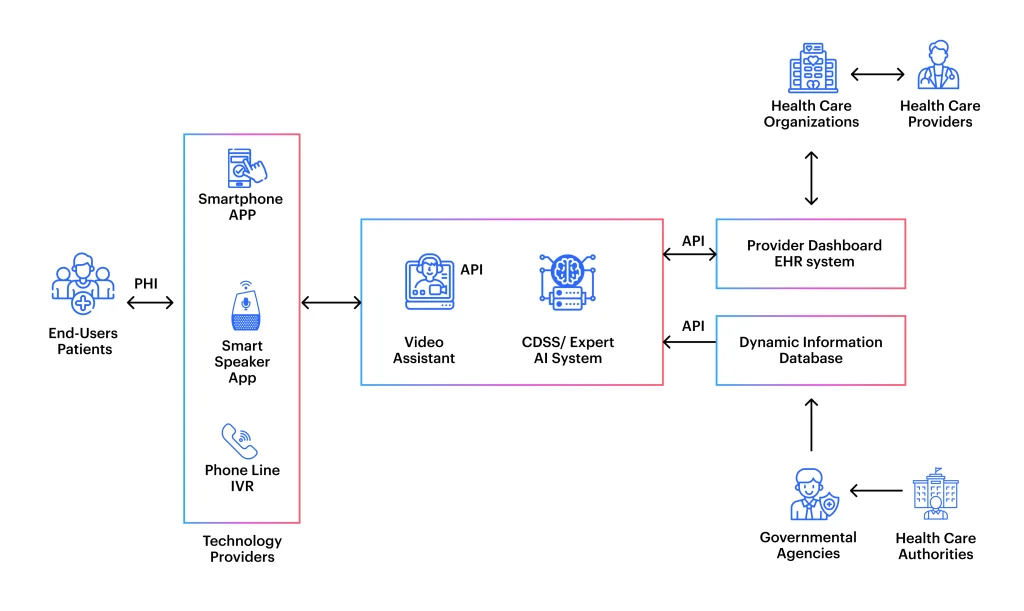
At its core, Conversational AI for healthcare refers to using intelligent virtual agents to interact with patients and healthcare providers through natural, human-like conversations. And these systems go far beyond simple automated responses; they understand context better, interpret intent, and give proper personalized assistance in real time, making healthcare communication faster, smarter, and more efficient.
The foundation of Conversational AI technology in healthcare lies in its combination of advanced tools like:
NLP allows the machine to understand and interpret human language
Machine Learning helps systems to improve with every interaction
Speech recognition combines voice-based inputs
Sentiment analysis gauges emotional tone
Large Language Models give contextual fluency to conversation, making sure that patients feel heard and understood.
Unlike rule-based chatbots that follow predefined scripts and have limited flexibility, Conversational AI can handle complex, multi-turn conversations, adapting responses based on user behaviour and historical data. To manage this, the technology can be integrated with an AI receptionist that’s capable of handling a large volume of patients’ inquiries with human-level nuance. Leading platforms like Nextiva are already innovating this shift to build a more resilient healthcare infrastructure where patient access is immediate and the quality of care is never compromised by administrative limits.
These intelligent systems operate on multiple channels, from website to app-based chatbots, voice assistants on smart devices, IVR systems for call centers, SMS, and even WhatsApp chat, and EHR-integrated virtual agents that provide personalized care suggestions.
A Must Read: Healthcare Software Development: A Complete Guide
By easily blending into patients’ digital lives, conversation AI is changing how care is delivered and accessed across the healthcare ecosystem.
AI at the Heart of Care: Practical Use Cases Transforming Healthcare
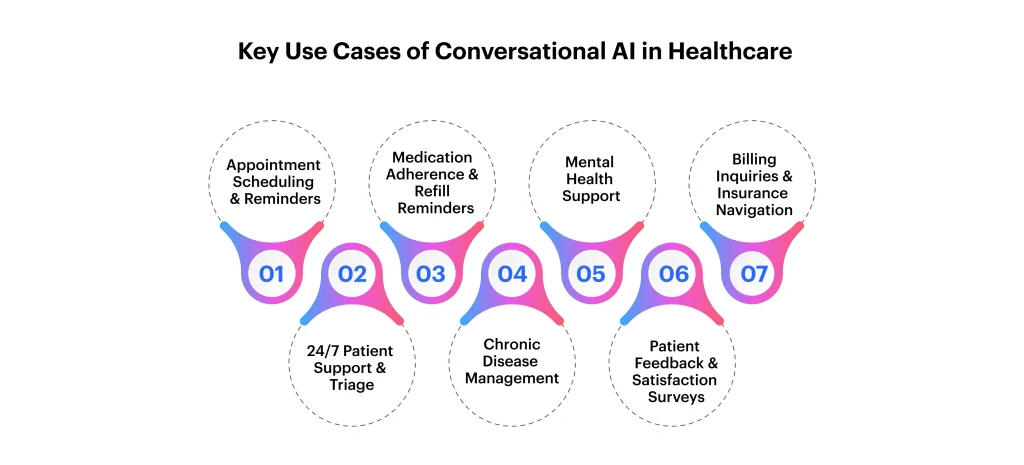
As the demand for more accessible, efficient, and personalized care rises, Conversational AI in healthcare has emerged as a powerful tool to communicate and enhance patient engagement.
From automating routine tasks to giving empathetic, real-time support, AI-powered virtual agents are making healthcare interactions simpler, faster, and more human-centric.
With the Conversational AI in healthcare market projected to grow significantly in the upcoming years, let’s explore how this technology is being practically applied across the different care continuum.
#1 Appointment Scheduling & Reminders
One of the most useful things Conversational AI does is simplify appointment management by automating the scheduling, rescheduling, and cancellation processes. Patients can interact with a voice AI agents or chatbots on websites, apps, or messaging platforms to quickly find available slots and confirm visits.
Additionally, it provides personalized appointment reminders and sends messages through email or SMS, reducing no-shows and improving operational efficiency for healthcare providers. Tools like DialMyCalls make this process even easier with automated voice and text notifications.
For appointment lines and nurse triage, latency directly affects completion rates and patient satisfaction. Leveraging a high‑performance voice AI stack with ultra-low-latency audio streaming, real-time barge-in, and programmable call controls lets teams build and launch voice agents quickly while keeping conversations natural. This enables instant slot lookups, EHR-driven prompts, and seamless escalation to live staff without awkward pauses - ideal for high-volume scheduling, refill reminders, and after-hours hotlines.
#2 24/7 Patient Support & Triage
Conversational AI successfully gives off-the-clock assistance with the help of virtual agents. They offer answers, frequently asking questions about symptoms, medication usage, insurance eligibility, and more.
It integrates AI-driven symptom checkers that assess patient input to triage non-emergency conditions, guiding individuals to the correct level of care without waiting in queues or relying on overburdened call centers.
#3 Medication Adherence & Refill Reminders
There are many AI’s practical use cases helping patients, mainly, it make sure patients follow the prescribed treatment plan, which is important for recovery and chronic disease control.
Conversational AI nudges patients by timely reminders to take medications, refill prescriptions, and confirm dosage schedules. It also coordinates with pharmacies to refill patient doses and minimize drop-offs.
#4 Chronic Disease Management
AI manages patients with severe conditions like diabetes, heart disease, or asthma, benefiting from ongoing virtual check-ins facilitated by Conversational agents. The system collects health metrics, gives coaching, and escalates issues when necessary.
Coupled with remote monitoring tools, it enables proactive, consistent care while also reducing the patient’s need for in-person visits.
#5 Mental Health Support
Conversational AI plays a major role in supporting mental well-being. Anonymous AI assistants guide users for stress relief exercises, giving cognitive behavioral therapy (CBT) techniques, and provide access to mental health resources.
The early stage support reduces stigma and helps bridge the gap for individuals awaiting professional intervention.
#6 Patient Feedback & Satisfaction Surveys
Conversational AI automates the process of collecting patient feedback through timely, context-aware surveys. Whether it’s a consultation or discharge, AI agents can solicit insights on service quality, doctor interaction, and overall experience, providing healthcare providers with valuable data to refine operations and healthcare delivery.
#7 Billing Inquiries & Insurance Navigation
After all the help through health treatments, AI also assists in simplifying medical bills, explaining insurance coverage, calculating co-pays, and checking the status of claims. It improves transparency and reduces administrative burdens on staff as well.
As AI healthcare solutions continue to mature, their role in daily clinical and operational workflows is becoming indispensable. All these use cases amazingly demonstrate that Conversational AI is not just an innovation; it is a critical enabler of modern, connected, and patient-first healthcare.
Empowering Engagement: Key Benefits of Conversational AI in Patient Care
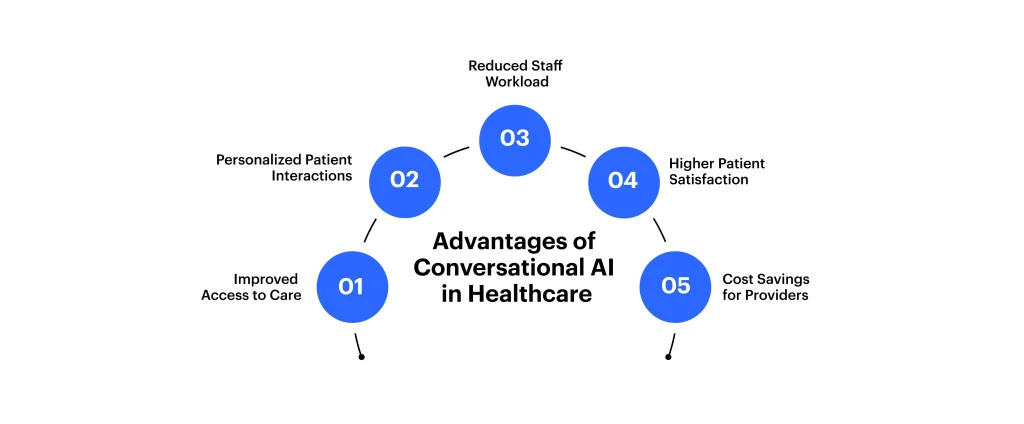
As healthcare shifts to a more patient-centric model, Conversational AI is becoming an important tool for communication, efficiency, and satisfaction.
By using intelligent automation and real-time conversations, AI systems are changing the way patients interact with providers, making it more accessible, personalized, and proactive.
Here are the key benefits that highlight how AI healthcare chatbots and virtual agents are redefining patient engagement.
#1 Improved Access to Care
Conversational AI offers 24/7 support, removing the constraints of traditional office hours and helping patients to get help anytime. With its multilingual capabilities, it makes sure that patients have inclusive communication across culturally diverse populations, expanding healthcare reach.
#2 Personalized Patient Interactions
AI agents greatly integrate with Electronic Health Records (EHRs) to deliver context-aware conversations, offering patients personalized recommendations. The communications are also tailored based on every patient’s individual medical history, preferences, and behavior for a more meaningful experience.
#3 Reduced Staff Workload
Conversational AI automates repetitive tasks like appointment scheduling, form filling, FAQs, and more. It mainly reduces the administrative burden, allowing medical staff to redirect their energy towards other quality work where human expertise is more needed.
#4 Higher Patient Satisfaction
Patients can easily benefit from instant responses and round-the-clock availability, leading to quick resolutions and reducing frustration. Conversational AI’s ability to manage the care journey with more independence fosters trust and engagement.
#5 Cost Savings for Providers
By operational automation, healthcare providers greatly optimize resource allocation, lower call center costs, and reduce appointment no-shows, ultimately improving financial outcomes without compromising patient care.
In today’s fast-evolving digital healthcare environment, Conversational AI for healthcare is a strategic ally for providers aiming to give smarter, scalable, and patient-first experiences.
Discover - 19+ AI In Healthcare Examples For Effective Medical Care
Proven in Practice: Real-World Examples of Conversational AI in Healthcare
While AI is promising and vast, its real impact is best seen in action. Many hospitals, clinics, and digital health platforms that use Conversational AI technology in healthcare are already transforming patient experiences, improving workflows, and reducing operational stress.
Below are some of the real-world examples showcasing its practical applications and measurable benefits.
Northwell Health – COVID-19 Virtual Assistant
Northwell Health implemented a Conversational AI chatbot to manage the surge of COVID-19-related inquiries. In its initial months, the system handled over 150,000 patient interactions, providing reliable symptom guidance and easing pressure on care teams.
Providence Health – Appointment Scheduling Automation
Providence Health has integrated a chatbot into its websites and apps, allowing patients to schedule appointments without staff intervention. This leads to quicker booking and a notable reduction in call center load.
Cleveland Clinic – AI-Powered Symptom Checker
Cleveland Clinic uses Conversational AI tools to help users assess symptoms and decide whether to seek personal care or not. This system empowers patients to make informed decisions while reducing unnecessary ER visits.
Mental Health America – AI for Anonymous Support
MHA launched an AI assistant that gives confidential mental health support and directs users to helpful resources. It serves as an accessible first step for people who are hesitant to reach out to a therapist.
UCHealth – Post-Discharge Follow-Ups
UCHealth uses an AI chatbot for post-discharge care, checking on progress, recovery, and medication adherence, to help reduce readmission rates and improve patient satisfaction.
These real-world implementations show that Conversational AI isn’t just a theoretical practice; it’s already reshaping healthcare delivery in the real world.
In fact, we have one of our own projects, Openxcell has developed a Smart AI Health App that allows users to receive real-time medical guidance, track symptoms through intelligent conversation flows, schedule appointments, and make faster and more informed health decisions. |
|---|
Best Practices for Deploying Conversational AI in Healthcare
Implementing Conversational AI in healthcare requires a strategic and patient-centric approach to make sure it delivers real value. Here are the key best practices to guide a successful deployment:
#1. Define Clear Objectives
First, start by identifying the problems you want to solve, such as reducing the administrative workload, improving patient engagement, or automating support services.
#2. Choose Healthcare-Focused AI Solutions
One major step is to opt for AI solutions designed specifically for the healthcare sector. These solutions should be compliant with data privacy regulations like HIPAA and capable of integrating with EHR systems.
#3. Start Small and Scale Gradually
Then, bring in high-impact use cases like appointment scheduling or FAQs. Once it validates, expand to more complex workflows like triage or post-treatment care.
#4. Blend AI with Human Support
After that, it gives a smooth handoff to live agents when required, and the hybrid model builds trust and maintains care quality.
#5. Continuously Monitor and Improve
Lastly, interactions and patient feedback should be regularly analyzed to refine AI behaviour and improve user experience.
By following these practices, it provides a safe, efficient, and scalable AI-driven transformation in healthcare.
Major Challenges in Implementing Conversational AI
As there are many benefits of Conversational AI, but implementing Conversational AI for healthcare has its own set of challenges which must be carefully addressed to give successful and long-term adoption.
Data Privacy and HIPAA Compliance
Healthcare data is extremely sensitive as it consists of patients’ information, so ensure proper handling, transmission, and storage. Proper consent management must also be in place to comply with HIPAA and other regulations.
AI Bias and Accuracy
AI models must be trained on different and representative datasets to avoid responses. Continuous tuning and validation are important to maintain accuracy and fairness in patient interactions.
Integration with Existing Systems
One important aspect is easy compatibility with EHRs, CRMs, and communication platforms, which is critical for operational efficiency and consistent patient experiences.
User Trust and Adoption
In any system, it is important for patients to engage. AI tools must give human-like empathy and clarity. Transparent communication about AI limitations helps build user confidence.
Cost and Technical Complexity
High initial investment and technical setup may be challenging for smaller providers, making it critical to consider scalability and vendor support.
Learn about -The Cost of AI in Healthcare: Crucial Factors to Evaluate
Addressing these challenges head-on is essential to unlock the full potential of Conversational AI in healthcare.
The Future of Conversational AI in Healthcare
The future of Conversational AI technology in healthcare is set to be more personalized, intelligent, and deeply integrated into the patient journey. As the AI model continues to change, virtual assistants will give more nuanced human-like interactions that are capable of understanding emotions, delivering real-time support, and predicting needs.
Integration with wearable devices, remote monitoring tools, and EHR will make care delivery more data-driven and proactive. Furthermore, advancements in multilingual capabilities and accessibility will ensure equitable care for different populations.
Closing the Loop: Conversational AI for Smarter Care
From streamlining appointment scheduling to adding personalized post care follow-ups, Conversational AI in healthcare is reshaping how providers and patients interact. With benefits such as improved access, reduced workload, and better satisfaction, this advanced technology is not just a trend; it is the future of modern care delivery.
To fully grasp the potential of AI, healthcare organizations need the correct expertise and strategy. That’s where our company, Openxcell, steps in, giving tailored healthcare AI solutions that blend innovation with compliance and care. With our proven experience in building intelligent, patient-centric systems, we help you to lead the digital healthcare revolution, one conversation at a time.