
A New Era in Life Sciences
In the quiet corridors of research labs, where experiments that once took years to validate, a silent revolution has taken place. Now the algorithms can predict molecular behavior, simulate cell responses, and design potential drugs before they are even synthesized. This remarkable shift is powered by Generative AI in life sciences, changing the very DNA of scientific discovery.
This blog explores how generative AI is accelerating breakthroughs in drug discovery, diagnostics, and personalized medicine. From reimagining research processes to create smarter, faster solutions, we will uncover how modern AI development services are enabling scientists and organizations to push the boundaries of what’s possible in life sciences.
What is Generative AI in Life Sciences?
At its core, generative AI in life sciences uses advanced machine learning models to create new data, simulate biological systems, and uncover insights that were previously beyond human reach.
By learning from massive datasets of molecular genomic and clinical information, it can design, predict, and optimize outcomes across every phase of research and development. As the generative AI for life sciences market expands, it is changing how innovation happens, from the lab bench to patient care.
In the life sciences context, it can:
Design new molecules with desired biological properties: It generates novel compounds optimized for safety, efficacy, and target precision.
Predict 3D protein structures and interactions: Accurately model how proteins bind and fold, thereby expediting the identification of drug targets.
Simulate biological processes for faster testing: Create virtual models of cells or systems to forecast reactions before physical trials.
Enhance image-based diagnostics in pathology and radiology: Improve detection accuracy through AI-enhanced medical image generation and analysis.
Now, let’s start with a major sector where Gen AI is working in life sciences, specifically in drug discovery.
How Generative AI is Transforming Drug Discovery
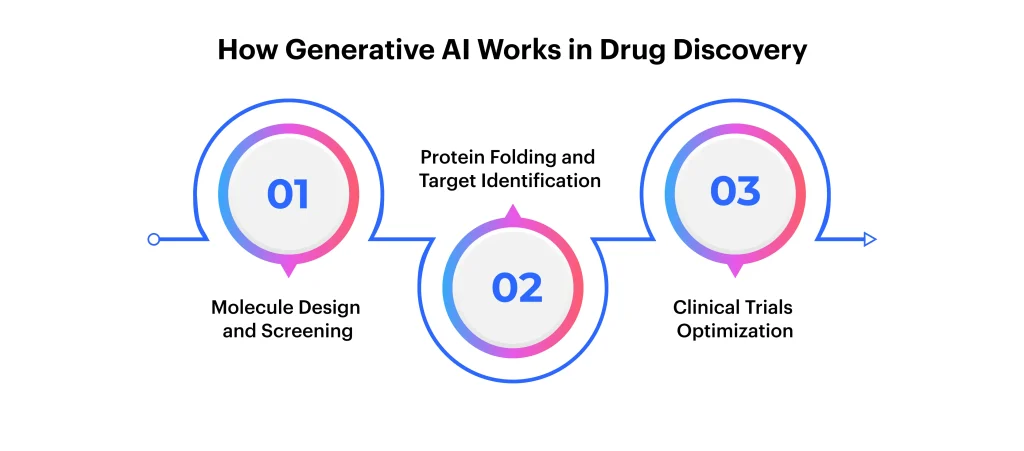
The process of discovering new drugs has traditionally been slow, costly, and filled with uncertainty. However, the generative AI in life sciences is rewriting the narrative by introducing data-driven creativity into each phase, from molecule design to clinical testing.
By understanding vast chemical and biological datasets, AI models can now predict and generate promising drug candidates, reducing research time from years to months. This new fusion of science and computation is helping researchers uncover potential therapies with unmatched speed and precision.
1. Molecule Design and Screening
At the heart of innovation lies the ability to make new molecules that meet the specific therapeutic goals. Generative AI models can:
It is possible to generate novel chemical structures with desired pharmacological properties that effectively target particular diseases.
The prediction of molecule target interactions to identify compounds with high binding affinity.
Reduces the need for exhaustive trial-and-error syntheses, saving significant lab time and costs.
2. Protein Folding and Target Identification
Generative AI helps in understanding how proteins fold and interact, which is vital for drug development. AI tools, especially from generative AI companies, can:
Understand disease mechanisms by predicting protein misfolding or mutations.
Identify new therapeutic targets through structural insights.
Design high-affinity ligands for binding, improving drug strength and selectivity.
3. Clinical Trials Optimization
Generative AI for life sciences is also transforming clinical testing by giving predictive modeling to enhance efficiency. It helps to:
Select suitable candidates for clinical trials based on genetics and biomarkers.
Predict adverse reactions before trials begin, improving safety outcomes.
Reduce trial dropouts and failures, accelerating drug approval and market readiness.
Additional Read: How AI in Drug Development Is Accelerating Drug Discovery
Generative AI in Life Sciences: Revolutionizing Diagnostics and Precision Medicine
Modern healthcare is evolving beyond reactive treatment toward predictive, personalized, and precision-driven care, and generative AI in life sciences is at the core of this transformation.
By generating synthetic data, improving imaging accuracy, and decoding genetic complexities, it is redefining how diseases are detected, understood, and treated. As the generative AI in life sciences market continues to expand, diagnostics and genomics are witnessing unprecedented levels of speed, accuracy, and scalability.
1. AI-Powered Diagnostic Imaging
Generative AI is revolutionizing medical imaging by improving how clinicians visualize and interpret data. They help radiologists and pathologists by:
Enhancing MRI, CT, and histopathology image quality for clearer insights.
Detecting tumors, lesions, or anomalies at early stages to enable timely intervention.
Reducing false positives/negatives, ensuring more accurate and reliable diagnoses.
2. Predictive and Preventive Healthcare
One of the most impactful generative AI use cases in life sciences lies in predictive healthcare. By analyzing patient data and modeling health trajectories, AI enables:
Personalized treatment plans tailored to individual genetic profiles.
Predictive biomarker identification to foresee disease progression.
Early disease detection in at-risk populations improves long-term outcomes.
3. Accelerating Genomics and Proteomics Research
Generative AI is driving breakthroughs in genomics and protein research by adding simulation-driven experimentation. In genomics, it assists in:
Synthesizing DNA sequences for gene editing experiments to test hypotheses virtually.
Predicting protein-protein interactions to map complex biological networks.
Simulating mutations to understand disease impact, paving the way for next-gen therapies.
Case Study: AI Health Assistant App - Openxcell developed an AI-powered health assistant app that helps users manage chronic conditions and access personalized care. The app analyzes medical reports, provides predictive insights, and supports early disease detection. With features like health tracking, meal recommendations, and voice-based assistance, it demonstrates a practical application of generative AI in life sciences.
Expanding Horizons: Generative AI Applications Beyond Research & Development
While drug discovery and diagnostics mainly steal the spotlight, generative AI in life sciences is making waves far beyond the lab. From streamlining operations to enhancing patient engagement, AI is changing every layer of the healthcare ecosystem. These applications not only improve efficiency but also help businesses deliver smarter, faster, and more personalized solutions.
Domain | Application |
|---|---|
Supply Chain Management | Predicting demand and optimizing pharmaceutical logistics |
Medical Writing | Generating clinical trial reports, documentation, and regulatory submissions |
Drug Repurposing | Identifying new therapeutic uses for existing drugs |
Patient Engagement | AI chatbots and virtual health assistants for post-treatment care |
Manufacturing | Designing optimized bioprocesses and predictive maintenance models |
Key Takeaways:
In supply chain management, AI predicts demand, reduces stockouts, and optimizes logistics.
Medical writing becomes faster and more accurate with AI-generated reports and regulatory documents.
Drug repurposing uncovers new therapeutic opportunities for existing compounds.
Patient engagement is enhanced through AI-powered chatbots and virtual assistants.
In manufacturing, predictive models improve efficiency, reduce errors, and optimize processes.
Collectively, these applications demonstrate how AI healthcare solutions are expanding the impact of generative AI beyond research, allowing life sciences organizations to innovate across operations and patient care.
Key Benefits of Generative AI in Life Sciences
The integration of generative AI in life sciences is driving an unprecedented transformation in how research, discovery, and healthcare operations work. From accelerating development timelines to enable data-driven innovation, AI is giving a measurable impact across each stage of the scientific lifecycle.
Here are some of the most powerful advantages shaping the industry today.
1. Speed & Efficiency
Generative AI accelerated research by simulating experiments, analyzing data, and predicting outcomes in record time, cutting drug discovery and testing phases from years to months.
2. Cost Reduction
Automated modeling and predictive analytics minimize expensive lab trials and clinical errors, mainly lowering overall R&D and operational costs.
3. Enhanced Accuracy
AI models enhance diagnostic precision, molecule targeting, and clinical decision-making, yielding more reliable and reproducible results across datasets.
4. Innovation Enablement
Among the top generative AI use cases in life sciences, innovation stands out. AI empowers scientists to explore new molecular designs and treatment methods, and gives personalized medicine strategies that were once impossible to achieve.
Related Read: What Is The Role Of Generative AI In Drug Discovery? Top 9 Use Cases
Navigating Challenges in Generative AI Adoption
As the generative AI in life sciences continues to grow, it also brings complex challenges that demand thoughtful regulation and responsible implementation. As the technology’s potential is vast, ensuring its ethical and transparent use is important for long-term trust and progress.
Data Privacy & Security – Protecting sensitive genomic and patient data is crucial, and strict compliance with healthcare data protection laws is necessary.
Model Interpretability – Many AI models function as black boxes, making it tough for researchers to understand the decision-making logic.
Regulatory Barriers – Approval frameworks for generative AI for life sciences apps are still changing, slowing clinical adoption.
Ethical & Bias Issues – It can be biased in training data, which can lead to skewed outcomes, emphasizing the need for fairness, inclusivity, and accountability in AI-driven healthcare.
The Future of Generative AI in Life Sciences
The future of generative AI for life sciences promises a new era of intelligent, data-driven innovation. As AI models change, they will not only design complex molecules and predict treatment outcomes but also simulate entire biological systems for real-time experimentation.
Integrating it with technologies like quantum computing, digital twins, and synthetic biology, it will further amplify discovery speed and precision.
In the coming years, we can expect AI to enable personalized medicine at scale, automate drug manufacturing, and enhance predictive healthcare ecosystems. This evolution will empower researchers and healthcare providers to move from reactive care to proactive, preventive solutions and redefine how life sciences organizations innovate.
Ushering in the Era of Intelligent Life Sciences
As we look back on the exploration of blogs, it is clear that generative AI in life sciences is more than just a technological advancement; it is a catalyst for faster discoveries, smarter diagnostics, and personalized treatments. The future of healthcare innovation lies in the synergy between human expertise and intelligent automation.
At Openxcell, we help organizations harness the potential through our AI development services, generative AI services, custom healthcare solutions, and more. From strategy deployment, we enable life sciences enterprises to innovate with confidence, speed, and precision.
FAQs on Generative AI in Life Sciences
1. How is Generative AI used in drug discovery?
Generative AI aids in designing new drug molecules, predicting compound interactions, and reducing research timelines, thereby transforming early-stage drug discovery.
2. What role does Generative AI play in diagnostics?
It enhances the accuracy by analyzing complex biomedical data, improving disease detection and predictive diagnostics.
3. Can Generative AI accelerate clinical trials?
Yes, it easily optimizes patient selection, predicts trial outcomes, and accelerates data analysis for faster approvals.
4. What are the main challenges of using AI in life sciences?
The major challenges are data quality, ethical considerations, and regulatory compliance.
5. How can organizations start adopting Generative AI?
Partnering with AI experts like Openxcell helps implement tailored solutions and scalable models.