

In 2018, OpenAI’s GPT-1 had just 117 million parameters. Today, large language models drive innovation across industries, influencing financial markets worth over a trillion dollars. This huge jump in size is one of the main reasons why chatbots like ChatGPT and Claude have become so successful and useful. As large language models continue to grow and shape the future of AI, it is important to understand what makes them work. This is where LLM parameters come into the picture.
These are like the model’s internal settings that help it learn and make better predictions. For anyone exploring AI services, knowing how parameters affect performance can help them build or choose the right models. Let’s break down why these tiny numbers matter so much.
What Are Parameters in LLMs?
In simple terms, LLM Parameters are the internal values a model learns during training. These values help the model understand patterns in data, like grammar, context, and meaning. The more parameters a model has, the better it can make predictions and generate human-like text.
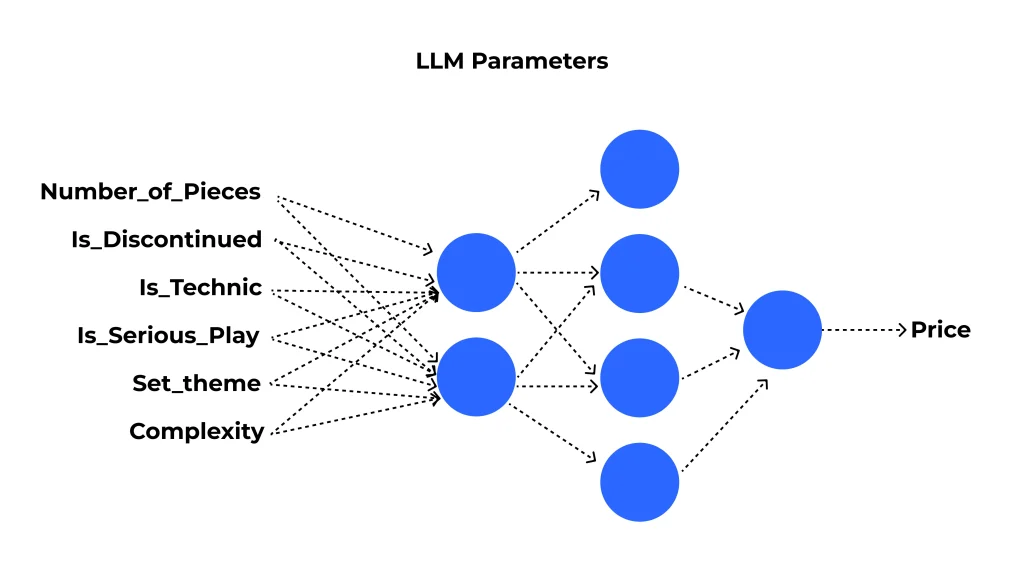
At the heart of every powerful language model lies its key component parameters.
Parameters play an important role in language prediction and generation. They adjust how the model responds to input, choosing the next word in a sentence, forming ideas, or answering questions perfectly.
To grasp its impact, consider popular models:
GPT-3 had 175 billion parameters — a landmark figure when it launched, and still the reference point most comparisons start from.
Today’s closed frontier models, including GPT-5.x, Claude Opus 5 and Sonnet 5, and Google’s Gemini 3, no longer disclose exact parameter counts at all — estimates for Gemini 3 alone run past a trillion.
Open-weight models still publish their numbers: Meta’s Llama 4 tops out around 400 billion parameters, and Alibaba’s Qwen uses a mixture-of-experts design with 1 trillion total parameters but only 32 billion active per request.
In LLM development, understanding the scale and role of parameters is vital for choosing or building the right models for your needs. Understanding what parameters set the stage, but to truly grasp their importance, we need to explore why parameters matter in the performance and behavior of large language models.
Why LLM Parameters Make All the Difference
Once we understand what LLM parameters are, it becomes clear why they play an important role in a model’s performance. These parameters directly influence how well a language model can learn, understand, and generate human-like text. Beyond understanding parameters, it’s equally important to consider how LLM guardrails help ensure safe, compliant, and contextually appropriate outputs in real-world applications.
As LLMs become more capable, they are shaping software development trends, influencing everything from AI-driven code generation to automated testing and software optimization. Understanding how parameters affect LLM behavior can help developers and businesses stay ahead of these shifts and build tools that align with modern development practices. These trends are increasingly important in strategic planning for AI-enabled applications.
Here’s why LLM parameters are important:
1. Better Language Understanding
More parameters help models accurately grasp context, tone, and meaning, leading to smarter interactions.
2. Improved Output Quality
It enables smooth, more relevant, and natural text generation, making the conversation feel human-like.
3. Task Flexibility
High-parameter models can handle multiple tasks like summarizing, translating, or answering questions without retraining.
4. Easy Fine Tuning
A solid parameters structure allows developers to quickly adapt models to specific business needs with less time and effort.
Simply put, parameters are the core of an LLM’s intelligence and adaptability. To fully understand how LLMs are built and optimized, it’s also important to know the difference between parameters and hyperparameters—two terms often confused but fundamentally different.
Parameters vs Hyperparameters: Know the Difference
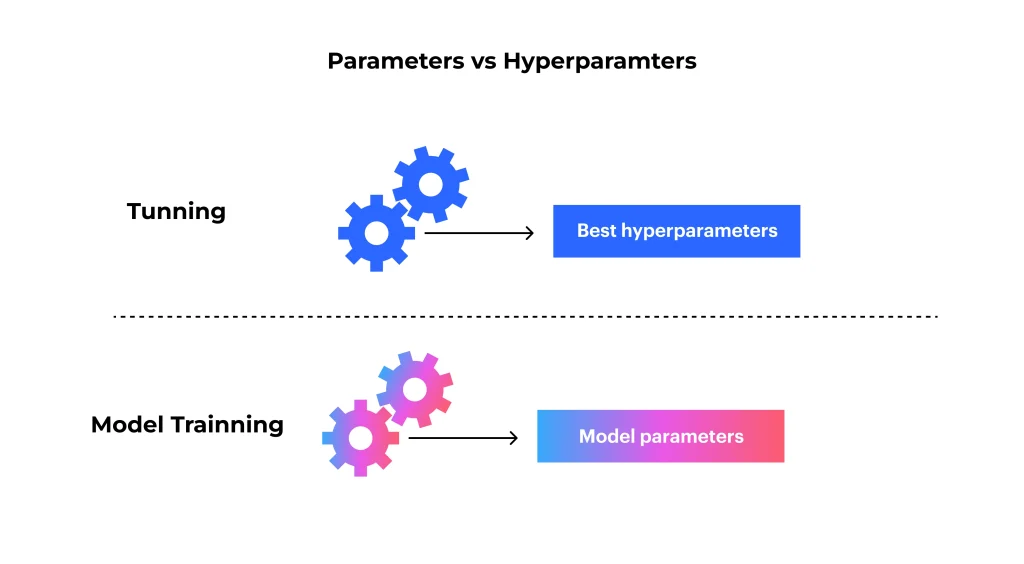
While diving into LLMs, it is common to mix both parameters and hyperparameters. As both are the keys to model performance, each plays a very different role in how models learn and behave.
1. Definition of Hyperparameters
Hyperparameters are set and chosen before training begins. Unlike parameters, they aren’t learned by the model; they guide how the learning happens.
2. Common Hyperparameters
There are many examples, including learning rate ( how fast the model learns), batch size ( how much data it sees at once), and number of epochs ( how many times it sees the full dataset).
3. Influence on Training vs Inference
Hyperparameters affect the training phase, determining how well the model learns. The parameters, on the other hand, use both training and inference.
4. Examples to clarify
In LLM training, the learning rate is a hyperparameter that controls how quickly the model learns. In contrast, the weights the model updates during training, commonly known as LLM parameters, are the values it learns and retains to make predictions.
Knowing about both is key for successful LLM fine-tuning and deployment. Now that we’ve covered the difference between parameters and hyperparameters, let’s take a closer look at the key types of parameters in LLMs and how each plays a unique role in shaping the model’s behavior.
An Interesting Read: Mastering LLM Agents: A Complete Guide
Key Types of Parameters in LLMs
To understand how LLMs process and generate human-like text, it is helpful to look at the main types of parameters that drive their performance. These parameters work together in layers to interpret input, find patterns, and produce meaningful responses. Knowing what are parameters in LLM are also means recognizing how each type contributes to the model’s intelligence.
1. Weights & Biases in Transformers
These are the core values that get updated during training, helping the model make accurate predictions across layers.
2. Attention Parameters
It is used in self-attention mechanisms, which allow the model to focus on relevant parts of the input sequence, improving context handling.
3. Embedding Layers
These transform words or tokens into numerical vectors, helping the model to understand semantic relationships.
4. Feedforward Networks
The layers process information and refine outputs between attention blocks, shaping the model’s final response.
Together, these parameters define how an LLM learns and performs. Getting the idea of the types of parameters gives us a solid foundation. Now let’s see how they scale in real models by looking at model size comparisons and real-world examples.
At Openxcell, we’ve put this into action through our custom LLM development projects, building scalable models tailored to unique business needs. Explore our work to see how we bring advanced LLM solutions to life across industries.
Generation Parameters: Temperature, Top-P, and the Settings You Actually Tune
Everything above describes parameters in the sense of a model’s trained weights — the values baked in during training that don’t change once the model ships. There’s a second, completely different sense of “LLM parameters” that trips people up: the settings you adjust at inference time, when you’re calling the model through an API or a playground. These don’t change what the model knows — they change how it decides what to say next.
Temperature
Temperature controls how predictable or random the model’s word choices are. A low temperature (near 0) makes the model pick the most likely next token almost every time, producing consistent, focused output — good for factual answers or code. A higher temperature (0.7–1+) flattens those probabilities, giving the model more room to pick less-obvious words, which suits brainstorming or creative writing but increases the risk of the response drifting off-topic.
Top-P (Nucleus Sampling)
Top-p sets a probability threshold: instead of considering every possible next word, the model only samples from the smallest set of words whose combined probability adds up to p (say, 0.9). It trims the long tail of unlikely words without hard-coding how many options to keep. Most teams tune either temperature or top-p, not both at once, since stacking them makes behavior harder to predict.
Top-K
Top-k is a simpler cousin of top-p: instead of a probability cutoff, it limits the model to choosing from a fixed number of the most likely next words (say, the top 40). Lower values make output more conservative and repeatable; higher values open up more variety. It’s less commonly exposed in modern APIs than temperature and top-p, but still shows up in local inference tools.
Max Tokens
This caps how long a single response can be, measured in tokens rather than words or characters. It’s mostly a cost and latency control — set it too low and responses get cut off mid-sentence; set it too high on a chatty model and you pay for output nobody reads.
Frequency Penalty
Frequency penalty discourages the model from repeating the same words or phrases too often within a single response, scaled by how many times that token has already appeared. It’s useful for longer-form content generation where repetitive phrasing reads as low-quality.
Presence Penalty
Presence penalty is related but distinct: it penalizes any token that has already appeared at all, regardless of how many times — pushing the model toward introducing new topics and vocabulary rather than circling back to what it already said. Frequency penalty cares about how often; presence penalty just cares whether.
Stop Sequences
A stop sequence is a specific string that, when generated, tells the model to end its response immediately. These are useful for structured output — for example, stopping generation right after a closing tag or delimiter in a formatted response, so you don’t have to trim boilerplate off the end yourself.
These generation parameters matter for anyone building with generative AI day to day, even without touching model training at all — getting them right is often the difference between an application that feels reliable and one that feels erratic.
Model Size Comparison and Real-World Examples
Understanding what are LLM parameters is essential to grasp how models scale in intelligence and capability. The number of parameters directly influences a model’s ability to generate relevant, coherent, and context-aware outputs. Below are some of the most impactful LLMs, showcasing how different parameter sizes affect performance and application in the real world.
Here’s a quick comparison of popular LLMs and their key features:
Model Name | Number of Parameters | Organization | Highlights |
|---|---|---|---|
GPT-3 | 175 Billion | OpenAI | The landmark model that proved scale works; largely superseded, kept here as the historical benchmark |
Llama 4 | Up to 400 Billion | Meta | Open-weight, rivals closed frontier models on many benchmarks, available for fine-tuning and local deployment |
Qwen | 1 Trillion total / 32 Billion active | Alibaba | Mixture-of-experts design — only a fraction of parameters activate per request, balancing scale with efficiency |
Current closed frontier models — GPT-5.x, Claude Opus 5 and Sonnet 5, and Google’s Gemini 3 — no longer publish exact parameter counts at all. Estimates for Gemini 3 alone run past a trillion, but none of the three major labs confirm a number.
GPT-3 (OpenAI)
GPT-3 was the turning point for generative AI — not just its size, 175 billion parameters, but how well it could mimic human conversation and thought patterns. It powered the first wave of commercial AI chatbots, content generators, and coding assistants, and its success set off the AI boom that followed. It’s since been superseded several times over, but it remains the reference point most size comparisons still start from.
Llama 4 (Meta)
Llama 4 is Meta’s current open-weight flagship, with a top configuration around 400 billion parameters. Unlike the closed frontier labs, Meta continues to publish its parameter counts and release model weights for fine-tuning and local deployment — which is why Llama 4 remains the model most independent researchers and enterprises point to when they need a transparent, self-hostable alternative to GPT-5 or Claude-class models.
Qwen (Alibaba)
Qwen takes a different approach: a mixture-of-experts architecture with 1 trillion total parameters, but only around 32 billion active for any given request. Rather than running the entire network on every query, it routes each input through a smaller subset of specialized “expert” sub-networks — which is how it reaches trillion-parameter scale while keeping inference cost closer to a much smaller dense model.
Model Evaluation: Are More Parameters Always Better?
While bigger models mostly dominate headlines, more LLM parameters don’t always mean better performance. Let’s explore how size balances with design and optimization. When evaluating models, it’s also helpful to compare scenarios like slm vs llm, as smaller, task-focused models can offer efficiency and resource advantages in specific use cases.
Performance Benchmarks
Bigger models like GPT-4 usually perform better in complex tasks, but their gains tend to diminish beyond a certain scale, especially for specific use cases.
Evaluating with Fewer Parameters
Smaller models can always deliver strong results while well optimized, especially with clear task focus and quality training data.
Role of Architecture and Training Quality
The model structure and how it is trained outweigh the sheer size. Clean data and smart architecture can beat brute force parameter scaling.
Emerging Trend: Small Models with Smart Tuning
Techniques such as LoRA and quantization allow compact models to perform impressively, redefining what is a parameter in LLM efficiency.
Additional Read: LLM Security: Protecting AI Models from Attacks & Data Leaks
Now that we’ve seen bigger isn’t always better, the real advantage lies in how parameters are used. Let’s explore how optimizing parameters post-training can enhance performance without increasing model size.
Optimizing Parameters Post-Training
Once a model is trained, fine-tuning its inner workings can majorly improve efficiency and output. This stage is all about getting more from existing LLM parameters without increasing model size.
Parameter Tuning During Fine Tuning or RLHF
Fine-tuning or using Reinforcement Learning with Human Feedback adjusts specific parameters to better align with user expectations or domain-specific tasks, often improving outcomes during LLM evaluation.
LoRA, Quantization, Pruning Techniques
Low-rank adaptation, quantization, and pruning reduce computational load by compressing or refining LLM parameters, allowing models to run faster with minimal performance loss.
Impact on Performance and Model Size
These methods help maintain accuracy while making models lighter, cheaper to deploy, and easier to integrate into real-world systems.
Final Thoughts: Why LLM Parameters Deserve Your Attention
As AI systems become more integrated into everyday applications, the need to understand and use LLM parameters is more important than ever. These parameters directly influence how well a model understands language, adapts to new tasks, and scales efficiently — and that’s true whether you’re evaluating a model’s trained parameter count before choosing it, or tuning its generation parameters like temperature and top-p once you’re actually building with it. For anyone building or using LLM tools, getting the parameters right is not optional—it’s essential for performance, cost-effectiveness, and long-term success.
At Openxcell, we help businesses harness the true power of LLMs through expert LLM development, targeted fine-tuning, and innovative Gen AI solutions. From designing efficient architectures to optimizing post-training models, we deliver AI systems that are smart, scalable, and ready for the real world.
In addition to understanding parameters, it’s equally important to be aware of the top LLM tools available today. These tools, from foundational models to deployment frameworks, help developers optimize performance, scale solutions, and choose the right model for specific use cases such as chatbots, summarization, or code generation. Keeping a pulse on the evolving tools landscape ensures smarter decisions throughout the LLM lifecycle.