
Mobile App Frameworks - Overview
The vital nature of technology is an innovation that brings a revolution for the techies. The mobile app industry is an excellent instance of such a revolution. When we talk about mobile apps, the selection of mobile app frameworks is the most essential thing. The majority of the companies are switching from websites to mobile apps which increases competition in the mobile app world.
As the standard of mobile apps is accelerating so does the usability and demand for Mobile App Frameworks. In this competitive phase selection of the right framework along with an apt platform and development strategy is pivotal.
In this article, we will go through the top 10 mobile app development frameworks of 2024 that would help mobile app developers in creating a stunning mobile app.
What is a Mobile App Framework?
Mobile app frameworks is a software library that provides an essential structure to support the development of apps for a specific environment. The mobile app frameworks act as skeletal support to build an app. The frameworks lessen the effort that the mobile app developer puts in by offering inbuilt tools, escalating productivity, and technology solutions to work on the coding part.
The mobile app frameworks can be of three different categories such as native frameworks for platform-specific development, mobile web app frameworks, and hybrid apps, which consists combine the features of both native and mobile web app frameworks.
Why Use Frameworks For Mobile App Development?
Frameworks allow reusability of code and design.
The encapsulation feature of frameworks provides simplicity which helps in providing data security.
Capable of customizing the framework for the implementation of business requirements.
The predefined interplay between various classes forms a template to reduce the development effort.
Best Mobile App Development Frameworks for Techies
1. React Native
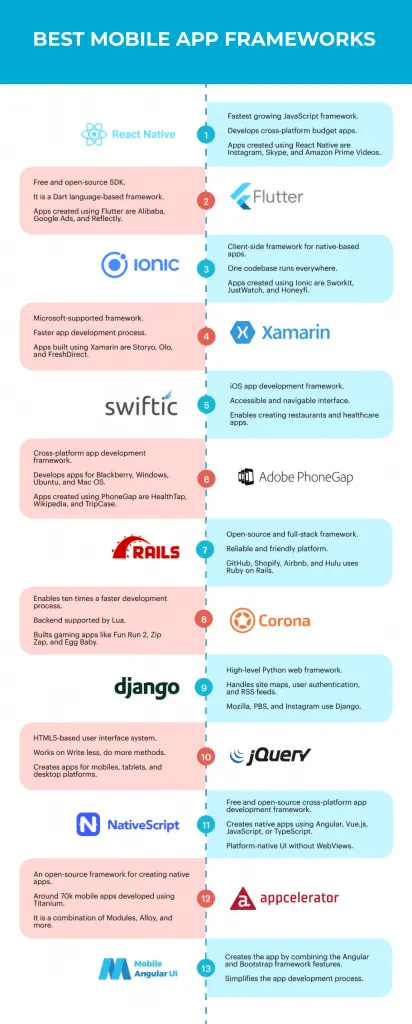
React Native is a JavaScript framework, designed for building native apps for platforms like Android and iOS. React Native is based on a JavaScript library created by Facebook called React. React Native framework brings its power to native mobile app development.
React Native is the competitor of Native Scripts and Xamarin in the world of mobile app frameworks. It is used by Instagram, Walmart, Airbnb, Tesla, and many more companies like them. Some of the top apps using React Native are Instagram, Messenger, Skype, and Amazon Prime Videos.
As per research, React Native is the 11th most popular Javascript category.
Features of React Native
Supports third-party library
Development time is short
Strong community support
Write once and use it everywhere
Benefits of React Native
Modular Architecture
Optimal Performance
Efficiency
Reusability
JavaScript
Support for Third-Party Plugins
2. Flutter
Flutter is one of the best hybrid mobile app development frameworks.
Flutter uses 2D rendering engine known as Skia to create visuals. These visuals are made to look like Cupertino style widgets and Material Design. The framework allows ease of testing to developers without restarting the project when an error occurs.
Flutter is a framework backed by Google which gives it a huge advantage since the reputation of Google products has always been outstanding.
Using Flutter, you can build cross-platform apps for iOS and Android that can run on any device. It uses Dart as its programming language.
The integration of Dart 2.2 & Flutter 1.2 is the major update by Flutter. Flutter 1.2 especially focusses on improving the performance of AOT-compiled code and improving AOT performance with the help of Dart language.
Flutter is the framework behind developing apps like Alibaba, AppTree, Google Ads, Reflectly, Google Greentea, Tencent, Bitfolio.
Features of Flutter
Huge widget library
One-stop solution for app development
Integration, scalability, and flexibility capabilities
Native performance
Benefits of Flutter
Supports cross-platform mobile app development
Reduces time for business logic and Flutter UI framework
Lightning-fast speed
Expressive & Flexible UI
Flutter has light-weight components
3. Ionic
Ionic is one of the most widely used frameworks for the development of mobile apps that is free and open-source.
Ionic is a client-side framework that helps in building native-based apps with a combination of CSS3, HTML, and JavaScript. The element of HTML5 helps in developing hybrid apps as well.
Ionic enables mobile app developers to use one codebase to build apps for various platforms. The Ionic-built apps have crossed the total number of 4 million. The Ionic framework is highly prevalent in many distinct industries. Recent studies indicate that the highest amount of usage of Ionic across the globe by websites is in the United States.
The integration of Ionic with Firebase, Identity Vault, and SQLite provides authentication and security to mobile apps.
Ionic CLI, Cordova Plugins, Ionic View, and CSS & Javascript Components are some of the best features of the Ionic framework.
Some of the popular progressive apps built using the Ionic framework are MarketWatch, Pacifica, Sworkit, JustMatch, Joule, McDonald’s Turkiye, ChefSteps, Untappd, and Diesel.
Features of Ionic
Open-source framework
Big support community
Feel-factor is native-like
Benefits of Ionic
Cross-platform app development
User Interface
Easy to adopt
Cordova Plugins
Performance
4. Xamarin
Xamarin is a Microsoft supported framework. App developers use Xamarin to create apps for Android, iOS, and windows with the help of C# codebase. These codes are shareable across multiple platforms including Windows and Mac OS.
It is a framework for mobile app development that saves time for developers by allowing them to code fast. Since Xamarin allows the benefit of code sharing, the developers can save a lot of their time. Some of the best apps built using Xamarin are Story, Just Giving, The World Bank, Olo, Insightly, and FreshDirect.
Features of Xamarin
Google emulator manager
Application loader
Android SDK manager
Visual Studio integration
Custom controls
Benefits of Xamarin
Less Complex Development Environment
Xamarin framework overcomes the limitations of hybrid apps
This framework performs CPU-intensive tasks 22X faster than hybrid HTML
Xamarin SDK is more updated and stable
Complete development ecosystem.
5. Swiftic
Swiftic is a framework for creating mobile apps for the iOS platform. Swiftic provides an easily navigable interface to mobile app developers. This framework is a convenient option as it offers a 30 days money-back guarantee option. Besides this, Swiftic also offers a 6-month success guarantee scheme.
Swiftic is the best framework when it comes to developing applications for businesses like restaurants, retail & commerce, and health & beauty.
Advantages of Swiftic
Affordable to develop a mobile app
Offers great app development process
Best framework to create small business apps
Features of Swiftic
In-app Coupons
Easy Communication
App Publication Assistance
Third-party Integration
Customer Engagement
6. Adobe PhoneGap
The PhoneGap framework facilitates people to see changes instantly. It is a cross-platform development framework which allows app developers to develop in HTML5, Javascript, and CSS.
The apps by Adobe PhoneGap ensures not only high-quality performance but also allows mobile app developers to develop apps without any hardware limitations. PhoneGap can develop apps for Windows, Blackberry, Mac OS, Ubuntu, and Firefox OS. The developers can also extend the functionality of this framework by adding plugins that are associated with it. With PhoneGap, the developers need to upload the codes, and the tool automatically compiles the code for them.
The apps developed by using PhoneGap are Paylution, The DHS Program, HealthTap, Wikipedia, and TripCase.
Features of PhoneGap
The strong and robust backend system
Offers flexibility
Open-source platform
Uses technologies like CSS3, HTML, and Javascript
Benefits of Adobe PhoneGap
Uniformity across platform
Based on JavaScript, CSS3, and HTML5.
Supports smartphone mainstays
7. Ruby on Rails
Rails is a Model-View-Controller framework that uses Ruby. It is an open-source and full-stack framework optimized for programmers. It is one of the most popular frameworks among mobile app developers. GitHub, Airbnb, Shopify, and Hulu use Rails.
Ruby on Rails framework is a beginner-friendly framework that helps mobile app developers in starting web development quite quickly.
There are many valuable gems for Ruby on Rails, which are library-like dependencies that extend the functionalities of your app. It also helps you in developing an app even faster and more efficiently. The latest version of Ruby On Rails 6.0 has come up with some interesting features like Action Mailbox, Action Text, Parallel Testing, Action Pack, and Action Cable.
The community of Rails is quite reliable and friendly, and there are many screencasts, tutorials, and resources that can help one in becoming a rails expert in no time.
Features of Ruby on Rails
Keyword Arguments
Turbolinks
Action view, mailer, and cable.
Render from anywhere
Symbol garbage collector
Benefits Of Ruby on Rails
Large Community
Test Automation
Libraries
Tooling
Code Quality
Productivity
Responsible Developers
8. Corona SDK
Corona SDK is ten times faster in developing an app than any other mobile app development framework. The Corona backend is supported by Lua which is a light-weight programming language that focuses mainly on speed, flexibility, and ease of usage.
Corona SDK is a framework for mobile app development that helps the developers who wish to code quickly and still maintain the quality of apps. Moreover, it is also a free and cross-platform framework.
Being the fastest mobile app development framework, using it in developing games is very appropriate. Some of the best gaming apps built using this framework are Zip Zap, I Love Hue, Fun Run 2, The Lost City, Mandora, Egg Baby, and Draw Rider Plus.
Features of Corona SDK
More than 1000 API’s and plugins
Cross-platform development
Availability of Corona Marketplace
Benefits Of Corona SDK
Single codebase
Quicker Monetization
Cross-Platform
Importance on design
Plugins for all the needs
Dominant APIs
Lua programming
Rights to a source code
9. Django
Django, a high-level Python Web framework supports rapid development and efficient design.
Experienced developers built apps using Django and take care of much of the hassle of Web development. One can focus on writing an app without needing to reinvent the wheel. It is a free and open-source framework.
Django takes care of user authentication, site maps, content administration, and RSS feeds. The user authentication system of Django provides a secure way to manage user accounts and passwords.
The business sector makes the highest use of the Django framework, says a survey by similar tech.
Features of Django
Python Web-framework
High Scalability
Excellent documentation
Offers high security
Provides rapid development
Benefits Of Django
Free and Open-source.
Django helps developers to take apps from concept to completion.
It is fast, secure, and scalable.
Django is reassuringly secure.
10. jQuery Mobile
JQuery Mobile is an HTML5-based user interface system that enables mobile app developers to build highly responsive applications. This framework follows the “write less, read more” mantra. JQuery has ThemeRoller that has great customizable themes to offer.
JQuery Mobile is compatible with other mobile app frameworks and also platforms like PhoneGap.
Advantages of JQuery Mobile
Easy to learn and develop apps
Cross-browser and cross-platform compatible
Create the custom theme using ThemeRoller
Features of JQuery Mobile
Lightweight size
Automated Initialization
Simple API
Powerful Theming Framework
Configured with HTML5
11. Native Scripts
Native Script is a framework for the development of hybrid apps. A Bulgaria based software company, Telerik is a creator and supporter of this framework.
The apps using the Native Scripts framework utilize the same APIs similar to using Xcode or the Android Studio. One can develop native iOS apps as well as native Android apps using TypeScript Angular, JavaScript, and Vue.js. NativeScript transpires all the XML components to iOS components and native Android.
Native Script is a framework that follows a holistic approach. Once you write code, it will be running smoothly across all 3 platforms. With Native Script, you have complete access to all iOS and Android APIs.
Features of Native Script
Ease authentication with different sign-on providers
More than one frame in an app
Use Webpack and LiveSync simultaneously
Modal dialog
Benefits Of Native Scripts
Cross-platform is the strength
Faster access to Native libraries
Open-source development ecosystem
12. Appcelerator Titanium
Appcelerator Titanium is an open-source framework that enables mobile app developers to create native mobile apps on platforms including Android and iOS. This framework takes JavaScript code, analyzes, and re-complies it into native code cementing. Appcelerator Titanium is the combination of Titanium SDK, Appcelerator CLI, Modules, Alloy, and more.
There are around 70k mobile apps developed using the Appcelerator Titanium framework. The 70 to 80% of the code created by this framework can be reused across various apps.
Benefits of Appcelerator Titanium
Rapid Prototyping
Web-oriented
Growing Community
JavaScript
Features of Appcelerator Titanium
MVC-based framework Alloy
Supports JavaScript and Ajax frameworks
UI components like dialog boxes, menus, and navigation bars.
13. Mobile Angular UI
The Mobile Angular UI is a framework that helps in developing mobile apps by combining the features of the Angular and Bootstrap framework.
Mobile Angular UI simplifies the process of development, and you can build the apps using HTML5. The mobile app developers can also make use of fastclick.js and overthrow.js offering a seamless experience.
This framework gives good server-side support and supports complex apps with ease. It is a free framework.
Features of Mobile Angular UI
Scrollable Areas
Dropdowns
Navbars
Toggle Switch
Modal and Overlays
Benefits Of Mobile Angular UI
Excellently styled default controls
It provides mobile components not found in Bootstrap.
Final Take on App Development Frameworks
The mobile app frameworks are the essential driving tools for building any mobile or web application. With plenty of mobile app frameworks in the market, the selection of a framework entirely depends on developers’ priorities and familiarity with a specific framework. 2024 is estimated to get exposure to various mobile app frameworks that can aid the Mobile App Development Company in their workings. The mobile app companies can consider all the above-listed frameworks while working on their next app development project.