

Key takeaways
A brief discussion about Svelte vs Vue, which are powerful frontend frameworks that offer host pros and cons.
Svelte is an open-source frontend component framework known for efficiency.
Vue is an open-source frontend JavaScript library for developing single-page applications and user interfaces.
Best JavaScript Framework: A quick overview
Stats | Svelte | Vue |
|---|---|---|
Hacker News Points | 1K | 2.3K |
Reddit Points | 574 | 3.9K |
Github stars | 75.2K | 206.3K |
GitHub Forks 4.3K | 4.3K | 34.7K |
Introduction
Svelte vs Vue is becoming a debatable topic; both are the best JavaScript frameworks that are becoming popular amongst web developers. When comparing Svelte and Vue, Svelte competes by offering and improving upon the same features as Vue.
In this blog, we discuss Svelte vs Vue, head-to-head comparisons, and the intricacies of both frameworks. We aim to equip you with a frontend framework that works best and aligns with your business needs.
Svelte vs Vue: A head-to-head framework comparison table
Feature | Svelte | Vue |
|---|---|---|
Language | JavaScript | JavaScript |
Bundle Size | Smaller due to compile-time optimization | Larger due to runtime overhead |
Learning curve | Challenging learning curve | Advanced learning curve |
Size of the framework | Small | Large |
Performance | Enhanced performance without virtual DOM | Prompt with Vue3 and composition API |
Render approach | Component compilation occurs during build time. | Virtual DOM rendering strategy |
Community support | Backed with rising community support | Established community support |
Security support | Absence of built-in security parameters | Supports security mechanisms |
Popularity | Gaining popularity | Highly popular |
CSS-handling | Unified with CSS scoping & styling | Accommodates CSS modules, scoped styles, and preprocessors. |
Tooling | Comprises a compact toolkit system similar to SvelteKit | Encompasses an extensive tooling ecosystem similar to Vue DevTools |
Component structure | Centered on reusability | Anchored in lifecycle hooks |
Developer UX | Succinct code leading to swift development | Well-documented and includes extensive tools & libraries |
Svelte: A complete overview
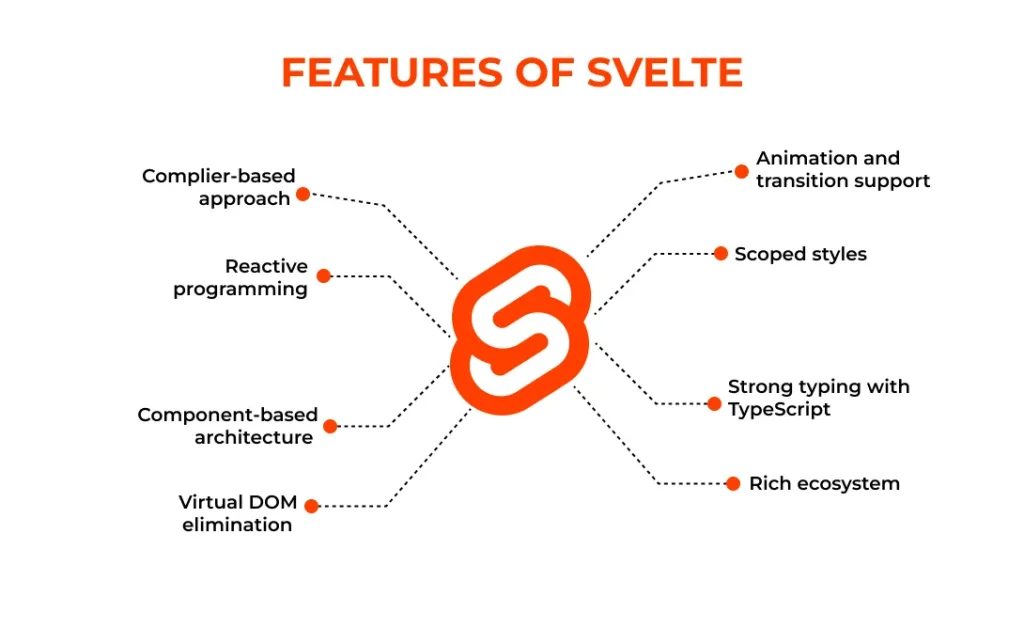
Svelte is one of the modern JavaScript frameworks developed to create interactive websites and web applications. The main idea behind developing Svelte is that it is similar to React and Vue, which allows developers to build web applications. It was developed by Rich Harris in 2016 to redefine front-end development with enhanced efficiency and robust speed.
Svelte was introduced to improve the developer’s toolbox for building dynamic user interfaces and to emphasize a seamless and intuitive development experience.
Svelte sets itself apart as a lightweight design tool by minimizing the overhead traditionally associated with front-end frameworks. This enables the delivery of web applications with great performance and scalability. The uniqueness of this tool allows to build ultra-fast applications.
Vue: A complete overview
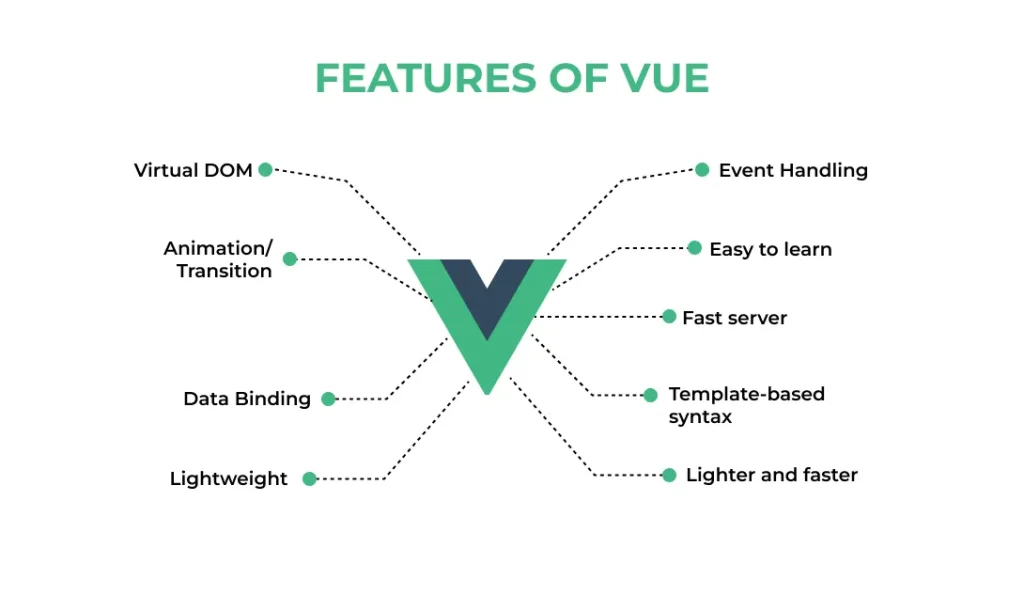
Vue.js is a well-known open-source front-end JavaScript library that allows users to build user interfaces and single-page applications. It was developed by Evan You in 2014; it is often hailed as well-known as “React Killer.” This framework comprises advanced features catering to the demands of complex applications, including routing, state management, and build tooling.
Vue is a lightweight and user-friendly platform, acclaimed as a favored choice for both freshers and seasoned developers. It follows the MVVM architectural platform known for its simplicity and ease of integration, which ensures a smooth development experience.
Vue js development is a go-to solution of innovation similar to Angular and React; it surpasses with its simplicity and ease of accessibility. It has adapting capabilities that offer lightweight solutions to learn and use. Due to the compromising features and performance, it is a preferred solution for those who seek efficiency in their workflows.
Svelte vs Vue: In-depth Comparison of Pros and Cons
Svelte and Vue are both JavaScript frameworks that have gained popularity among developers. Let us understand the core differences by briefly comparing Vue vs Svelte.
Svelte vs Vue: Capability of Performance
# Svelte Performance
Svelte works on a compile-time approach and converts your components into JavaScript code. This minimizes overhead associated with other frameworks.
Works autonomously on reactive updates; it doesn’t rely on virtual DOM. This results in quick rendering as and when data changes.
The lack of virtual DOM minimizes the memory overhead and reduces the need to synchronize DOM with the component state.
#Vue Performance
Vue is considerable for medium to large-scale applications. It is not as lightweight as Svelte
Vue has an additional abstraction layer and a reactivity system since it operates through a virtual DOM.
It uses virtual DOM to update actual DOM efficiently.
WHOSE THE WINNER? Comparing both Svelte and Vue, Svelte stands out in terms of performance.
Svelte vs Vue: Size of the Application
# Svelte Application Size
Svelte applications are small bundle sizes compiler-based approaches.
Svelte complies with components in JavaScript and eliminates runtime libraries like Vue.
Svelte components are very efficient and result in minimal overhead in terms of code size.
The reactive updates are complied with during build time.
#Vue Application Size
Vue application has a larger bundle size, allowing the development of large and complex applications.
It encompasses a variety of plugins and tools that help to manage large and complex applications.
The file-based component system and syntax template contribute to Vue’s large bundle size.
WHOSE THE WINNER? Comparing both Svelte and Vue, Vue outperforms the game of Application size.
Svelte vs Vue: Extended prominence
#Svelte prominence
Vue is significantly popular due to its large and active community of developers.
Vue is suitable for developing small-scale and large-scale enterprise applications.
GitHub stars are the evidence of extensive interest and adoption amongst the developers.
It is a well-established ecosystem with diversified plugins, tools, and resources.
#Vue prominence
Svelte is gaining momentum, but the community is smaller than Vue’s.
It has a unique approach that allows one to build web applications, focusing on optimizing compile time.
Many companies and projects implemented it even after having a smaller community than Vue.
WHOSE THE WINNER? Comparing both Svelte and Vue, Vue wins the battle of popularity.
Svelte vs Vue: Measure of the learning curve
#Svelte learning curve
The syntax is straightforward, with additional features like reactive declarations and directives.
It consists of unique concepts that manage the application state.
Its tooling is streamlined and minimalistic, which provides an interactive environment.
#Vue learning curve
Vue.js consists of a combination of both HTML-based templates and CSS for styling.
It includes components, directives, and computed properties requiring initial learning.
Vue CLI simplifies project setup, development, and deployment tasks.
It has an active community, extensive documentation, tutorials, forums, and third-party libraries.
WHOSE IS THE WINNER? Comparing both Svelte and Vue, Vue leads the learning curve.
Svelte vs Vue: Pace of development
#Svelte development pace
It requires minimal setup, which speeds up the initial setup process.
Svelte compiles code, avoiding the virtual DOM abstraction, leading to faster rendering.
The reactivity system reduces additional reactive state management libraries.
Allows component-scoped stypes, which leads to easy and fast styling.
Syntax is concise and intuitive, which speeds up the development.
#Vue development pace
A rich ecosystem of libraries, plugins, and tools accelerates the development process.
A robust set of tools offers a streamlined development experience.
It allows the encapsulation of templates, improves organization and maintainability, and speeds up development.
Offers suites of debugging tools to accelerate the developments and provide insights.
Well-organized documentation speeds up the development process.
WHOSE IS THE WINNER? The extended features and functionalities of Vue help it stand out from Svelte.
Svelte vs Vue: Enhanced Scalability
#Svelte scalability
Smaller bundle sizes enhance scalability by reducing the amount of data.
Reactive updates are highly efficient because their compiler-generated code offers better performance and scalability.
Supports code and enhances scalability by reducing the initial load time.
#Vue scalability
It comes with Vue Router, a routing library that allows single-page applications.
Supports server-side rendering, which enhances scalability by improving performance.
Promotes component-based architecture, which facilitates scalability.
Provides Vuex, a state management library inspired by Flux and Redux.
WHOSE IS THE WINNER? Both Svelte and Vue are much more flexible and scalable for developing different applications.
Svelte vs Vue: Future Predictions
#Svelte future
The Svelte forecasted trend is an increased utilization of building rich and interactive components.
Combined code is more efficient and lightweight compared to other methods.
It is a more reasonable and existing prediction.
Svelte trends include increased popularity, ecosystem development, integration with other frameworks, and improved tooling.
#Vue future
Vue has some predictions, which include steady growth and popularity, integration with backend technologies, and ecosystem growth.
WHOSE IS THE WINNER? Both Svelte and Vue have bright future predictions.
RELATED TOPIC: Svelte vs. React
Vue vs Svelte: Final words
To conclude, both Vue and Svelte are modern, robust frameworks designed to simplify the web development process and deliver high-performance applications.
Vue is a go-to framework with a mature ecosystem along with comprehensive documentation. In other words, it suits developers looking forward to a scalable and versatile framework with an easy learning curve.
On the contrary, Svelte differs from Vue; its innovative approach allows it to develop exceptionally fast applications with less boilerplate.
Well, the decision to choose one solely depends on the project requirements; it also depends on your team if you have the required skill set. The ecosystem size versus the cutting-edge optimization has unique pros and cons and can differ according to the choices.
In the case of Vue and Svelte, both can be preferable with a unique set of advantages. Moreover, it can be the right choice for bringing efficiency and an innovative approach to bring your web application to life.
Why should you choose OpenXcell?
Vue and Svelte are popular JavaScript frameworks that help improve user experience, features, and functionality. Due to this, choosing one becomes challenging; we at OpenXcell help you develop dynamic and exceptional applications. We help you determine which framework suits your project requirements the best, such as performance needs and application size.
FAQs:
Which one should you choose: Svelte or Vue?
Well, choosing one from Svelte or Vue can be challenging. Weighing both of them with their own set of pros and cons can help you better. Svelte is often used for developing smaller apps because of its straightforward approach. On the other hand, Vue is a lightweight framework that is adaptable irrespective of project size.
Is Svelte worth learning in 2024?
Svelte.js has been a progressive framework since 2016, and many big companies have adopted it. It has been integrated into their web development. Therefore, it is promising as well as relevant if you are trying to look into Svelte.js in 2024.
How big is the Svelte bundle compared to Vue?
Regarding the bundle size, Svelte and Vue have notable differences. The bundle size of Vue is 33.9 kB, while Svelte is drastically lower with 1.7 kBm.
Which front-end framework from Svelte vs Vue is right for you?
Choosing one from Svelte and Vue primarily hinges upon the project’s needs and preferences. Svelte might be the way to focus on simplicity, rapid development, and high performance. On the contrary, you can opt for Vue for those looking for flexibility, an easy learning curve, and a vast community support system.
Can Svelte and Vue be used in the same project?
It is feasible to incorporate both Vue and Svelte for the same project. On the contrary, it is not recommended because it will create complexity or potential conflicts. It is advisable to choose one particular framework to ensure consistency and maintainability.