

Most custom software engagements start the same way: a long discovery phase, a proposal with a team roster attached, and a timeline measured in quarters rather than weeks. By the time a mid-market company has a working system in hand, priorities have often shifted, budgets have been renegotiated, and it's genuinely hard to point to who owns the code.
That's not really a failure of any one vendor — it's a structural problem with how custom software development has traditionally been staffed and scoped. Large teams and long timelines make sense for large, multi-year platform builds. They make much less sense for the kind of focused project most mid-market companies actually need: a specific internal tool, an AI pilot, a system integration. A newer model, Forward Deployed Engineering, is built for exactly that gap — and it's becoming dramatically more viable now that AI coding tools can cover ground that used to require a much larger team.
What Is Forward Deployed Engineering?
Forward Deployed Engineering (FDE) describes an engagement model where a senior engineer works embedded directly inside a client's team and systems, building the actual software rather than advising from the outside or managing a larger offshore unit through several layers of account management. The name comes from the idea of being deployed "forward," at the point of need, rather than working at a remove from it.
The term originated at Palantir, where forward deployed engineers were sent on-site with enterprise and government clients to build and adapt software against real operational problems, rather than shipping a generic product and leaving the customer to figure out implementation on their own. That origin was built for large enterprise and government contracts, with all the scale and timeline that implies.
Applied to mid-market custom software development — companies roughly in the 20 to 500 employee range — the same core idea holds, but the shape of the engagement changes considerably. Instead of a multi-year enterprise contract, it becomes a focused, time-boxed project: one embedded engineer, or a small dedicated pod, shipping a specific system and then handing over full ownership of the code. It's a narrower, faster-cycle application of the model, suited to companies that know roughly what they need built and want it built by one accountable person rather than coordinated across a team.
Traditional Custom Software Development vs. Forward Deployed Engineering
The practical differences between the two models show up most clearly when you compare how each handles team structure, timeline, accountability, and what you're actually left with at the end of the engagement.
Traditional Custom Software Development | Forward Deployed Engineering | |
|---|---|---|
Team structure | Project manager plus a rotating pool of developers, often distributed across time zones and account layers | One embedded senior engineer, or a small dedicated pod, working directly with your team |
Typical timeline | 3–12+ months, frequently extended mid-project as scope shifts | 4–12 weeks for a defined deliverable |
Accountability | Diffused across a team and account management layers; hard to trace a decision back to one person | Direct — the engineer building the system is the same person you're talking to day to day |
Code ownership | Often ambiguous until contract renegotiation, especially under staff-augmentation arrangements | Full ownership handed over at project completion, by default |
Cost structure | Ongoing retainer or large fixed-team cost, regardless of actual output in a given month | Scoped to the engagement, tied to a specific deliverable |
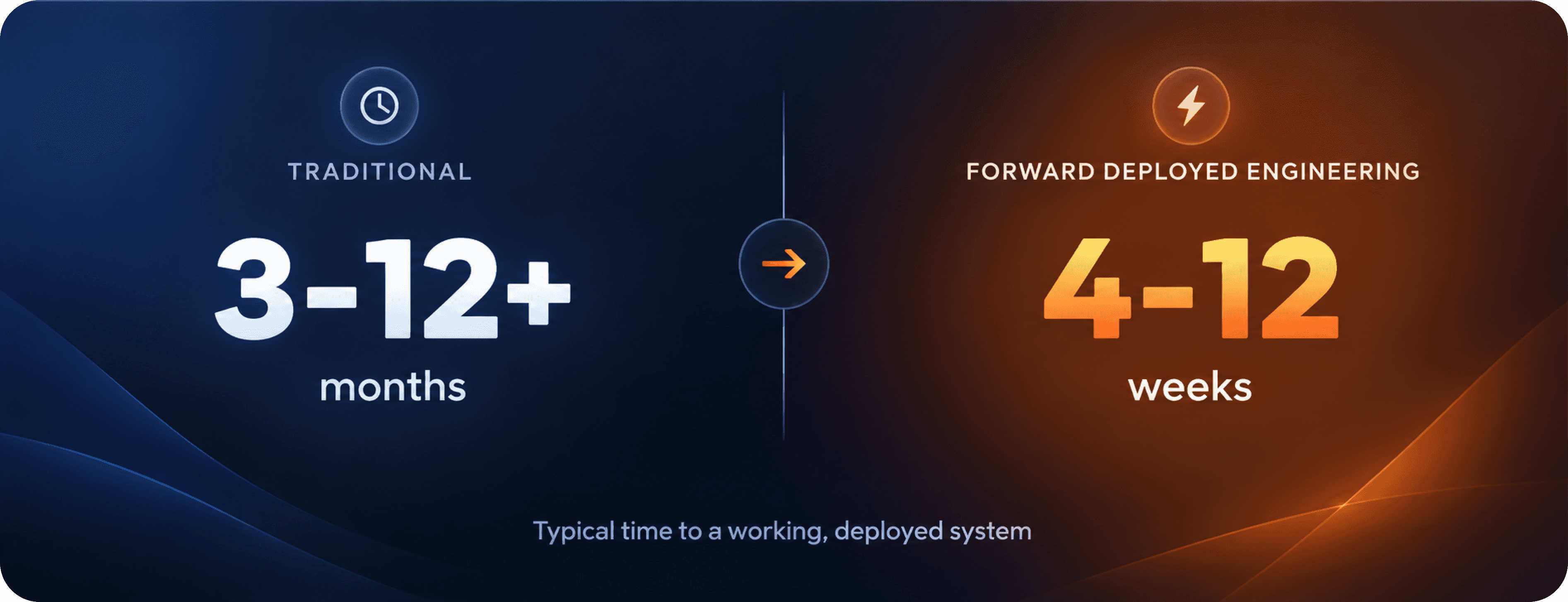
Neither model is universally better. A genuinely large, multi-year platform build still benefits from a full team and long-term staffing — that's not a problem FDE is trying to solve. But for a well-defined, single-system project, the traditional model's overhead — the account layers, the ramp-up time for a rotating team, the ambiguity around who actually owns the result — often doesn't match the size of the problem being solved.
How AI Tools Change the Equation
The FDE model isn't new in concept, but it used to have a hard ceiling: one engineer, however senior, could only move so fast working alone. That ceiling has moved substantially in the last two years. Modern AI coding tools — agentic assistants like Claude Code and GitHub Copilot, IDE-native tools like Cursor, and CLI-driven coding agents — let a single experienced engineer cover ground that used to require a full team split across several developers.
This isn't about AI writing an entire application unattended and shipping it. It's that scaffolding, boilerplate, test coverage, and a lot of the mechanical translation from spec to working code — the work that used to consume the bulk of a project's early weeks — now happens in a fraction of the time. That frees the embedded engineer to spend their time on the parts of the job that actually require judgment: architecture decisions, integration edge cases, and understanding what the client's team actually needs versus what they originally asked for in a kickoff meeting.
Picking the right tool for a given task matters here, and it's not a solved problem — a coding agent optimized for large-context refactoring behaves differently from one optimized for fast, cheap iteration, and the underlying model matters as much as the tool wrapping it. We've compared several of these directly: Roo Code against Cline for agentic coding workflows, and Claude Haiku against Sonnet for situations where speed and cost should outweigh raw capability. Cost and infrastructure tradeoffs matter too — for engagements where running models locally makes sense, we've also looked at LM Studio against Ollama and Mistral against Llama 3 as open-weight options. For a broader view of the landscape, our roundup of AI tools for developers covers what's available beyond these specific comparisons.
The net effect: an embedded engineer working with the right AI tooling can realistically deliver, in a 4–12 week window, what used to justify a much larger traditional team and a much longer timeline. That's the specific shift that makes Forward Deployed Engineering a more practical option for mid-market companies now than it would have been even two or three years ago.
Openxcell's Forward Deployed Engineering Model
Openxcell applies this model specifically to AI-powered custom software development for mid-market teams. In practice, that means an embedded senior engineer — not a rotating team — working directly inside your existing workflows and systems, rather than through a separate offshore unit reporting up through account managers.
Engagements run 4–12 weeks, scoped to a specific deliverable — an internal tool, an AI pilot that needs to move from proof-of-concept to something reliable, a system integration between existing platforms — rather than structured as an open-ended retainer. At the end of the engagement, full code ownership transfers by default, with no separate negotiation required to get it. Delivery is AI-augmented throughout, using the same class of coding tools discussed above to compress timelines without cutting corners on architecture, testing, or code quality.
It's a deliberately narrower offering than a full-service development shop, and that's intentional: it's built for companies that already have a reasonably clear picture of what needs to be built and want it delivered fast, by one accountable engineer, rather than managed through a larger team.
When You Don't Need a Fully Custom Build: Customable
Not every mid-market software need is genuinely bespoke. A CRM, an internal knowledge base, an employee portal, an applicant tracker — these are common enough patterns that building one from a blank canvas, even on a fast FDE timeline, can be more than the problem requires. Customable, also built by Openxcell, is a catalog of production-ready business applications across categories like CRM, ERP, project management, and internal portals — each one already live and running, previewable before you buy, sold as a one-time purchase rather than a per-seat subscription. You get full source code and unlimited users, and can self-host on your own infrastructure.
The two offerings are built on the same underlying idea. When one of Customable's existing applications is a close enough fit, buying it and customizing it to your specific workflows is faster and cheaper than commissioning a build from scratch. And when it genuinely isn't a fit, Customable's own from-scratch option hands the project to a forward-deployed engineer, embedded with your team — effectively the same engagement described throughout this article, just entered through a different door.
Is Forward Deployed Engineering the Right Fit?
FDE tends to work best when a project has a reasonably clear scope, a defined timeline, and a client team that's able to work directly with an embedded engineer rather than through several layers of account management. It's a weaker fit for genuinely undefined, multi-year platform builds, where a larger dedicated team and a longer-term staffing model still makes more sense — and a weaker fit for teams that specifically want a large team's worth of parallel output rather than one highly leveraged engineer.
If your need matches a common pattern — a CRM, a portal, an internal knowledge base — it's worth checking whether Customable already has a close fit before scoping a fully custom build; it's usually the faster path when it applies. If your team has a more specific system to build — particularly one where AI tooling can meaningfully speed up delivery, or an early-stage build where scope is still tight — it's worth evaluating Forward Deployed Engineering against the traditional staffing model rather than defaulting to it. For a good example of how this plays out in practice, our guide to scoping an MVP-stage engagement walks through the same kind of scope-first thinking. You can see how Openxcell structures Forward Deployed Engineering engagements in more detail on our custom software development page.