How Integrating AI in Private Equity is Transforming Businesses
 Last updated:April 23, 2026
 8 Min Read
- How does AI in Private Equity Work?
- Data Layer
- Data Engineering & Integration
- Data Storage Indexing
- AI/ML & Analytics Layer
- Decision Intelligence Layer
- Enterprise Integration Layer
- Top 08 AI Use Cases in Private Equity
- Competitor Analysis
- Due Diligence Automation
- Portfolio Management
- Defining Exit Strategies
- Advanced Risk Management
- Deal Sourcing
- Capital Preservation
- Expert Network Analysis
- What is the Future of AI in Private Equity?


Key Pointers Related to AI in Private Equity
- AI accelerates competitor analysis based on the online presence, activities, and trends.
- The ML algorithms evaluate legal and regulatory documentation to foster preventive strategies.
- AI also ensures a strong portfolio presence to facilitate the acquisition process.
- AI audits the market situation and business standing for better returns.
- AI secures businesses against risks associated with market fluctuations and their effects on the company portfolio.
- AI simplifies outreach by customizing the pitch based on past interactions, outcomes, and the dataset.
- AI simplifies private equity for new investors by minimizing damages and risk categorization.
- AI makes relevant insights and quality data accessible to further simplify acquisition.
The current landscape showcases rapid shifts in living standards. An EY Report shows that in Q1 of 2025 itself, global private equity acquisitions have increased by 45%, and their value has doubled from 2024 Q1. To represent this graphically,
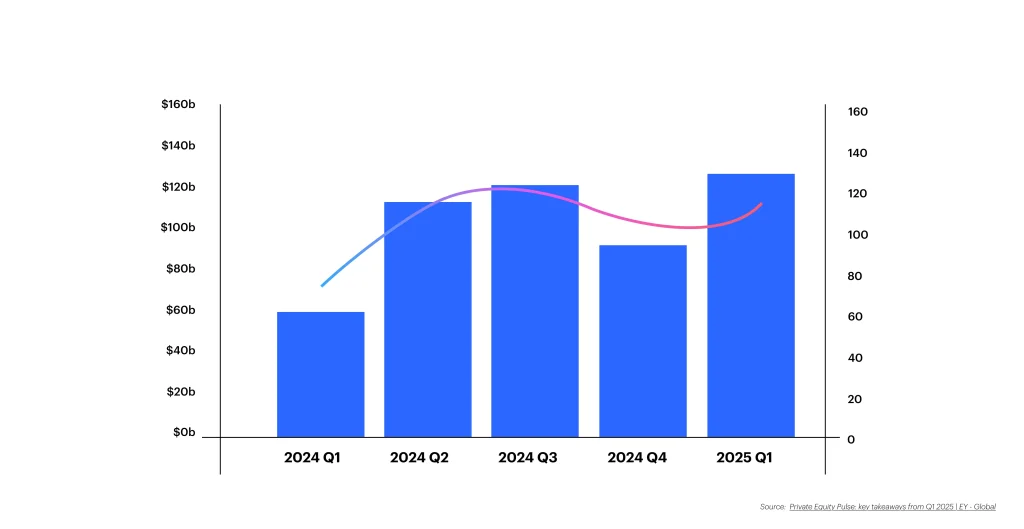
While there is an upward trend in private equity acquisitions, the volatile nature of the market has also led to skepticism among business owners and investors. This is where AI in private equity comes into play. Artificial intelligence simplifies the whole process and safeguards against risks in the dynamic market.
The blog will elaborate on the eight use cases of AI for private equity. If that is something you would like to know about or are planning to invest in private equity yourself, then this blog has all the information you need. So, let us begin,
How does AI in Private Equity Work?
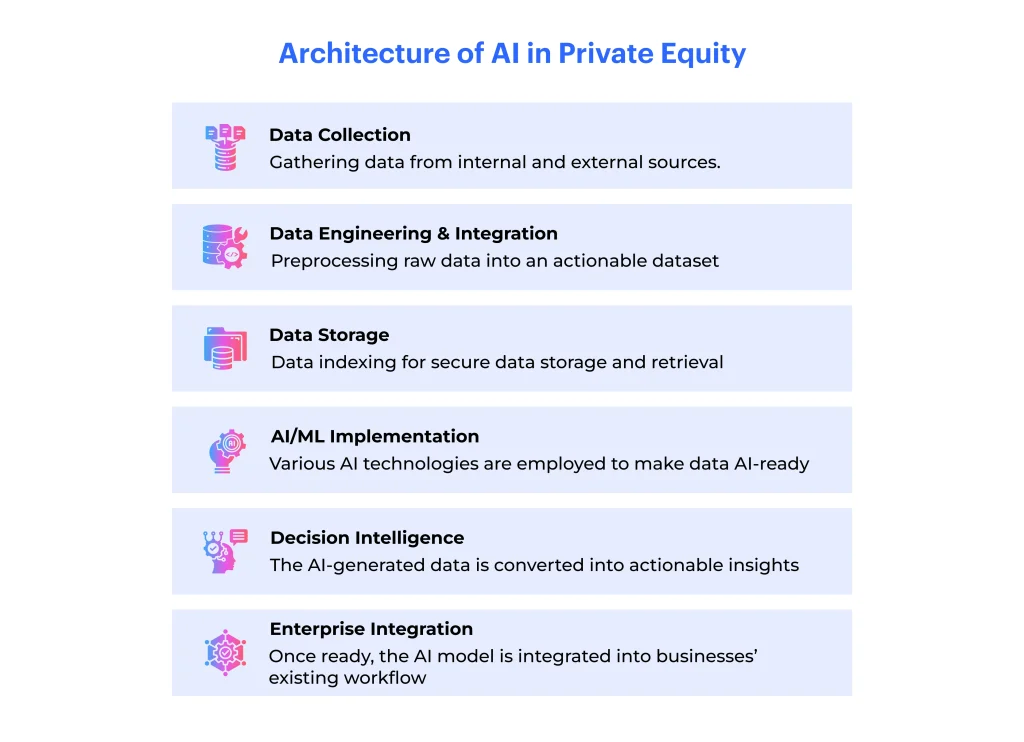
The sophisticated AI architecture simplifies different processes in personal equity. The experts determine major themes and requirements to design it according to the client’s requirements.
The section will explain AI architecture and how every layer contributes to a simpler and faster PE experience.
Data Layer
This layer gathers structured and unstructured data from various internal and external datasets. The tools and techniques used are APIs, data connectors, NLP web crawlers, and web scrapers.
The internal sources include CRM data, financial models, portfolio performance history, and investment memos. The external data sources include market insights, the ESG database, press releases, and SEC filings.
Data Engineering & Integration
This layer converts the raw data into actionable datasets and insights. Key technologies at play here are data lakes like Snowflake, BigQuery, and AWS Glue. The system also uses Data Build Tool and Trifacta. along with various ETL tools that streamline data movement and transformation.
This layer is responsible for maintaining and monitoring ETL pipelines, data normalization and enrichment, de-duplication and anomaly detection, and entity resolution. This layer takes the raw data filtered from level one and prepares it for the AI model to utilize.
Data Storage Indexing
The preprocessed dataset needs scalable storage and secure retrieval, which is achieved through proper data indexing. A combination of a reliable data warehouse, data lakes, and vector database is utilized for easy-to-manage data storage and retrieval.
These tools cater to different data formats, such as data warehouses for structured data, data lakes for unstructured documents, and vector databases for semantic search (data retrieval).
Related Read: 13 Best Vector Databases for AI-Powered Solutions | Openxcell
AI/ML & Analytics Layer
Once filtered, sorted, and stored, the data is further transformed into AI-friendly data. Depending on the usage scope, level, and requirement, different AI tools are employed to enhance data utilization.
Large language models scan various textual datasets like documents and knowledge groups. Sentiment analysis evaluates the risks and intentions, while resilient exit models powered by NLP ensure market timing optimization. This helps with relevant output generation.
Decision Intelligence Layer
This layer is responsible for taking AI-generated data and converting it into actionable insights using BI tools such as Tableau, Power BI, Looker, etc. Some companies also use custom interfaces with their requirement-specific features and functionalities.
This layer has many benefits in private equity and can be used for ESG scoring visualizations, KPI benchmarking, and creating investment committee-ready presentations.
Enterprise Integration Layer
Once completed, the AI model is integrated with the business infrastructure. These AI models are added to different lifecycle stages to enhance their capabilities and functionality.
It automates email, call, or meeting logs in its CRM tool. AI assists throughout the data management pipelines via predictive scoring, assessing company traits. LLM assesses contracts and financial statements and generates a detailed report.
Top 08 AI Use Cases in Private Equity
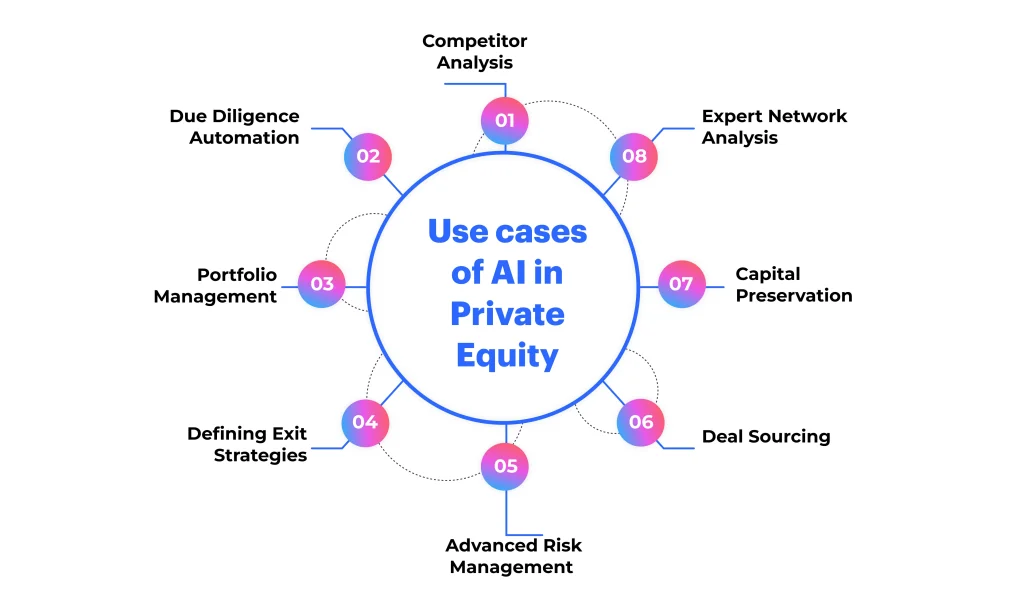
Now that the AI architecture is understood, let us know the importance of investing in AI development services. Here are the eight best AI use cases in private equity.
Competitor Analysis
Staying current with market trends and competitor activities is important, but it is often not prioritized. Using AI tools for private equity helps companies automate this process almost entirely.
AI platforms quickly filter out relevant customer reviews, social media posts, articles, and other information sources to generate a thorough report on market trends and competitor activities. The AI solutions allow businesses to take preventive measures and explore new opportunities.
Due Diligence Automation
AI automates regulatory filings, IP documentation, and news updates for faster assessment and growth opportunities. Using AI to audit and assess financial documents for discrepancies, errors, or fraudulent activities improves accuracy.
The benefit of generative AI in private equity is that its ML algorithms can capably evaluate legal contracts, flag potential compliance breaches, and take relevant preventive measures. AI also monitors varied social media outlets to analyze the company’s reputation and associated risks before acquisition.
To translate AI-driven diligence into defensible deal terms, PE teams should pair these tools with guidance from corporate deals and acquisitions specialists who interpret red flags, manage antitrust and regulatory reviews, and draft SPAs, disclosure schedules, and transition services agreements. Aligning legal strategy with data-backed insights accelerates negotiations and reduces closing risk.
Portfolio Management
A strong portfolio makes the acquisition process easier for everyone, and using AI further improves it. Artificial intelligence offers real-time visibility into key performance metrics, which helps with early issue identification and resolution.
AI automates regulatory adherence, reducing the burden on human resources. One fundamental use case for AI in private equity is that it helps companies track environmental, social, and governance (ESG) metrics to strengthen their company portfolios further.
Defining Exit Strategies
AI’s predictive analytics and smart algorithms assess the market situation, business standing, and industry trends to design the perfect exit strategy in case of a merger or acquisition. AI also analyzes the portfolio to help investors get a more accurate company evaluation.
AI-powered audits and document analysis generate relevant insights into competitor activities, which assist in negotiating the best possible exit deal. Using AI tools for private equity helps firms reduce time and resources while maximizing investment returns.
Suggested Read: Top 20+ AI business ideas to launch in 2025
Advanced Risk Management
Since AI models analyze thousands of documents in one go, it is very easy to review years of data. This helps investors identify patterns and previous statements, and allows investors to get a better overview of the company’s worth and value.
AI for private equity monitors market fluctuations and their effect on the company portfolio, reducing risks. Additionally, these AI tools help mitigate cybersecurity concerns and operational risks by proactively identifying and resolving vulnerabilities.
Deal Sourcing
AI identifies and pinpoints minute details, such as customer sentiment, quarterly performance metrics, etc., that distinguish emerging companies from the rest. NLP filters out relevant data from varied media channels, such as press releases, news publications, blogs, etc.
AI also simplifies outreach by generating a tailored pitch based on past data, interactions, and outcomes. Filtering out potential companies makes screening processes easier and helps prioritize high-value portfolios with promising results.
Capital Preservation
Another use case of AI in private equity is capital management and preservation, which minimizes damage and assists investors. AI allows investors to categorize risks and accordingly make investment decisions.
This benefits early investors when navigating the complex, dynamic market. It also gives investors a consistent and unbiased view of prominent portfolio companies. AI centralizes data from multiple sources, further assisting new and experienced investors in making data-driven decisions.
Expert Network Analysis
AI extracts prominent insights and excerpts from interviews for easily accessible, quality data. This helps businesses save time and resources without compromising on the output quality. Auto transcription further adds to the convenience as it reduces the manual labor.
Using generative AI in private equity adds benefits, as it can generate concise, easy-to-follow summaries. Businesses get to highlight key pointers for future reference. Another benefit is sentiment analysis, which gauges confidence, perspective, understanding, etc.
Check out our blog for more in-depth insights on AI in investing
What is the Future of AI in Private Equity?
The current scenario clearly demonstrates AI’s impact on the private equity industry. From automated processes to accurate assessments, AI optimizes processes to their maximum potential.
With the accelerated pace of current developments, the need for AI-powered solutions will only increase. Various AI-powered technologies, such as natural language processing, machine learning, autonomous processes, etc., will continue to improve security, process efficiency, and accuracy.
So, what to do next?
The best move here would be to connect with AI experts who can simplify complex concepts into easy-to-navigate solutions. At present, AI implementation is welcomed but with skepticism; many are still considering it a viable long-term solution. This is why integrating AI now will give businesses an unmatched competitive advantage and operational efficiency.
As a custom fintech AI service provider, Openxcell has proficiently designed numerous AI-powered solutions for a wide range of industries and business scales. Their team of professionals ensures top-notch fintech solutions through their ethical and transparent development practices.
From custom solutions to enterprise-scale AI development, our team proficiently tackles every business challenge and translates it into premium solutions powered by modern technologies.

A Philosophy student who knocked on the door of the technology, Vaishnavi is a writer who likes to explore stories, one write-up at a time. A reader at heart, she plays with words to tell the tales of the digital world.