How AI in Drug Development Is Accelerating Drug Discovery
 Last updated:September 17, 2025
 11 Min Read
- Role of AI in Drug Development
- Key Roles of AI:
- How AI is Revolutionizing Drug Development
- The Modern Drug Development Process Powered by AI
- Key Applications of AI in Pharmaceutical Research
- 1. Target Identification and Validation
- 2. Drug Screening
- 3. Preclinical Testing
- 4. Clinical Trials Optimization
- 5. Personalized Medicine
- How AI is Transforming Clinical Trials
- Benefits of Using AI in Drug Development
- Speed
- Cost Reduction
- Precision
- Personalization
- Challenges AI Faces in Drug Development
- Real-World Examples of AI in Drug Development
- Atomwise
- BenevolentAI
- Insilico Medicine
- Pfizer & IBM Watson
- AI’s Impact on Drug Safety and Side Effect Prediction
- Future of AI in Drug Development
- A Few Closing Remarks to End on AI for Drug Development
- FAQ about AI in Drug Development


Did you know that bringing a new drug to the market takes an average of 10 to 15 years and costs over $2 billion?
This astonishing timeline and investment highlight why the pharmaceutical industry is turning to AI in drug development as the new and powerful solution. It helps in analyzing complex datasets to predict drug interactions and optimize clinical trials. AI is transforming every stage of the drug discovery process.
With the extra support of advanced AI development services, pharmaceutical companies can accelerate timelines, cut costs, and deliver safer and more personalized medicines.
In this blog, we will explore the role of AI in drug development, key applications across the research pipeline, how it enhances clinical trials, its benefits and challenges, real-world use cases, and the future of AI-driven drug discovery.
Role of AI in Drug Development
The role of artificial intelligence in drug development is changing how new medicines are discovered, tested, and delivered to patients. It uses vast biomedical datasets, predictive models, and automation. AI is minimizing trial and error while making faster, data-backed decisions. With the integration of new Gen AI services, pharmaceutical research is becoming more efficient and patient-centric.
Key Roles of AI:
- Accelerating Target Discovery
It identifies disease-causing genes and proteins quickly.
- Enriching Drug Screening
AI virtually simulates molecule target interactions to save costs and time.
- Optimizing Clinical Trials
Improves patient recruitment, reduces dropout rates, and monitors safety in real time.
- Facilitating Personalized Medicine
AI creates tailored therapies based on genetic, clinical, and lifestyle data.
- Predicting Safety & Efficacy
AI helps anticipate side effects and optimizes drug dosing early in the process.
How AI is Revolutionizing Drug Development
The adoption of AI for drug development is changing the pharmaceutical landscape by reshaping traditional processes that were once extremely slow, uncertain, and costly. Now, AI offers unprecedented speed, precision, and adaptability, helping researchers unlock new possibilities in medicine.
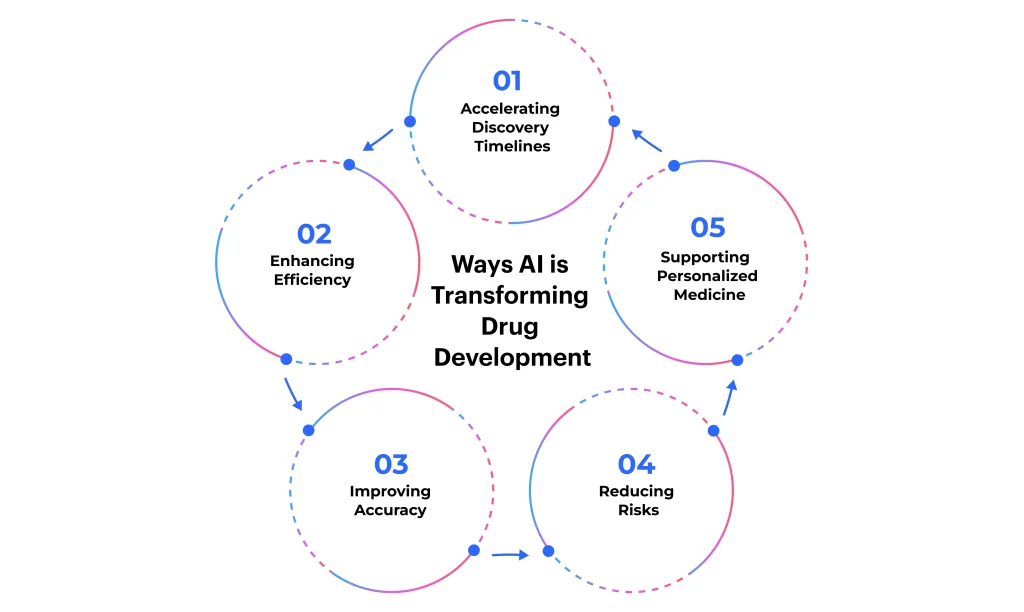
Here’s how it is making a big difference:
- Accelerating Discovery Timelines
AI greatly scans millions of compounds and predicts promising candidates in days that used to take years.
- Enhancing Efficiency
It automates repetitive tasks such as molecule screening, freeing researchers for high-value work.
- Improving Accuracy
Provides precise insights into drug target interaction and reduces false positives.
- Reducing Risks
AI predicts potential failures, side effects, and toxicities early in the pipelines.
- Supporting Personalized Medicine
It uses genetic and clinical data to create patient-specific treatment strategies.
By simplifying processes and minimizing uncertainties, AI is paving the way for faster, safer, and more effective therapies.
The Modern Drug Development Process Powered by AI
Traditionally, drug development is a lengthy journey that goes through the phases of discovery, preclinical testing, clinical trials, and regulatory approvals, often stretching the process over a decade.
Each phase demands enormous resources, involves high risks, and faces uncertainties that can delay or derail progress. This is where AI in drug development is giving transformative, streamlining processes that were once heavily manual and time-consuming.
By analyzing vast biomedical datasets and running predictive simulations, AI accelerates discovery, identifies the most promising compounds, and predicts potential failures before costly or trial phases.
During preclinical testing, AI easily evaluates toxicity and drug behavior in the body with high accuracy, reducing the need for exhaustive physical experiments. In clinical trials, it aids patient recruitment, monitors safety in real time, and adapts study protocols for better outcomes.
With the support of advanced data engineering services, pharmaceutical companies can integrate AI easily into existing research pipelines, making sure data-driven insights flow smoothly across all stages of development.
Key Applications of AI in Pharmaceutical Research
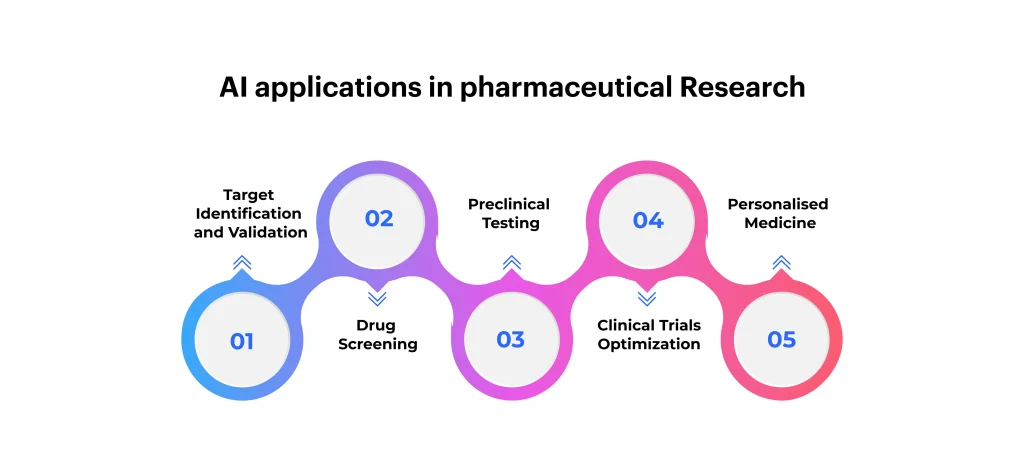
The integration of AI in drug discovery and development is changing how pharmaceutical companies identify new drugs, test them, and bring them to market. By using data-driven insights, AI minimizes uncertainty and accelerates outcomes across the entire research pipeline.
Here are some of the core applications where AI is making the biggest impact:
1. Target Identification and Validation
AI analyzes genomic and proteomic data to uncover disease-causing genes or proteins. It speeds up the identification of viable drug targets, also reducing the risk of pursuing ineffective ones.
2. Drug Screening
By virtual screening and predictive modeling, AI greatly simulates interactions between thousands of molecules and biological targets, narrowing down the candidates for lab testing.
3. Preclinical Testing
AI predicts toxicity, drug metabolism, and side effects before animal or human trials, which saves a significant amount of time and reduces unnecessary costs.
4. Clinical Trials Optimization
From patient recruitment to real-time monitoring, AI optimizes trial design, predicts dropouts, and ensures patient safety while accelerating approval timelines.
5. Personalized Medicine
By integrating genetic, clinical, and lifestyle data, AI supports the design of customized therapies, improving treatment effectiveness and minimizing side effects.
Real-World Example: Medical Care with an AI Health Assistant
One of the prime examples is a medical care solution created by Openxcell, an AI health assistant, which enhances healthcare delivery. The platform helps patients receive timely, personalized support, real-time monitoring, and easy interaction with healthcare providers. The project highlights how AI’s role in healthcare extends beyond drug research and improves everyday medical care, giving better patient experiences and outcomes.
How AI is Transforming Clinical Trials
Clinical trials are one of the most resource-intensive stages of drug development. They mainly face delays due to recruitment challenges, high dropout rates, and complex data management. AI simplifies these hurdles by making trials smarter, faster, and more reliable.
- Patient Recruitment: AI scans electronic health records and genetic data to identify the most suitable candidates quickly.
- Monitoring & Compliance: Wearables and AI-powered apps track the patient’s adherence, giving accurate trial data.
- Predictive Analytics: Algorithms forecast patients’ outcomes and detect potential risks early.
- Adaptive Trial Designs: AI amazingly adjusts study protocols in real time, improving safety and efficiency.
By addressing inefficiencies, AI guarantees clinical trials deliver faster, more accurate, and cost-effective results.
Benefits of Using AI in Drug Development
The adoption of artificial intelligence in drug development is changing how new medicines are being discovered, tested, and delivered to patients. By using data analytics and predictive models, AI eliminates bottlenecks, reduces risks, and improves overall efficiency.
With the great support of innovative AI healthcare solutions, pharmaceutical companies are achieving results that were once thought impossible.
Speed
AI accelerates the drug discovery process by screening millions of compounds and predicting potential drug-target interactions in a fraction of the time. What traditionally took years can now be accomplished in weeks.
Cost Reduction
AI reduces the need for extensive lab experiments and failed trial attempts, helping pharmaceutical companies save billions in R&D expenditures, making drug development more sustainable.
Precision
AI delivers accurate predictions for effectiveness, toxicity, and molecular behavior, minimizing false positives and securing only the most promising candidates to move forward in the pipeline.
Personalization
Through genomic and clinical data analysis, AI tailors therapies to individual patients, improving treatment effectiveness while reducing adverse effects, paving the way for true personalized medicine.
By combining speed, cost efficiency, accuracy, and personalization, AI is driving a paradigm shift that brings safer, faster, and more affordable medicines to market.
Challenges AI Faces in Drug Development
As there is immense potential for AI in drug development, its adoption also comes with critical challenges that must be addressed for widespread success. From data-related hurdles to regulatory roadblocks, these issues can slow down the innovation if not carefully managed.
- Data Quality
Incomplete, biased, or inconsistent biomedical datasets can lead to inaccurate predictions and limit the AI’s effectiveness.
- Regulatory Concerns
Strict compliance requirements from bodies such as the FDA and EMA create barriers for AI-driven solutions to gain approval.
- Model Interpretability
There are many AI models that work as “black boxes”, making it hard for researchers and regulators to fully understand how predictions are made.
- Integration with Existing Systems
Legacy pharmaceutical infrastructure mostly struggles to adopt AI technologies, which easily cause inefficiencies.
Overcoming these challenges requires collaboration between technology providers, researchers, and regulators to unlock AI’s full potential in healthcare innovation.
Real-World Examples of AI in Drug Development
The power of artificial intelligence in drug development can be easily understood by looking at real-world applications. There are several pioneering companies and collaborations that are showcasing how AI is revolutionizing the pharmaceutical industry.
Atomwise
Atomwise uses deep learning for virtual drug screening, analyzing billions of molecular structures, and predicting promising candidates. The AI platform has accelerated research in diseases like Ebola, multiple sclerosis, and cancer.
BenevolentAI
BenevolentAI uses AI to analyze biomedical literature and datasets, which gives faster drug repurposing and discovery. Notably, it identified potential treatments for COVID-19 within weeks, highlighting AI’s agility.
Insilico Medicine
Insilico Medicine has developed the first AI-designed drug for fibrosis, which entered human trials in record time. Its generative AI models create entirely new molecular structures, opening doors to novel therapies.
Pfizer & IBM Watson
Pfizer partnered with IBM Watson to harness natural language processing and machine learning for immuno-oncology research, helping accelerate the discovery of cancer therapies.
Openxcell’s Contribution
Openxcell has built an AI health assistant app that empowers patients with personalized support, smart recommendations, and real-time interaction with healthcare providers. The app demonstrates how solutions extend AI’s value beyond drug discovery to improve healthcare delivery and patient outcomes.
AI’s Impact on Drug Safety and Side Effect Prediction
Ensuring drug safety is one of the most important steps in development, as unexpected side effects can delay or even halt approval. With AI for drug development, pharmaceutical companies can predict potential issues much earlier in the process, improving both patient trust and safety.
- Early Side Effect Prediction – AI greatly analyzes historical data, and molecular structures flag possible adverse reactions before clinical testing.
- Drug-Drug Interaction Analysis – The machine learning models amazingly detect harmful interactions between multiple medications.
- Real-Time Monitoring – All AI tools track patient responses during trials, alerting researchers to risk instantly.
- Optimized Dosing – Algorithms help to determine safe and effective dosage levels tailored to different patient groups.
By actively identifying risks, AI enhances safety, reduces trial failures, and provides only the most reliable drugs to move forward.
Additional Read: What Is The Role Of Generative AI In Drug Discovery? Top 9 Use Cases
Future of AI in Drug Development
The future of AI in pharmaceuticals looks promising, with innovations set to drastically shorten timelines and improve outcomes. In the coming years, AI will surely go beyond support research to drive end-to-end automation of drug discovery and development.
What’s Ahead:
- Generative AI – It designs entirely new drug molecules with optimized properties.
- Digital Twins – Creates virtual patient models to test drugs before real trials.
- AI-Powered Labs – Automates experiments by reducing manual effort and speeding results.
- Smarter Collaborations – It creates greater synergy between pharma companies and AI startups.
Together, these advancements can easily reduce development time from over a decade to just a few years, making life-saving treatments more accessible worldwide.
A Few Closing Remarks to End on AI for Drug Development
AI is amazingly changing the pharmaceutical industry by making drug development faster, more precise, cost-effective, and patient-centric.
From identifying drug targets and predicting side effects to optimizing clinical trials and providing personalized medicine, it is clear that AI in drug development is not just a trend but a transformative force.
Companies need the right expertise and innovative solutions to truly understand AI’s potential. At Openxcell, we specialize in delivering advanced AI and Gen AI-powered platforms customized for healthcare and life sciences.
With our proven experience in developing AI assistants, predictive analytics tools, and data-driven healthcare platforms, we help businesses unlock new opportunities in drug discovery and patient care.
FAQ about AI in Drug Development
1. What is the role of AI in drug development?
AI in drug development greatly helps researchers identify drug targets, predict molecular interactions, and optimize clinical trials, making the process faster, more cost-effective, and more precise.
2. How does AI improve the efficiency of clinical trials?
AI facilitates patient recruitment, monitors data in real time, and predicts risks early, providing safer and more efficient clinical trial outcomes.
3. Can AI reduce the cost of drug discovery?
Yes, AI for drug development reduces the need for extensive lab experiments and failed trial attempts, cutting down billions in R&D costs.
4. How is AI used in personalized medicine?
AI easily analyzes genetic, clinical, and lifestyle data to design tailored therapies, improving treatment outcomes and minimizing side effects.
5. What are the challenges of adopting AI in drug research?
The key challenges include data quality, regulatory compliance, model transparency, and integrating AI into existing pharmaceutical systems.

Manushi, a former literature student, now crafts content as a writer. Her style merges simple yet profound ideas. Intrigued by literature and technology, she strives to produce content that captivates and stimulates.