AI Voice Agents: Transforming Modern Business Communication
 Last updated:March 26, 2026
 10 Min Read
- What is an AI Voice Agent?
- How AI Voice Agents Work
- Key Use Cases and Applications of AI Voice Agents
- Why Are Businesses Adopting Voice AI Agents?
- How to Implement AI Voice Agents in Business
- Step 1: Define Use Case & Objective
- Step 2: Choose the Right Technology Stack
- Step 3: Integrate with Existing Systems
- Step 4: Train the Agent
- Step 5: Test & Optimize
- Key Benefits of Adopting AI Voice Agents
- Challenges and Limitations of Implementing AI Voice Agents
- The Future of AI Voice Agents
- Conclusion: Shaping the Voice-First Future
- FAQs on AI Voice Agents


Key Highlights of the Blog:
- Understanding what AI voice agents are and how they work
- Exploring real-world use cases and industry applications
- Discovering why businesses are rapidly adopting voice AI technology
- Learning the advantages, challenges, and implementation process
- Uncover what the future holds for AI-driven voice communication
In a world where instant human-like communication is becoming the norm, AI voice agents are leading a silent revolution. Got the pun? No, ok, moving on. AI voice agents help a lot, from scheduling meetings to handling customer queries and more.
These intelligent conversational systems are transforming how we interact with customers. A recent study predicts that over 60% of customer interactions will be managed by voice-driven AI within the next few years, given that the era of text-based communication is quickly losing its grip.
As we step into this voice-first era, Voice AI agents are helping businesses build more natural, personalized, and scalable communication systems. Backed by Gen AI services, they are not just changing customer experiences but redefining how brands speak, listen, and respond, making communication faster, more intuitive, and more human than ever.
What is an AI Voice Agent?
In this digital age, conversations are no longer limited to human interactions; machines can mimic them, talking, understanding, and responding intelligently. This is due to AI voice agents, which are transforming how businesses and humans communicate.
Definition:
An AI voice agent is an advanced virtual assistant powered by AI that listens, understands, and responds to voice commands in real time. It utilizes technologies such as speech recognition, natural language processing, and machine learning to facilitate natural, human-like conversations.
Examples:
Popular examples include Siri, Alexa, and Google Assistant, some of the best AI voice agents that are widely used by individuals and businesses for everyday tasks, answering queries, scheduling, and providing customer support.
Key Characteristics:
- Conversational understanding: It interprets tone, intent, and language naturally.
- Context retention: Remembers past interactions for continuity.
- Multilingual capabilities: Communicates across multiple languages.
- Emotion-aware interactions: Detects sentiment and adapts responses accordingly.
How AI Voice Agents Work
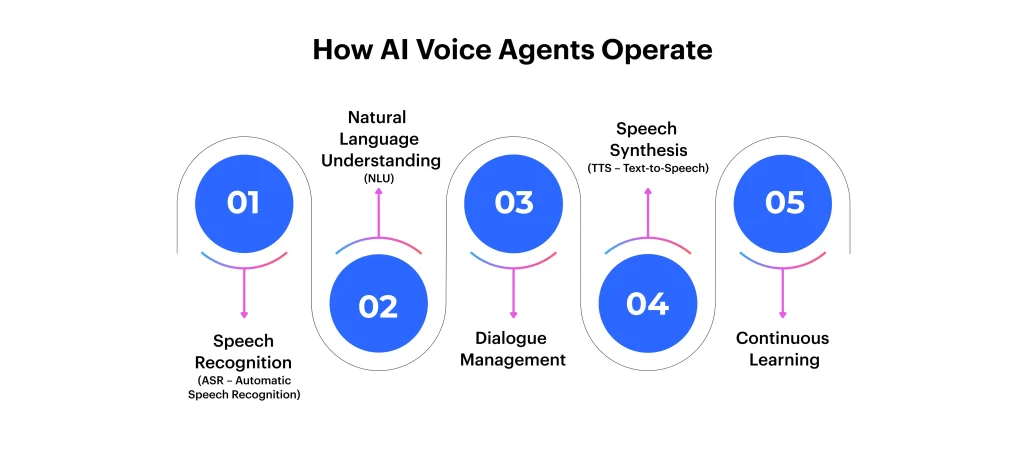
Behind each easy conversation with machines lies a powerful blend of technologies that enable machines to understand, process, and respond like humans. AI voice agents function through a sophisticated pipeline of speech and language technologies that turn sound into meaning and meaning back into speech.
Whether built using an AI voice agent platform or through custom AI development services, the process involves several critical stages that work in harmony.
- Speech Recognition (ASR – Automatic Speech Recognition)
This first stage converts human speech into text using machine learning algorithms. It is powered by technologies such as DeepSpeech, Google Speech-to-Text, and Whisper for real-time accuracy.
- Natural Language Understanding (NLU)
Once the text is extracted, NLU interprets the intent, context, and sentiment behind the world. NLP models like BERT, GPT, or custom LLMs help to decode them effectively.
- Dialogue Management
This stage decides the most relevant response or action based on the detected intent using a decision-making framework or reinforcement learning systems.
- Speech Synthesis (TTS – Text-to-Speech)
Here, lastly, the AI converts its text-based response into natural human-like speech. Tools like Amazon Polly, Azure Speech, or ElevenLabs make it possible.
- Continuous Learning
Each interaction enhances the AI’s accuracy, tone, and contextual understanding, making conversations smarter over time.
Additional Read: Understanding the Types of AI Agents Shaping the Future
Key Use Cases and Applications of AI Voice Agents
AI voice agents are no longer limited to personal assistants; they have become essential tools across various industries, streamlining communication, improving efficiency, and enhancing user experiences. From customer service to smart devices, these intelligent systems are changing the way businesses and individuals interact with technology.
- Customer Support & Call Centers
AI Voice agents can function as an AI receptionist, giving 24/7 automated assistance, handling routine queries, and ticketing efficiently. It reduces human workload, improves response time, and gives consistent support. For example, airlines and banks use AI agents to manage FAQs and reservations easily.
- Healthcare Industry
In the healthcare sector, AI voice agents assist with appointment scheduling, patient reminders, and real-time medical transcription. The virtual nurse assistants help patients receive guidance without waiting, improve care, and operational efficiency.
- Retail & E-commerce
They enhance the shopping experience through product recommendations and order tracking via voice, allowing customers to interact naturally and receive personalized assistance during their purchase journey.
- Finance & Banking
Voice AI agents facilitate voice-activated transactions, fraud detection, and account management, making banking safer and more convenient for users.
- Smart Devices & IoT
Integrating with home assistants, vehicles, or industrial systems allows easy voice control and monitoring across devices.
- HR & Recruitment
AI voice agents help with pre-screening candidates and answering employee FAQs, streamline HR processes, and reduce administrative burden.
Why Are Businesses Adopting Voice AI Agents?
Businesses across industries are quickly embracing AI voice agents to stay competitive, improve customer interactions, and streamline operations. These intelligent systems are helping organizations deliver faster, smarter, and more personalized communication while optimizing costs and gaining actionable insights.
- Enhanced Customer Experience
Voice AI agents deliver natural, human-like interactions, making customer support more engaging and personalized. It leads to higher satisfaction and stronger brand loyalty.
- Cost Efficiency
By automating routine tasks and queries, businesses reduce dependency on large support teams, cutting operational costs without compromising service quality.
- Multilingual Reach
AI agents can communicate in multiple languages, enabling businesses to cater to global audiences and overcome language barriers easily.
- Real-Time Response
The instant voice responses improve service speed, making sure customers get help exactly when they need it.
- Data-Driven Insights
Interactions with AI voice agents generate valuable data, helping businesses to refine strategies and improve their overall operations.
Partnering with an AI agent development services provider can help implement these solutions effectively.
How to Implement AI Voice Agents in Business
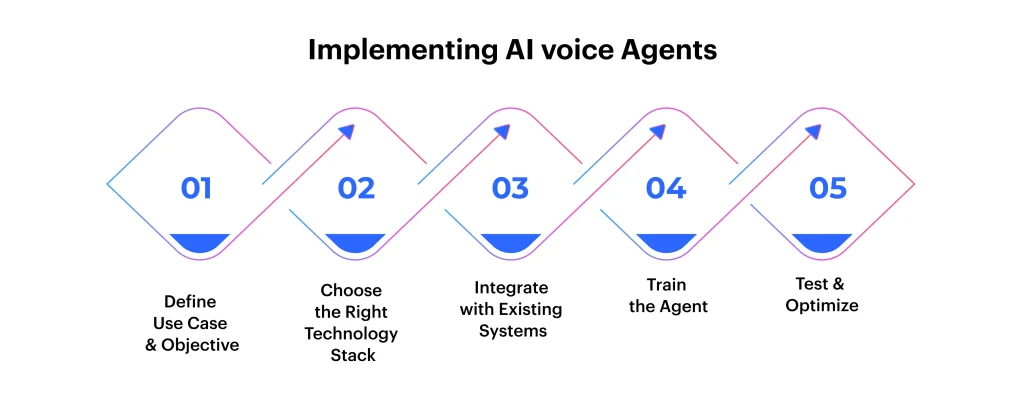
Adopting AI voice agents in business operations needs a structured approach that combines strategy, technology, and continuous optimization. The successful implementation makes sure that voice automation aligns with your organization’s goals while delivering a seamless user experience.
If you are wondering how to build a Voice AI agent, here is a step-by-step guide to help you get started effectively.
Step 1: Define Use Case & Objective
First, start by identifying areas where voice automation can make the most impact, be it customer support, lead generation, appointment scheduling, or internal communication. The clear objectives help in designing an AI solution that addresses the business-specific needs.
Step 2: Choose the Right Technology Stack
Select the correct tools for speech recognition, NLP, and voice synthesis. Use technologies like Google Speech to Text, Azure, or Whisper for recognition; Dialogflow, OpenAI, or Rasa for NLP; and Amazon Polly or even ElevnLabs for realistic voice output. The right tech stack ensures accuracy and natural conversation flow.
Step 3: Integrate with Existing Systems
For a smooth workflow, integrate your AI voice agent with existing systems like CRM, ERP, or telephony platforms. It helps to automate end-to-end processes and give unified customer insights.
Step 4: Train the Agent
Feed the agent with domain-specific data and sample conversations to improve contextual understanding. The proper training guarantees that the voice agent can handle real-world scenarios effectively.
Step 5: Test & Optimize
Continuously test performance in real-world conditions, monitoring factors like tone, latency, and user satisfaction. Optimize regularly to enhance the accuracy and engagement.
Businesses can also use AI voice agent services for business to design, train, and deploy scalable voice solutions that elevate customer experience and operational efficiency.
A Must-Read: How to Build an AI Agent: A Step-by-Step Guide
Key Benefits of Adopting AI Voice Agents
Implementing Voice AI agents gives businesses a competitive advantage by streamlining operations, improving customer experiences, and driving measurable business growth.
From round-the-clock availability to personalized engagement, these intelligent systems are changing how organizations communicate and serve their customers.
a. Operational Benefits
With 24/7 availability, businesses can give uninterrupted support across time zones. This system’s scalability during high demand ensures that it can easily handle multiple queries simultaneously, reducing call handling time and improving overall efficiency and productivity.
b. Customer Experience Benefits
AI voice agents enable human-like conversation, making interactions more natural and engaging. Its ability to deliver personalized interactions to enhance customer satisfaction, while faster resolutions give quick problem-solving without long wait times.
c. Business Benefits
The best AI voice agents help companies achieve lower operational costs by automating repetitive tasks. They also give better analytics from voice data, providing valuable insights and contributing to improved conversion rates through proactive, data-driven engagement.
Challenges and Limitations of Implementing AI Voice Agents
While AI voice agents are revolutionizing communication, they still face many challenges that limit their full potential. Understanding these limitations helps businesses plan better and ensure smoother adoption.
a. Understanding Accents & Dialects
AI systems mainly struggle to accurately interpret different accents or regional dialects, leading to miscommunication.
b. Privacy & Data Security
Handling sensitive voice data requires strict compliance with privacy laws and strong encryption measures to prevent breaches.
c. Emotional Intelligence Gap
AI agents may lack empathy or emotional awareness, making them less effective in sensitive conversations.
d. Integration Complexity
Connecting voice AI with current systems like CRM or ERP can be technically demanding.
e. Maintenance & Model Drift
Continuous updates and retraining are necessary to maintain accuracy as user behavior and language evolve.
The Future of AI Voice Agents
The future of communication is set to be more intuitive and human-like, with AI voice agents evolving beyond simple command-response systems. They will enable hyper-personalized communication, adapting to individual preferences and contexts, while emotionally intelligent agents will understand tone and sentiment to respond with empathy.
As technology advances, Voice AI agents will merge voice and vision integration, giving immersive experiences through avatars and virtual interfaces. Their multimodal and multilingual evolution will enable seamless interactions across devices and languages. However, enterprise-grade custom LLMs will empower organizations to build domain-specific agents tailored to their unique business needs, making future communication more natural, responsive, and intelligent than ever.
Related Read: What Are AI Agents? Types, Examples, and Their Growing Impact
Conclusion: Shaping the Voice-First Future
In today’s fast-evolving digital landscape, AI voice agents are redefining how humans and technology communicate, making the conversations faster, more personalized, and effortlessly natural. From customer support to automation and analytics, Voice AI is becoming the cornerstone of modern business communication.
To stay ahead in this voice-driven era, partnering with a trusted expert like Openxcell can make all the difference with our cutting-edge AI services, AI agent development services, custom AI voice agent solutions, and more. We help businesses transform the way they connect, engage, and grow.

FAQs on AI Voice Agents
1. What are AI voice agents?
AI voice agents are intelligent virtual assistants that understand, process, and respond to human speech using technologies like speech recognition, NLP, and text-to-speech. They are used across industries to automate tasks, improve customer interactions, and enhance operational efficiency.
2. How do AI voice agents benefit businesses?
They deliver 24/7 support, reduce operational costs, enable personalized interactions, and generate valuable insights from voice data. Businesses using AI voice agent services can improve customer satisfaction and streamline internal workflows.
3. What industries can use AI voice agents?
AI voice agents are widely used in customer support, healthcare, finance, retail, HR, and smart devices. They help automate routine tasks, schedule appointments, assist in transactions, and provide conversational commerce experiences.
4. How can I build a voice AI agent for my business?
How to build a voice AI agent involves defining the use case, selecting a technology stack, training the agent with domain-specific data, integrating it with existing systems, and continuously testing and optimizing performance.
5. What platforms are available for creating AI voice agents?
Many AI voice agent platforms like Dialogflow, Rasa, OpenAI, and Amazon Lex allow businesses to design, deploy, and manage intelligent voice assistants tailored to specific needs.

Manushi, a former literature student, now crafts content as a writer. Her style merges simple yet profound ideas. Intrigued by literature and technology, she strives to produce content that captivates and stimulates.