How AI Inventory Management Transforms Modern Supply Chains
 Last updated:December 4, 2025
 15 Min Read
- What Is AI Inventory Management?
- How AI Inventory Management Works
- 1: Collect Real-Time Data
- 2: Machine Learning Models Analyze Patterns
- 3: Predict Demand with 90–95% Accuracy
- 4: Trigger Automated Replenishment
- 5: Monitor Warehouses Using Computer Vision
- 6: Continuously Optimize Using Real-Time Feedback
- Technologies Behind AI Inventory Management
- Technology Breakdown
- Top Benefits of AI-Powered Inventory Management
- 1. Demand forecasting accuracy increases by 25–50%
- 2. 30–35% reduction in inventory carrying costs
- 3. Up to 80% fewer stockouts
- 4. 20–40% reduction in expired or excess inventory
- 5. 60–80% automation of manual processes
- 6. Better warehouse accuracy using computer vision
- 7. Higher revenue from fewer lost sales
- 8. Accurate replenishment planning
- 9. Improved supply chain visibility
- 10. Faster decision-making with AI dashboards
- AI Inventory Management vs Traditional Systems
- AI Inventory Management Use Cases by Industry
- Retail
- eCommerce
- Manufacturing
- Healthcare & Pharma
- Food & Beverage
- Logistics & Warehousing
- Real-World Success Stories: AI Inventory Management in Action
- How Enterprises Implement AI Inventory Systems
- Step 1: Inventory Auditing & Data Discovery
- Step 2: AI Model Selection
- Step 3: Integrations with ERP, POS & WMS
- Step 4: Dashboard & Automation Setup
- Step 5: Deployment
- Step 6: Optimization
- Challenges & How AI Solves Them
- Future Trends: What AI Inventory Management Will Look Like by 2030
- Conclusion: Smarter Inventory, Smarter Business
- Frequently Asked Questions: AI Inventory Management


TLDR
Your stockroom can now think for itself. Funny, right? Let me explain to you.
AI watches every shelf, predicts what sells next, restocks before you run out, and eliminates costly guesswork. With 90–95% forecasting accuracy and automated replenishment, AI-powered inventory management cuts stockouts, reduces carrying costs, boosts revenue, and keeps your supply chain running like a self-driving engine. From retail to pharma, the future of inventory is smarter, real-time, and almost fully autonomous.
Managing inventory today is no longer about counting and refilling products; it is more about staying ahead of demand, reducing waste, and making sure each shelf is stocked with precision.
As businesses face rising costs, complex logistics, and unpredictable customer behaviour, traditional systems fall short.
This is where AI inventory management steps in, changing stock control from a reactive task into a predictive, automated, and highly efficient process.
Global stats showing the shift to AI inventory systems
- 44% of supply chain leaders have already adopted AI for inventory optimization (Gartner, 2024).
- AI reduces forecasting errors by 20–50%.
- Retail companies using AI cut stockouts by 30–50%.
- AI-driven warehouses improve operational efficiency by 25–40%.
In this blog, we’ll break down how AI works behind the scenes, the technologies powering it, its real-world benefits, and why enterprises are rapidly adopting it.
What Is AI Inventory Management?
AI inventory management utilizes artificial intelligence to predict, control, and automate stock-related decisions with greater accuracy than traditional systems. Instead of relying only on historical data or manual judgment, it uses real-time insights to ensure the right products are always available at the right time.
In simple terms, AI for inventory management works by collecting live data from sales, suppliers, the warehouse, and demand signals. The machine learning models easily analyze this information to forecast the future demand, identify potential stockouts, and optimize replenishment. The whole system can trigger automatic orders and detect issues before they can impact operations.
With support from modern AI development services, companies can implement solutions that continuously learn from patterns, reduce manual workload, and provide end-to-end visibility across the supply chain, making inventory faster, smarter, and more efficient.
How AI Inventory Management Works
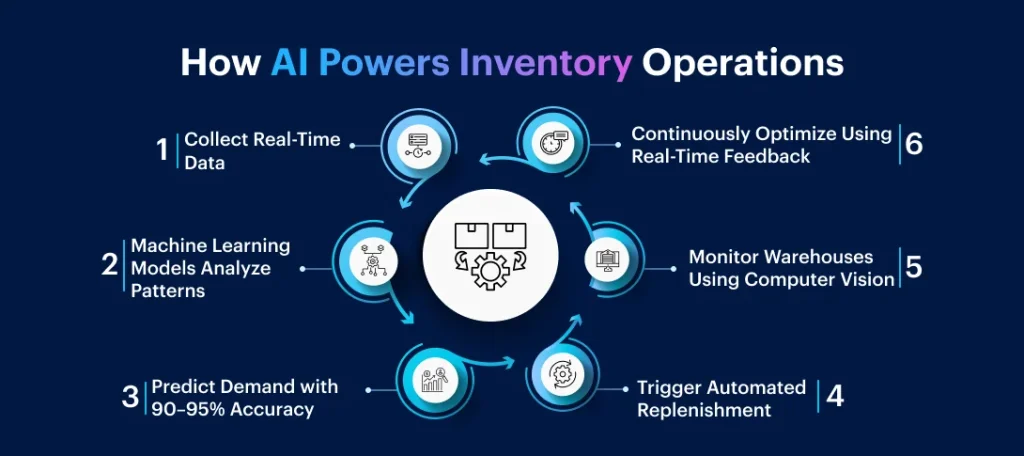
AI inventory management changes traditional stock control into a fully predictive and automated cycle. Instead of reacting to shortages or excess stock, businesses can implement a system that continuously senses demand, analyzes patterns, and adjusts inventory in real-time. To understand how AI is used in inventory management, here is a simplified breakdown of the core steps that power modern intelligent inventory systems.
1: Collect Real-Time Data
The process starts with gathering live data from POS systems, online sales, warehouses, sensors, supplier portals, and market trends. The real-time flow makes sure that inventory decisions are based on what’s happening now, not earlier weeks or days.
2: Machine Learning Models Analyze Patterns
Machine learning identifies buying trends, seasonality, regional demand variations, and supply chain bottlenecks. These insights help AI tools for inventory management understand why products move the way they do.
3: Predict Demand with 90–95% Accuracy
Using a mix of historical data and real-time signals, the system forecasts future demand with strong accuracy. These predictions prevent stockouts, reduce major inventory, and prepare businesses for sudden demand shifts.
4: Trigger Automated Replenishment
Once predictions are made, AI automatically generates purchase orders, adjusts reorder levels, and gives alerts to suppliers. The system ensures that the correct quantity is reordered at the right time, eliminating the need for manual intervention.
5: Monitor Warehouses Using Computer Vision
Cameras and computer vision continuously scan aisles, shelves, bins, and pallets. It can easily detect misplaced items, count stock, flag discrepancies, and update inventory levels in real time for error-free operations.
6: Continuously Optimize Using Real-Time Feedback
AI systems learn and improve with each sales event, stock movement, and supplier update. They refine forecasts, adjust replenishment logic, and suggest better warehouse workflows to maximize efficiency and reduce costs.
Through these steps, AI inventory management builds an intelligent ecosystem which runs with minimal manual input yet delivers maximum accuracy. From predicting demand to automating replenishment and monitoring stock through computer vision, AI gives enterprises complete control over the inventory landscape, faster, smarter, and more reliably than ever before.
Technologies Behind AI Inventory Management
An AI inventory management system is powered by a combination of advanced technologies that work together to automate workflows, predict demand, and give real-time visibility. These tools enable businesses to transition from reactive stock control to proactive, data-driven decision-making.
Here is a brief overview of the core technologies that enable a modern AI-driven inventory management setup.
| Technology | Role |
| Machine Learning (ML) | Demand prediction, stock optimization |
| Predictive Analytics | Forecasting future inventory needs |
| Computer Vision | Automated warehouse counting, shelf recognition |
| IoT Sensors | Real-time tracking of goods |
| Large Language Models (LLMs) | Conversational reporting, natural-language inventory queries |
| RPA | Automated order processing |
| Digital Twins | Simulate inventory flows |
| Reinforcement Learning | Dynamic price & stock optimization |
Technology Breakdown
- Machine Learning: Learns from patterns to optimize demand planning and reduce stock errors.
- Predictive Analytics: Uses historical and external data to estimate future inventory needs.
- Computer Vision: Scans shelves and warehouses to update stock counts automatically.
- IoT Sensors: Tracks the movement and condition of goods in real time.
- LLMs: Enable teams to ask natural language queries and generate instant inventory insights.
- RPA: Automates purchase orders, approvals, and routine stock processes.
- Digital Twins: Create virtual models to test and optimize inventory strategies.
- Reinforcement Learning: Continuously adjusts pricing and stock rules for maximum efficiency.
Together, these AI solutions create a smart, connected inventory ecosystem built for accuracy and speed.
Additional Read: AI in Supply Chain Management: Transforming the Industry
Top Benefits of AI-Powered Inventory Management
Modern businesses need smarter, faster, and more predictive ways to manage stock, and it is exactly what AI inventory management delivers. By combining automation, data intelligence, and real-time monitoring, companies can eliminate inefficiencies that have long plagued traditional systems.
Whether a business can handle thousands of SKUs or run multinational warehouses, the advantages are transformative. Here is a detailed look at the core benefits of inventory management with AI and why global enterprises are rapidly adopting it.
1. Demand forecasting accuracy increases by 25–50%
AI easily learns from historical patterns, seasonality, and promotions, and considers external factors to generate highly accurate forecasts. This helps businesses plan inventory more precisely and avoid costly errors.
2. 30–35% reduction in inventory carrying costs
By predicting exact demand and optimizing stock levels, AI can majorly reduce the excess inventory. The businesses spent less on storage, overheads, and insurance, boosting operational profitability.
3. Up to 80% fewer stockouts
AI for inventory management makes sure that products are replenished at the perfect time, reduces missed sales, and gives real-time alerts with predictive reordering to prevent unexpected shortages.
4. 20–40% reduction in expired or excess inventory
AI amazingly identifies slow-moving, expiring, or obsolete items before they become a financial burden. It leads to better rotation and reduces a lot of wastage.
5. 60–80% automation of manual processes
The routine tasks like stock counting, order creation, and report generation become automated. The teams can shift their focus to higher-value tasks instead of repetitive inventory jobs.
6. Better warehouse accuracy using computer vision
Computer vision monitors shelves, pallets, and bins with near-perfect precision. It also detects misplaced items, mismatched SKUs, and discrepancies far faster than manual checks.
7. Higher revenue from fewer lost sales
When customers always find the items available, the business experiences higher conversion rates and strong customer satisfaction, reducing stockouts and directly increasing revenue.
8. Accurate replenishment planning
AI determines the ideal reorder points and order quantities based on real-time data. This consistency ensures smooth operations and prevents the need for emergency procurement.
9. Improved supply chain visibility
AI integrates demand, supply, warehouses, suppliers, and sales channels into a single, unified view. Businesses gain live insights into stock movements, delays, shortages, and risks.
10. Faster decision-making with AI dashboards
Interactive dashboards turn complex data into actionable insights. Managers can instantly identify areas that require attention, such as demand spikes, low stock, or delayed shipments, without manual investigation.
By combining automation, analytics, and predictive intelligence, these benefits show why enterprises are rapidly changing their operations. With the support of a custom software development company, businesses can implement AI-driven solutions to tailor workflows, resulting in long-term efficiency, scalability, and smarter decision-making across their supply chain.
AI Inventory Management vs Traditional Systems
Traditional inventory systems mainly rely heavily on manual processes and historical records, mainly leaving businesses vulnerable to stockouts, overstocking, and delayed decision-making.
In contrast, AI inventory management uses advanced algorithms, real-time data, and predictive analytics to optimize every aspect of stock control. Here is a detailed comparison:
| Feature | Traditional | AI-Powered |
| Forecasting | Historical data only | Multivariable + ML + external data |
| Error Handling | High | Very low |
| Replenishment | Manual | Automated |
| Visibility | Limited | Real-time |
| Scalability | Low | High |
| Efficiency | 50–60% | 85–95% |
| Insights | Static | Predictive |
- Forecasting: Traditional systems typically rely on historical data, often missing trends or sudden demand shifts. AI-powered systems combine multivariable data, external signals, and machine learning to accurately predict future needs.
- Error Handling: The manual calculation in traditional systems results in high error rates. The AI in inventory management minimizes mistakes through automation and real-time validation.
- Replenishment: Traditional replenishment is reactive and manual. AI automates orders, ensuring stock is replenished proactively.
- Visibility: Legacy systems give limited insights into stock levels and movement. Where the AI systems offer real-time tracking across warehouses, channels, and suppliers.
- Scalability: Traditional methods struggle to scale with the increasing number of SKUs or locations. AI-powered solutions adapt easily to expanding operations.
- Efficiency: Manual processes achieve 50 to 60% efficiency at best. The AI optimizes workflows, achieving 85 to 95% operational efficiency.
- Insights: Mostly traditional systems produce static reports. AI system delivers predictive insights, enabling smarter, data-driven decisions.
This whole comparison highlights why companies are rapidly transitioning from conventional methods to AI-driven solutions, unlocking accuracy, efficiency, and predictive power across their supply chains.
AI Inventory Management Use Cases by Industry
Each different industries rely on inventory in unique ways, but the goal is always the same: To have the right product, in the right place, and at the right time.
AI for inventory management adapts to each sector’s challenges with predictive analytics, automation, and real-time visibility. Here are the ways various industries benefit from AI in inventory management.
Retail
AI helps retailers to prevent stockouts, optimize shelf replenishment, and predict seasonal or regional demand shifts. It ensures the high-demand item stays available while reducing slow-moving inventory.
eCommerce
Online businesses utilize AI to forecast demand across multiple channels, automate fulfillment, and manage inventory. AI also helps reduce return-related stock issues and improve delivery accuracy.
Manufacturing
AI tracks raw materials, predicts production needs, and prevents line stoppages caused by inventory shortages. It effectively synchronizes supplier lead times with production schedules to ensure smooth manufacturing flows.
Healthcare & Pharma
AI ensures that life-saving medical supplies, drugs, and equipment are always in stock. It also reduces wastage by tracking expiry dates and managing temperature-sensitive inventory with precision.
Food & Beverage
AI amazingly predicts the demand for perishable goods, minimizes spoilage, and automates batch rotation. It also enhances compliance by continuously monitoring freshness and safety standards in real time.
Logistics & Warehousing
AI optimizes storage layouts, automates picking routes, and provides real-time visibility into inventory across multiple distribution centers. It enhances accuracy and speeds up the order fulfillment process.
A Must Read: AI In Logistics: Shaping The Future Of Supply Chain Management
Real-World Success Stories: AI Inventory Management in Action
Here are a few standout examples showing how leading companies, and even Openxcell, apply AI to transform inventory control.
Amazon
Amazon uses AI to analyze billions of data points and forecast demand across its massive catalog, enabling hyper-accurate stock predictions and dynamic warehouse slotting.
Walmart
Walmart leverages predictive analytics and machine-learning models to fine-tune inventory levels across thousands of stores, reducing stockouts and overstocking and improving supply-chain efficiency.
ZARA
ZARA employs AI-based demand sensing to track sales data and fashion trends in real time, allowing it to quickly allocate inventory, minimize unsold stock, and ensure popular designs remain available in stores.
Openxcell’s Own Use Case Example
Openxcell’s portfolio shows how custom AI solutions power intelligent retail and eCommerce operations. Through predictive analytics, stock level optimization, and real-time inventory tracking, Openxcell helps in automating replenishment and synchronizing stock across channels, enabling more reliable product availability, fewer manual errors, and improving operational efficiency.
These real-world examples demonstrate how AI tools for inventory management enable companies to transition from reactive stock control to predictive, data-driven supply chains, thereby reducing costs, minimizing waste, and maintaining customer satisfaction.
How Enterprises Implement AI Inventory Systems
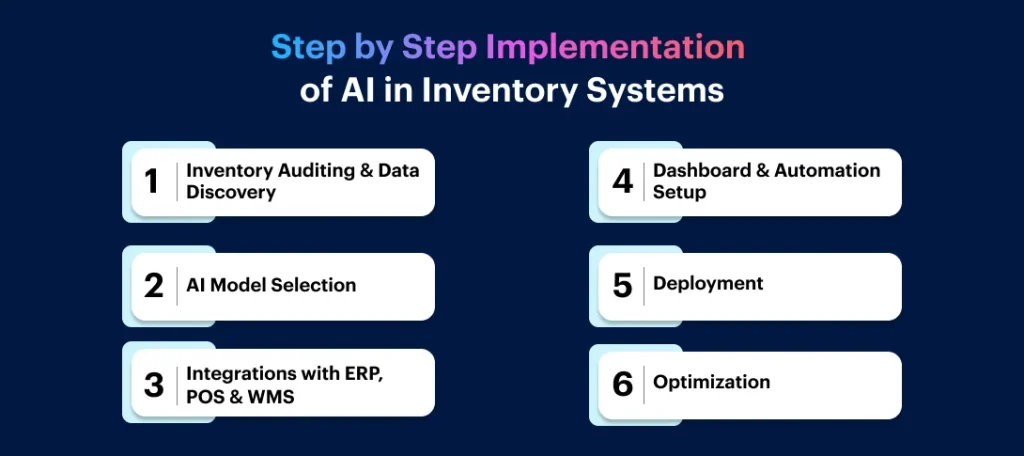
Implementing AI inventory management in an established enterprise ecosystem is not just a tech upgrade; it is a complete transformation of how stock, demand, and operations are handled. This process combines strategy, data intelligence, and automation to build a system that consistently optimizes itself.
Here is a clear, step-by-step view of how enterprises typically execute an AI-driven rollout.
Step 1: Inventory Auditing & Data Discovery
Enterprises first begin by assessing the current state of inventory, data quality, and operational workflows. The historical sales data, SKU movement, supplier timelines, and season trends are gathered. This step makes sure the AI system starts with clean, structured, and reliable data.
Step 2: AI Model Selection
The next step is for teams to choose the right algorithms for forecasting, anomaly detection, or replenishment optimization. Whether rule-based models or deep learning, the goal is to match the model of the organization’s SKU complexity, demand patterns, and automation needs.
Step 3: Integrations with ERP, POS & WMS
For AI-based inventory management to work in real time, easy connections across core systems are vital. Enterprises integrate their ERP, WMS, and Supply chain tools so AI can monitor stock movement live and make accurate predictions.
Step 4: Dashboard & Automation Setup
A unified dashboard is built to visualize stock levels, demand forecasts, supply delays, and send alerts. Enterprises also configure automation scenarios, such as supplier notifications, auto-replenishment, or stock redistribution, depending on the defined threshold.
Step 5: Deployment
After testing in controlled environments or pilot stores, the AI system is rolled out across all regions or warehouses. The teams validate predictions, track accuracy, and make sure the system aligns with on-ground operations.
Step 6: Optimization
AI models change continuously, and enterprises refine them by feeding new sales data, adjusting parameters, and improving automation flows. This creates a self-learning system that becomes more accurate month after month.
With a structured implementation approach and reliable retail software development support, enterprises can build scalable inventory systems that reduce stockouts, eliminate dead stock, and unlock long-term operational efficiency.
Challenges & How AI Solves Them
Managing inventory comes with many big challenges, from unpredictable demand to operational inefficiencies. AI tools for inventory management help businesses tackle these problems by giving predictive insights, automation, and real-time monitoring.
| Challenge | AI Solution |
| Unpredictable demand | ML forecasting |
| Human errors | Automation |
| Overstocking | Optimization models |
| Delayed replenishment | Predictive ordering |
| Poor warehouse visibility | Computer vision |
| Wastage | Expiry prediction |
- Unpredictable demand: Machine learning easily predicts the demand patterns to minimize surprises.
- Human errors: Repetitive tasks, such as stock counting and order creation, are automated, thereby reducing the likelihood of mistakes.
- Overstocking: AI calculates optimal stock levels to prevent excess inventory.
- Delayed replenishment: AI anticipates needs and triggers timely restocking to prevent shortages from occurring.
- Poor warehouse visibility: Cameras and sensors monitor stock placement to ensure accurate records.
- Wastage: AI tracks product shelf life to prevent spoilage and reduce losses.
By addressing these core challenges, AI transforms inventory from a reactive, error-prone process into a proactive, efficient, and cost-effective system.
Future Trends: What AI Inventory Management Will Look Like by 2030
The future of AI inventory management promises a fully autonomous, hyper-efficient supply chain. The warehouses operate with zero-touch automation, where AI and robotics work comfortably together to move, sort, and restock products without human intervention.
Real-time consumer behavior forecasting will allow businesses to anticipate demand before it happens, while AI-driven supply chain twins simulate entire operations for smarter decision-making. Even autonomous inventory drones will monitor stock levels, conduct inspections, and deliver items across facilities.
By 2030, AI for inventory management will not only optimize the process but also change how inventory is tracked, predicted, and replenished, creating faster, smarter, and nearly self-operating supply chains.
Conclusion: Smarter Inventory, Smarter Business
AI in inventory management is changing how companies can forecast demand, automate replenishment, and optimize stock across different industries. This helps them in reducing stockouts and overstocking by enabling real-time visibility and predictive insights. AI empowers enterprises to work faster, more effectively, and with better accuracy.
Case studies from Amazon, Walmart, and ZARA, as well as innovative solutions by Openxcell, demonstrate the tangible benefits of integrating AI into inventory workflows.
At Openxcell, we specialize in AI-powered eCommerce and retail solutions, helping businesses automate inventory, improve order accuracy, and get end-to-end visibility. With expertise in logistics software development, our AI solutions streamline operations, reduce costs, and enhance customer satisfaction, enabling companies to build smarter, data-driven supply chains that are ready for the future.
Frequently Asked Questions: AI Inventory Management
1. What is AI inventory management?
AI inventory management uses artificial intelligence to predict demand, automate replenishment, and optimize stock levels, improving efficiency and reducing errors.
2. What are the benefits of AI inventory management?
It increases forecasting accuracy, reduces stockouts and excess inventory, automates manual processes, and provides real-time visibility into the supply chain.
3. How much does AI inventory management cost?
Costs vary based on business size, complexity, and the technology stack. Many enterprises begin with scalable solutions that expand to meet their inventory needs.
4. Can AI integrate with existing ERP or POS systems?
Yes. Modern AI tools for inventory management seamlessly connect with ERP, POS, and warehouse systems to provide real-time insights and automated workflows.
5. Which industries benefit the most from AI inventory management?
Retail, eCommerce, manufacturing, healthcare, food & beverage, and logistics see the most impact, as AI helps optimize stock, reduce wastage, and improve fulfillment.
6. How is AI used in inventory management?
AI is applied for demand forecasting, automated replenishment, predictive analytics, warehouse monitoring, and process optimization, enabling smarter decision-making.

Manushi, a former literature student, now crafts content as a writer. Her style merges simple yet profound ideas. Intrigued by literature and technology, she strives to produce content that captivates and stimulates.