Will AI Replace Software Engineers? The Truth Behind AI and the Future of Coding
 Last updated:February 5, 2026
 10 Min Read
- Current Capabilities of AI in Software Engineering
- What AI Cannot Replace in Software Engineering
- A. Complex System Design
- B. Creative Problem Solving
- C. Accountability, Ethics & Decision Making
- D. Collaboration and Communication
- The Shift: From “Code Writers” to “Problem Solvers”
- New Opportunities AI Is Creating for Engineers
- 1. AI-Augmented Developers
- 2. New Engineering Roles
- 3. Higher Focus on Product Thinking
- Skills That Will Remain in High Demand
- Common Misconceptions About AI Replacing Jobs
- Misconception 1: AI Writes Perfect Code
- Misconception 2: AI Eliminates Software Jobs
- Misconception 3: AI Makes Engineers Obsolete
- The Bigger Picture: Every Tech Shift Feels Like This
- The Future of Coding: Collaboration, Not Competition
- Frequently Asked Questions (FAQs)


TLDR: The "Fact vs Fiction"
- The Myth: AI is coming for your IDE.
- The Reality: AI is a powerful tool, not a replacement.
- The Verdict: While it’s true that automation is eating the “boilerplate” parts of the job, the need for human intuition and ethical oversight is at an all-time high.
Read and learn why the fear that will AI replace software engineers is misunderstood and how you can stay unreplaceable in a world of autonomous code.
In 2026, the tech world stands at a historic crossroads. As autonomous agents move beyond simple code completion to manage entire feature names, many wonder: Will software engineers be replaced by AI? The traditional image of a developer hunched over a keyboard, manually typing every semicolon, is indeed fading. However, this is not that type of blog, but more informative on radical transformation.
Let’s start with today’s AI software development, which has matured into a collaborative ecosystem where human intuition directs machine execution. While AI handles the heavy lifting of boilerplate and debugging, the role of engineers has been elevated to that of high-level architecture. We aren’t just writing code anymore; we are orchestrating intelligence to solve business problems faster and more securely than ever before.
Current Capabilities of AI in Software Engineering
AI has changed from a support tool into a powerful accelerator for modern engineering teams. It has growing capabilities to fuel conversations around AI replacing software engineers, but the reality is more about efficiency gains than outright replacement.
- AI Can Write Code—Fast
AI tools easily generate functions, APIs, and boilerplate code in seconds, significantly reducing development time for repetitive tasks.
- Non-Developers Can “Code”
With a low-code platform and AI assistance, even non-technical users can build prototypes and MVPs without deep programming knowledge.
- Intelligent Debugging & Testing
AI amazingly helps to detect bugs, suggest fixes, and auto-generate test cases, making the QA cycle faster and more reliable.
- Documentation Automation
AI can easily summarize codebases and create documentation, improving maintainability and onboarding speed.
- DevOps & Deployment Automation
AI strongly optimizes CI/CD pipelines, monitors deployments, and predicts failure, enhancing system stability.
Headlines Love Drama
As there are headlines exaggerating disruption, experienced teams, mainly any custom software development company, use AI as a productivity tool and not as a replacement.
What AI Cannot Replace in Software Engineering
While the narrative of whether will AI replace software engineering dominates the news, there are core human faculties that algorithms simply cannot replicate. High-level software development is an art of trade-offs, and it needs a nuanced understanding of human needs and technical constraints.
A. Complex System Design
AI excels at functioning, but it lacks the human excellence of architecture. Designing is a distributed system that balances latency, cost, and scalability, requiring a high-level strategic vision that AI lacks.
B. Creative Problem Solving
AI can only remix the existing patterns, but when a “black swan” or, in simple words, complex events occur, like totally unique business challenges, only human engineers can innovate beyond the training data.
C. Accountability, Ethics & Decision Making
Algorithms cannot take any legal or moral responsibility, so deciding how to handle user data privacy or maintaining bias in AI output needs human judgment only and human ethical accountability.
D. Collaboration and Communication
Technical success depends on translating vague stakeholder requirements into reality. AI cannot navigate office environments; empathy and negotiation need to align a team toward a common goal.
The Shift: From “Code Writers” to “Problem Solvers”
AI isn’t eliminating engineering roles; it is redefining them. As intelligent tools take over the repetitive and time-consuming tasks, software engineers are moving beyond writing lines of code toward higher-level problem solving, which directly impacts business and user outcomes.
How the Software Engineer Role Is Evolving
| Old Role | New Role |
| Writing every line | Reviewing & refining AI output |
| Manual debugging | AI-assisted diagnostics |
| Pure coding | Strategic engineering thinking |
| Syntax-focused | System & product-focused |
The evaluation highlights why the question of whether will AI replace software engineers misses the bigger picture.
Modern engineers now spend more time validating AI-generated code, designing scalable architectures, and making informed technical decisions. Instead of focusing on syntax, they think in terms of system, performance, and product value.
AI-powered tools and Gen AI services act as accelerators, not substitutes, freeing engineers to apply critical thinking, creativity, and strategic insights. And as a whole, the result is a role that is more influential, more collaborative, and far more aligned with real-world problem solving than ever before.
New Opportunities AI Is Creating for Engineers
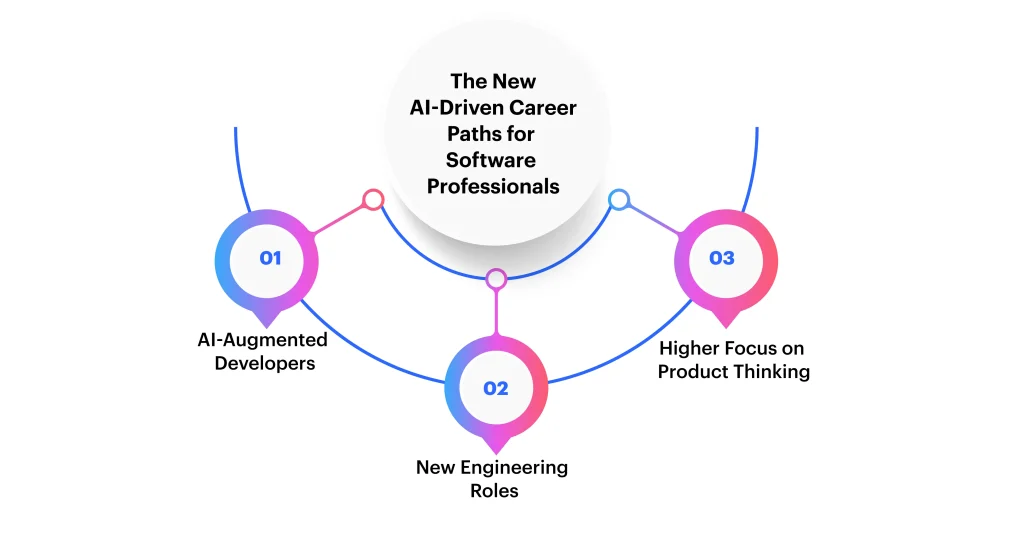
In 2026, the question is no longer whether will software engineers be replaced by AI, but how quickly they can pivot to new opportunities created in this tech explosion. Rather than shrinking the market, AI is acting as a catalyst for high-value, specialized services that didn’t exist a few years ago.
1. AI-Augmented Developers
The 10x developer is now a new reality, by using AI to handle syntax and boilerplate, a single engineer can now oversee complex end-to-end projects, which previously required a full team, significantly increasing their market value.
2. New Engineering Roles
The industry is seeing a surge in demand for AI integration specialists, LLM Ops Engineers, and AI security auditors. These professionals mainly focus on the orchestration, safety, and fine-tuning of models rather than just manual coding.
3. Higher Focus on Product Thinking
As the barrier to building drops, the value of thinking rises. Engineers are now moving into the roles that need a deep understanding of user experiences and business strategy, making sure that the software built actually solves real-world problems.
Is AI replacing software engineer roles? No, it’s promoting them to more creative, strategic, and impactful positions within the tech ecosystem.
Additional Read: 15 Best AI Tools for Developers in 2026 [Free and Paid]
Skills That Will Remain in High Demand
As AI reshapes the development workflows, the most valuable engineering skills are changing from execution to expertise. This evolution proves that the question of will software engineering be replaced by AI overlooks the skills that machines simply cannot replicate. The demand for high-level product engineering has never been higher for those with the right toolkit.
A. Abstract Thinking & Architecture Design
AI can generate components. But humans architect the ecosystem. Success in today’s world requires designing scalable, microservice-based architectures that balance performance with long-term maintainability.
B. AI Integration & Automation Knowledge
Mastering AI integration services is a core requirement in modern engineering. And the engineers must know how to connect LLMs to proprietary data via RAG and manage autonomous agentic workflows.
C. Soft Skills
Technology is ultimately a human service; it has the ability to negotiate with stakeholders, lead cross-functional teams, and translate vague business into technical specs and remain an exclusively human superpower.
D. Security & Compliance
As AI speeds up development, it also accelerates potential risks. Engineers are now the final line of defense, making sure that AI-generated code meets rigorous SOC-2, HIPAA, and data privacy standards.
Real-World Impact: We have applied human-led skills while developing the AI product JobTatkal. While GPT-4 handles the automated profile generation, our engineers’ architectural oversight was what truly drove the results, reducing the hiring time by 91% and ensuring he platform could scale securely for thousands of users.
Common Misconceptions About AI Replacing Jobs
As AI adoption accelerates, many assumptions about job loss are driven more by fear than by facts. This is what led to widespread confusion about will AI replace software engineers, when the reality is far more different and in-depth.
Misconception 1: AI Writes Perfect Code
The reality is that AI-generated code often suffers from repetition or insecure patterns. In fact, research shows that up to 40% of AI-suggested snippets contain vulnerabilities. That’s where a human engineer acts as the ultimately safety net, auditing logic to ensure it meets the enterprise-grade security and compliance standards.
Misconception 2: AI Eliminates Software Jobs
History and current data show that as the cost of code generation declines, demand for complex, high-quality software skyrockets. Rather than eliminating roles, AI is shifting the market toward a high-hiring phase for senior architects who can manage the increased output of AI-augmented teams.
Misconception 3: AI Makes Engineers Obsolete
AI is a powerful tool, not an autonomous agent; it excels at replication but fails at novel problem-solving and strategic decision-making. You aren’t being replaced by an algorithm, but you are being challenged to evolve into a high-level “Director of Systems” who orchestrates these tools for maximum impact.
The Bigger Picture: Every Tech Shift Feels Like This
Every major technological leap sparks fear before it creates progress, and AI is no different. The debate around AI replacing software engineers echoes the same concerns raised during the earlier shifts that ultimately strengthened, not eliminated, engineering roles.
History Repeats Itself:
- Compilers didn’t kill programmers; they ended the era of manual binary coding and allowed us to write in human-readable languages.
- Frameworks didn’t kill developers; they automated the repetitive “boilerplate” so we could focus on building unique, high-value features.
- Cloud didn’t kill infrastructure engineers; it transformed them into DevOps and SRE specialists who manage global systems at scale.
- AI is just the next tool; it is the ultimate “power-up” that shifts our focus from writing individual lines to orchestrating entire intelligent ecosystems. You can hire AI developers to make the idea a reality.
The Future of Coding: Collaboration, Not Competition
The debate over will software engineer be replace by AI hopefully ends in this blog. AI is a productivity multiplier and not a substitute for human ingenuity.
While it excels in automating the repetitive and mundane, it cannot replicate the strategic architecture, ethical judgment, and new way of problem-solving that define high-level engineering. The future belongs to those who view AI as a powerful co-pilot rather than a threat.
However, navigating this AI-driven world requires more than just a tool; it needs a proper partner with deep domain expertise and a vision for scalability.
At Openxcell, our veteran engineers blend years of architectural experience with cutting-edge AI orchestration to turn complex ideas into robust, secure, and market-ready products. Don’t just build for today, architect for the future with a team that knows how to lead the AI revolution.
Frequently Asked Questions (FAQs)
1. Will AI replace software engineers in the next few years?
While AI is fundamentally changing the workflow, the short answer is no. Will AI replace software engineers? Not in the sense of making them obsolete. Instead, it is replacing the manual aspects of the job. In 2026, engineers are evolving into high-level orchestrators who use AI to handle boilerplate code while they focus on system design, complex logic, and security.
2. Is AI replacing software engineers at the entry-level?
The market is shifting, and junior roles are becoming more demanding. Rather than AI replacing software engineers at the start of their careers, it is raising the bar. Entry-level developers are now expected to be “AI-native,” meaning they must know how to audit AI-generated code and integrate it into larger systems rather than just writing basic scripts.
3. How soon will software engineers be replaced by AI for simple tasks?
For routine tasks like writing unit tests, basic documentation, and CSS scaffolding, the transition has already happened. However, even for simple tasks, human oversight is required to prevent “hallucinations.” The fear that will software engineers be replaced by AI entirely ignores the fact that software still requires a human touch to align with specific, often shifting, business goals.
4. Will AI replace software engineering as a viable career path?
On the contrary, software engineering is becoming more critical than ever. As the cost of software development declines with AI, demand for more complex, personalized, and secure digital products increases. This creates a massive need for experienced engineers who can manage these sophisticated, AI-augmented development lifecycles.
5. What unique value do humans bring that AI cannot replicate?
AI lacks “Product Sense”, the ability to understand why a feature is being built for a specific user. It cannot navigate ethical dilemmas, take legal accountability for code failures, or creatively solve complex problems that aren’t in its training data. These remain the core reasons why humans stay at the center of the development process.

Manushi, a former literature student, now crafts content as a writer. Her style merges simple yet profound ideas. Intrigued by literature and technology, she strives to produce content that captivates and stimulates.