AI in Procurement: The Ultimate Guide to Smarter Sourcing
 Last updated:November 21, 2025
 16 Min Read
- What is AI in Procurement?
- Types of AI in Procurement
- Real-World Use Cases of AI in Procurement
- AI-based Spend Analysis for Cost Saving
- Invoice Data Extraction
- Error Detection
- Smart Supplier Performance Evaluation
- Virtual Assistants
- Intelligent Sourcing
- Streamlined Purchase Order Processing
- Predictive Analytics
- Supplier Risk Management
- Benefits of AI in Sourcing and Procurement
- Challenges of AI in Procurement
- How to Use AI in Procurement: Best Practices
- 1. Define Clear Goals and Objectives
- 2. Foster Cross-Functional Collaboration
- 3. Ensure High-Quality and Consistent Data and Volume
- 4. Start with a Small Pilot Project
- 5. Partner with the Right AI Solution Provider
- 6. Focus on Training and Change Management
- 7. Monitor, Evaluate, and Iterate AI Systems
- 8. Keep Check on Ethical and Security Concerns
- The Future of AI in Procurement
- Blockchain Technology
- Advanced Natural Language Processing
- Conversational AI
- AI-Powered Preventive Maintenance
- Full Process Automation
- Automated Value Creation
- Full Spend Transparency
- AI in Procurement: The Road Ahead


Procurement can often lead to inefficiencies, such as false forecasting, delayed processes, and supplier risks, ultimately inflating costs. Many organizations that still utilize traditional procurement are caught up in these and even find it hard to make decisions. How do you deal with this? Consider AI for procurement, a game-changing solution for all of your problems.
The value of artificial intelligence can’t be described enough. It works like an assistant that can analyze numerous amounts of data in seconds, provide invaluable insights, and even make strategic recommendations. It even has the power to learn and adapt its performance as needed.
Here are some statistics that indicate the demand for AI procurement.
- 96% of businesses leverage AI for the procurement process, and 58% believe AI helps with deeper insights and decision-making.
- As per Gartner, 50% of the procurement contract management will be AI-based by 2027.
For procurement professionals, business leaders, and companies, it’s high time to consider AI development services to optimize operations, improve accuracy, and unlock new levels of efficiency. Solutions focused on AI for business leaders are particularly valuable in procurement, helping streamline supplier selection, automate repetitive tasks, and enhance decision-making with predictive insights.
To clear all your doubts, we will explain what is procurement, its types, use cases, benefits, challenges, and best practices in detail here.
So, let’s dive right in.
What is AI in Procurement?
AI in procurement is the use of advanced technologies and algorithms to ensure machines or computer programs mimic human aspects and perform tasks with improved efficiency, speed, and accuracy.
AI systems can analyze, understand, reason, and solve complex problems in procurement daily. Organizations implementing AI often integrate these capabilities with existing procurement software to create a unified platform that combines traditional purchasing functions with intelligent automation. These include analyzing massive amounts of data, navigating dynamic market conditions, reducing risks, contact management, strategic sourcing, and optimizing supplier relationships.
The end goal of using AI in procurement is to streamline various aspects of the procurement process, further allowing organizations to make informed decisions, enhance resource allocation, and drive operational efficiency.
Types of AI in Procurement
When we talk about procurement, different forms of advanced technology get involved with AI. Organizations worldwide use these types of AI to manage sourcing, supplier partnerships, and the entire procurement process.
Machine Learning
Machine learning is a subset of AI that detects patterns in massive datasets and can help in decision-making.
These ML algorithms have the potential to identify patterns and relationships that are not possible with a simple human brain. This analysis is highly beneficial for the people involved in the procurement process, enabling them to make data-based decisions, improve supplier selection, and even make precise demand forecasting.
For instance, an ML model can examine historical purchasing data, supplier performance over the years, and market fluctuations and trends to predict future demand, eventually allowing organizations to set correct inventory levels and maintain proper stocks.
Robotic Process Automation (RPA)
Robotic process automation (RPA) algorithms are especially developed to mimic human actions to execute repetitive tasks. Although RPA is technically not categorized as AI, it is powered by it.
By combining RPA with ML and AI, businesses can build an autonomous procurement ecosystem that helps with supplier database updation or invoice processing without human help. It is even responsible for speeding up routine operations, thus enabling procurement teams to focus on strategic initiatives instead of administrative burdens.
Natural Language Processing
Natural Language Processing (NLP) is a branch of AI that enables machines to understand, analyze, and generate human language. It helps procurement teams extract valuable insights from textual data, including spoken language, improving decision-making and efficiency. NLP enhances contract management using AI and facilitates supplier communication through chatbots and virtual assistants. These AI-powered tools handle RFQs, negotiations, and queries, boosting responsiveness and reducing manual workload
NLP enhances contract management and facilitates supplier communication through chatbots and virtual assistants. These AI-powered tools handle RFQs, negotiations, and queries, boosting responsiveness and reducing manual workload. NLP automatically extracts relevant information from customer feedback, proposal results, and other documents, ensuring smarter, data-driven procurement strategies.
Also Read: NLP vs LLM: What Works Best for Your AI Strategy?
Real-World Use Cases of AI in Procurement
AI is responsible for changing how organizations operate across the world today. From cost savings to removing anomalies to risk management, AI-based solutions make procurement highly flexible, efficient, and strategic. Let’s look at some real-world AI in procurement examples.
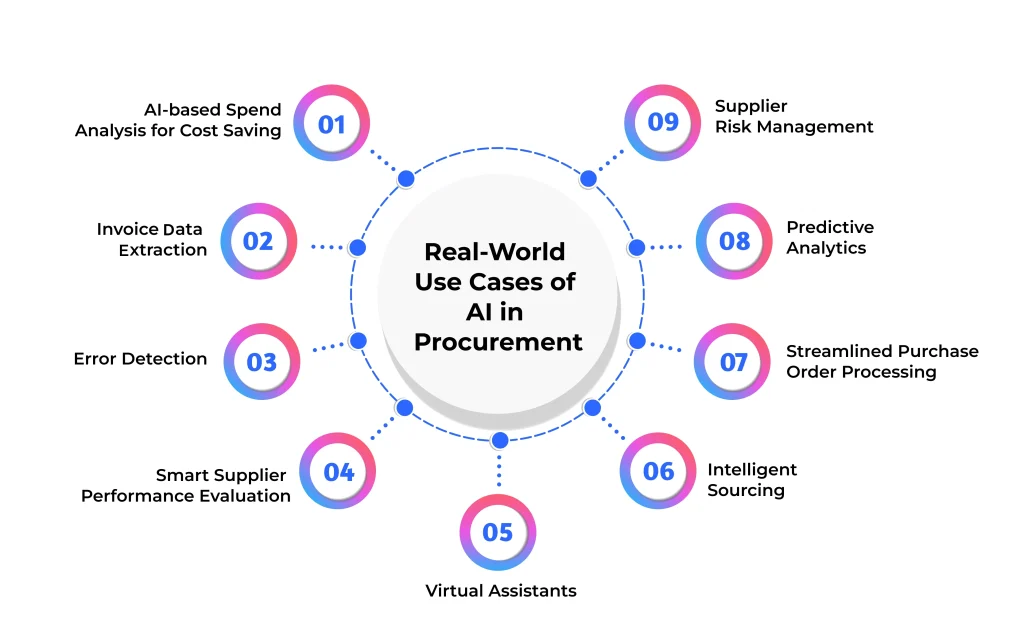
AI-based Spend Analysis for Cost Saving
Money saved is money earned—AI ensures the entire amount is used wisely. AI-based procurement teams analyze spending and supplier patterns to find hidden cost-saving opportunities. By knowing spending patterns, removing impulse buying, categorizing data, and simplifying contacts, procurement businesses can cut their costs by up to 20%.
Invoice Data Extraction
Eliminate manual invoice processing and frequent human errors. One crucial AI use case in procurement is allowing the account payable team to extract, validate, and categorize invoice data in seconds.
Using the OCR and machine learning, AI fetches relevant invoice details, decreases processing time, and provides more compliance. Many businesses also rely on structured formats like an invoice template pdf to maintain consistency, speed up payment cycles, improve cash flow management, and prevent manual invoice issues.
Error Detection
Procurement mistakes can cost a lot in the long run; however, AI acts here as a bodyguard and identifies any issues in advance to prevent workflow issues. AI systems analyze procurement data to determine fraud, pricing discrepancies, compliance irregularities, and other probable risks in the supply chain lifecycle. Modern data extraction techniques enable AI to pull relevant information from invoices, purchase orders, and supplier communications to build comprehensive risk profiles automatically.
By detecting all the anomalies ahead of time, AI systems provide businesses the freedom to reduce risks, improve compliance, and keep supplier’s trust intact.
Smart Supplier Performance Evaluation
Evaluating the supplier’s performance is vital throughout the procurement process. An AI system measures the supplier’s achievement based on historical data, on-time deliveries, quality standards, quality metrics, and compliance rates. This further allows procurement teams to evaluate performance regularly and build strong relationships with them.
Virtual Assistants
Generative AI-powered virtual assistants are responsible for turning procurement into a conversation-driven function. These virtual assistants can understand, interpret, and respond to RFQs(Request for Quotation), supplier queries, negotiations, and contract management without human help.
Imagine having a 24/7 assistant who doesn’t miss anything. This Gen-AI virtual assistant speeds up responses, improves supplier interactions, and enables the procurement team to focus more on strategic initiatives instead of admin tasks.
Intelligent Sourcing
Another crucial AI use case in procurement is smart supplier sourcing. Don’t choose a supplier based on the price but on the value it delivers. AI-powered sourcing tools can analyze supplier abilities, market trends, historical data, and contract terms to suggest the most optimal suppliers according to procurement needs and goals.
AI even simplifies the RFQs, bid evaluations, and contract negotiations, thus making the procurement teams more efficient and leading to better and stronger relationships with the supplier.
Organizations also manage RFPs alongside RFQs and bids. With generative AI, proposal teams can reuse approved content, auto-draft answers from knowledge bases, and orchestrate reviews to streamline RFP responses with AI, cutting turnaround times and reducing risk. Secure, permissioned content plus CRM and SSO integrations keep responses compliant while enabling collaboration with procurement, legal, and SMEs. In fact, many companies are now adopting AI RFP solutions to automate and optimize their entire request-for-proposal process, enabling faster, smarter, and more consistent sourcing decisions.
Streamlined Purchase Order Processing
Processing purchase orders manually requires a lot of time and effort, but this has become a thing of the past with AI. An AI-driven tool streamlines purchase order creation, tracking, and approval. This further helps to reduce cycle times and remove any bottlenecks. When combined with a purchase order management system, it makes it easy to automate workflows, track approvals, and maintain full visibility throughout the procurement process.
An AI-based system helps detect potential delays, pricing issues, or contract breaches, leading to simplified workflows without human assistance. For e-commerce businesses, especially those using Shopify, integrating Shopify purchase order apps can further automate and enhance the procurement process, making order management more efficient and error-free.
Predictive Analytics
Wouldn’t it be amazing if procurement teams could see the future? AI-powered predictive analytics makes this possible. AI analyzes a massive amount of historical data, such as past sales, market trends, and external factors (such as weather), to predict demand fluctuations, price changes, and more.
This amount of dynamic approach allows the business to free itself from any disruptions and make data-driven decisions.
Supplier Risk Management
Procurement is not just limited to cost; it even includes mitigating risks. AI systems constantly track various aspects of suppliers, such as financial stability, geopolitical issues, compliance violations, and other concerns. In simple words, AI provides early alerts about potential disruptions.
Benefits of AI in Sourcing and Procurement
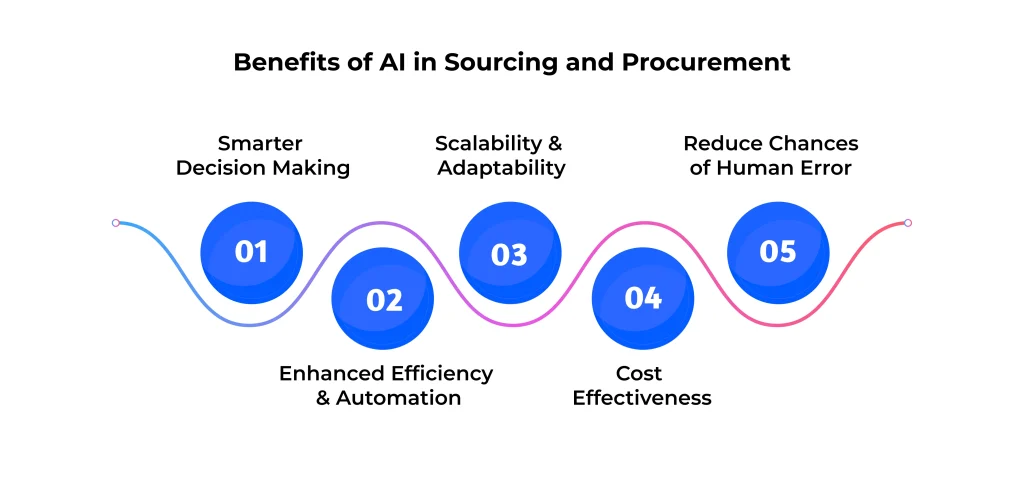
Here are some of the essential benefits of AI in sourcing and procurement.
Smarter Decision Making: AI utilizes some of the best algorithms and analytics to examine a massive amount of data without much hurdle. With a data-backed strategy, AI allows procurement teams to get valuable insights about supplier performance, spending patterns, and market fluctuations. This further allows them to choose the best suppliers, pricing, and contracts.
Enhanced Efficiency & Automation: Manual processing is time-consuming and slows business down. AI-based automation of repetitive tasks leads to higher productivity and faster cycles. By automating manual tasks, such as data entry, supplier selection, invoice processing, contract management, etc., procurement teams can invest time in strategic tasks and provide a better return on investment.
Scalability & Adaptability: Procurement is never static—it grows according to market conditions and demands. In general, AI models possess the ability to handle increasing supplier networks, varying demand, and sourcing challenges. Despite all of this, AI ensures that procurement operations evolve, regardless of business size.
Cost Effectiveness: AI helps to cut procurement costs without affecting the quality. By improving supplier selection, negotiating deals effectively, and forecasting demand, AI allows procurement teams to make considerable cost savings. In addition, AI helps with analyzing spending patterns, thus further leading to more savings for businesses.
Reduce Chances of Human Error: A small error in procurement can turn into a big problem. AI helps to automate repetitive tasks, such as closing supplier contracts, invoice processing, data validation, and compliance checks. This results in better accuracy, enhanced compliance, and simplified procurement workflow without human intervention.
Challenges of AI in Procurement
Even though AI provides amazing benefits, its implementation comes with some hurdles. Here are some of the most common roadblocks to implementing AI in Procurement, along with possible solutions.
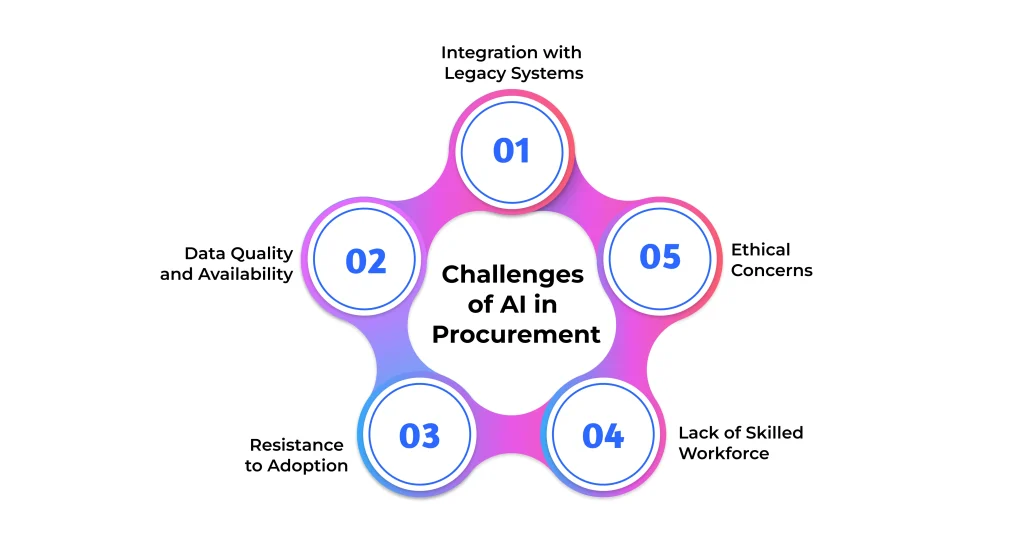
Integration with Legacy Systems: When Old meets new, there are high chances that things will not go as expected. Various procurement teams use outdated ERPs and supply chain systems, which leads to compatibility issues. For seamless integration with legacy systems, procurement teams need to make strategic planning, invest in custom APIs, and hire the best AI experts.
Data Quality and Availability: AI is only as good as the quality of the data it is extracted from. Here, procurement data is scattered across different sources. Hence, there can be incomplete, inconsistent, and outdated procurement data, which can result in improper insights and incorrect decision-making. Businesses need to verify that they are getting clean, structured, and instant data to utilize AI for procurement operations.
Resistance to Adoption: Change is difficult, particularly when automation replaces traditional systems. Procurement teams usually face the fear of job displacement or skepticism about AI-based systems. To address this, organizations should work towards change management, optimize culture, offer training, and showcase AI as a role enhancer, not a taker.
Lack of Skilled Workforce: AI in procurement isn’t ready to use instantly and requires a team of AI professionals. However, the shortage of AI-savvy experts, data science analysts, and automation experts poses a major hurdle. Organizations should consider bridging this gap by investing in AI training, upskilling programs, and collaborations with AI service providers.
Ethical Concerns: AI might be intelligent; however, it might always be partial. Biased algorithms, supplier data privacy, and accountability can cause serious issues in procurement. Organizations should deal with these issues to maintain honesty in the procurement process. They should consider adding thorough AI policies, ethical sourcing rules, and full transparency to address regulatory issues.
How to Use AI in Procurement: Best Practices
Implementing AI in procurement is similar to diving into uncharted waters. Therefore, it requires an effective strategy and precision. For a smooth transition, businesses should consider following the best practices listed below to enhance efficiency, adoption, and long-term success.
So, let’s dive right in!
1. Define Clear Goals and Objectives
AI it requires a predefined set of steps to obtain desired results. Begin by listing the problems in your current procurement system, setting measurable goals, and identifying the best strategies to achieve them.
Whether you’re looking to automate invoice processing, simplify supplier selection, optimize spend analysis, etc., defining the goal helps you craft a result-oriented strategy.
2. Foster Cross-Functional Collaboration
AI is not just useful as a procurement tool; it acts as an asset for the entire organization. It encourages collaboration from different stakeholders, such as procurement, IT finance, data, and more, for flawless integration, enhanced decision-making, and seamless AI adoption.
This cross-functional collaboration leads to innovation, alignment, and shared goals, and crafts a holistic approach to AI integration.
3. Ensure High-Quality and Consistent Data and Volume
AI works on the principle of “Garbage In, Garbage Out.” Therefore, you should ensure that data is clean, high-quality, consistent, and extensive before feeding into the AI models. Address any data issues instantly because better data quality will lead to accurate and highly insightful AI-based procurement decisions.
4. Start with a Small Pilot Project
Directly working on a big project can be risky and increase the chances of failure. Instead, it’s always better to start with a small pilot project to target some pain points. By focusing on a single crucial procurement function, such as invoice processing or supplier evaluation, businesses can test, evaluate, and optimize the processes before final deployment.
5. Partner with the Right AI Solution Provider
Choosing the right AI development services provider is the most crucial thing for procurement. Therefore, consider going for an AI solution provider with higher industry expertise, better customer support, and a robust AI team. An expert AI provider helps you with better AI implementation, integration, and long-term success in AI-based procurement.
6. Focus on Training and Change Management
AI adoption is not limited to technology but also involves people. Procurement professionals should be trained to use AI tools and technologies well. Various workshops, hands-on training, and support should be provided to employees to foster a culture of AI change and innovation.
7. Monitor, Evaluate, and Iterate AI Systems
AI procurement implementation doesn’t work according to the “Set it, Forget it” approach. Businesses need to continuously collect user feedback and evaluate outcomes, considering the key performance metrics. This further allows them to optimize the AI models according to real-world usage. Lastly, it is required to evaluate AI regularly to achieve desired procurement goals.
8. Keep Check on Ethical and Security Concerns
“With great power comes great responsibility.” This proverb applies to AI too. Businesses need to focus on reducing biases, monitoring AI models for transparency and accuracy, and implementing stricter policies and rules to protect data.
By following a well-planned approach, companies can transform the procurement process, improve operational efficiency and performance, and ensure that AI models comply with global procurement regulations.
The Future of AI in Procurement
With the introduction of new technologies and tools, the future of AI in procurement looks absolutely bright. Here are some advanced technologies that can be used in AI procurement.
Blockchain Technology
AI in blockchain promises protected contracts, secure & transparent transactions, and real-time supplier verification, thus eliminating fraud and improving trust & transparency in procurement. Smart contracts backed up by AI are responsible for automating the agreement process, while blockchain ensures to maintain stability and seamless data sharing across the supply chains.
Advanced Natural Language Processing
Advanced NLP will transform the entire communication process in procurement. How? This will enable machines to dissect complex contracts, analyze supplier emails, and fetch all the relevant information from legal documents with very little human effort. By considering the advancements in NLP, procurement teams communicate with AI like seasoned strategists.
Conversational AI
No need to wait to reply to emails. AI will change completely how the procurement experts communicate with the systems. Virtual assistants and AI-powered chatbots can now handle negotiations, process RFQs, and respond to any issues in real-time, thus making communication flawless and accessible 24*7. In addition, this ensures that the team
can now focus on strategic tasks and maintain constant communication with suppliers and internal stakeholders.
AI-Powered Preventive Maintenance
Want to fix problems before they occur? AI can now do this. It inspects equipment potential and supplier authenticity to predict failures, ensure preventive maintenance, reduce downtime, and achieve cost savings. Ultimately, this leads to flawless operations and uninterrupted supply chain activities.
Full Process Automation
As the same suggests, full process automation will completely remove human involvement from the entire procurement, such as the process, approvals, compliance, and reporting.
By streamlining the operations, procurement teams will shift their focus from manual tasks to strategic decision-making.
Automated Value Creation
Automated value creation utilizes AI to determine cost-saving opportunities and even find value-generation opportunities, such as sourcing strategic alternative suppliers and enhancing supplier relationships without human input. This dynamic approach helps reduce risks and improve overall performance.
Full Spend Transparency
Full-spend transparency will encourage businesses to obtain insights about spending patterns, showcasing cost leakages, fraud risks, and even inefficiencies. By using AI analytics, procurement teams can make effective decisions, negotiate well, and even comply with the available resources.
AI in Procurement: The Road Ahead
As of now, we have looked at the transformative power of AI in procurement, along with its diverse applications, benefits, challenges, and future trends. From predictive analytics to smart decision-making to operational efficiency, AI empowers teams to make effective decisions regarding sourcing, supplier management, and cost efficiency.
Businesses should adopt AI-based solutions to survive and thrive in AI. Partnering with Openxcell can help. We provide best-in-class generative AI development services for startups and enterprises. Our AI experts use innovative tools and technologies to provide solutions according to your business needs.

Girish is an engineer at heart and a wordsmith by craft. He believes in the power of well-crafted content that educates, inspires, and empowers action. With his innate passion for technology, he loves simplifying complex concepts into digestible pieces, making the digital world accessible to everyone.