AI Governance: Building Trust, Compliance, and Innovation
 Last updated:July 31, 2025
 10 Min Read
- Understanding AI Governance: What It Is and Why It’s Essential Today
- Key Pillars That Strengthen AI Governance
- Ethical Foundations
- Risk Management
- Accountability & Ownership
- Compliance & Regulation
- The AI Governance Lifecycle: From Planning to Progress
- 1. Strategy & Policy Development
- 2. Implementation & Tooling
- 3. Monitoring & Auditing
- 4. Measurement & Continuous Improvement
- Best Practices & Real-World Examples in AI Governance
- 1. IBM’s Multi-Layered Governance
- 2. Informatica’s Data-Centric Approach
- 3. ServiceNow’s Governance Workspace
- 4. Diligent’s Safe-to-Fail Pilots
- Driving Business Success with Responsible AI Governance
- Navigating Challenges and Trends in AI Governance
- Conclusion: Shaping a Responsible AI Future
- FAQs on AI Governance


In this day and age, AI is changing the way we live and work; it is immensely involved in everything we do, from doing projects to studying to office work, etc. But as AI grows, the concerns over its ethical use also grow, and the demand for transparency and accountability is also growing louder.
A recent IBM study reveals that 85% of global executives believe trustworthy AI is important, but only 25% say their organizations have AI governance to support it. So, as AI is now influencing important decisions in fields such as finance, security, healthcare, etc, the absence of oversight can lead to reputational risks and biased outcomes. To help that here comes – AI Governance.
Confused with this new term, let us explain simply:
AI governance is a structured approach to ensure that AI systems are transparent, fair, and aligned with human values. For companies offering AI development services, implementing governance frameworks is no longer optional; it is a strategic imperative for sustainable innovation and compliance.
Understanding AI Governance: What It Is and Why It’s Essential Today
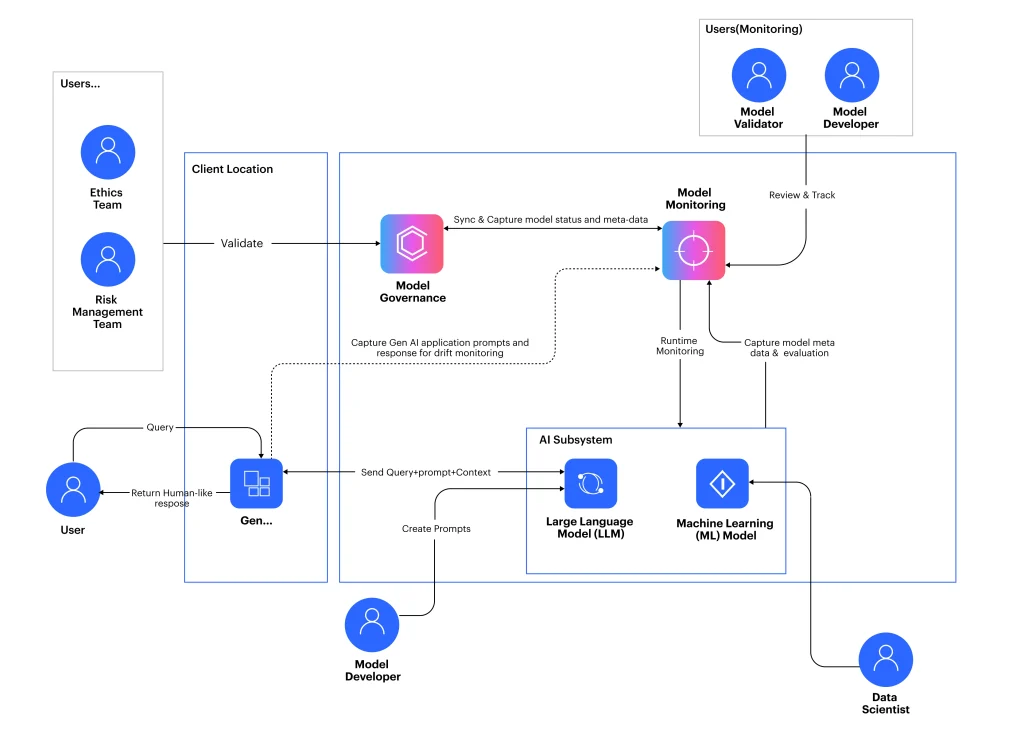
AI governance refers to a set of policies, frameworks, and practices that guide how artificial intelligence is made to be monitored and used ethically. It makes sure that AI is built responsibly, to keep the system safe, ethical, transparent, and unbiased.
Artificial intelligence governance helps businesses define who is accountable for AI decisions, how data is managed, and how potential risks can be prevented. It involves keeping track of AI systems in use, making sure they meet legal, ethical, and business standards throughout their lifecycle.
Why it matters now
As AI becomes more powerful and widely adopted by everyone, its potential impact on both good and bad is also growing fast. From automating business processes to influencing hiring or loan decisions, AI systems are shaping real lives and outcomes. Without proper oversight, it can unintentionally cause harm, reinforce discrimination, or operate in different ways that are difficult to explain or control.
That’s why artificial intelligence governance is more important than ever. It builds trust, reduces risk, and helps businesses stay ahead of evolving regulations. It ensures AI systems deliver long-term value while aligning with societal norms and human rights. In short, AI governance is the foundation for safe, responsible, and future-ready AI innovation.
Also Understand – LLM Security: Protecting AI Models from Attacks & Data Leaks
To truly implement responsible AI security, it is important to understand the foundational elements of an effective governance framework. So, let’s explore the core pillar of AI governance.
Key Pillars That Strengthen AI Governance
To fully grasp AI’s responsibility and benefits, it needs to build on strong key foundations or principles. These pillars guarantee that AI systems are safe, fair, and aligned with human values. By working with these pillars, organizations can build trust and avoid costly risks, especially when working with advanced systems like LLM fine-tuning or automated decision-making tools.
Ethical Foundations
An AI system should be designed properly to avoid bias, respect privacy, and make fair decisions. Ethics help guide how data is used and ensure AI respects human values.
Risk Management
In any AI system, it is important to identify and reduce the risks AI can bring, like incorrect outputs, misuse, or security breaches. AI governance tools help track risks and keep systems under control.
Accountability & Ownership
Clear roles should be defined in the system so everyone knows who is responsible for managing and monitoring AI. This will help maintain, control, and avoid confusion if issues arise.
Compliance & Regulation
Following local and global laws is essential when building any AI system. The AI system must also comply with data privacy laws and industry rules to avoid legal trouble and remain trustworthy.
These pillars work as the foundation for any strong AI strategy, making systems safer, more reliable, and easier to manage.
The AI Governance Lifecycle: From Planning to Progress
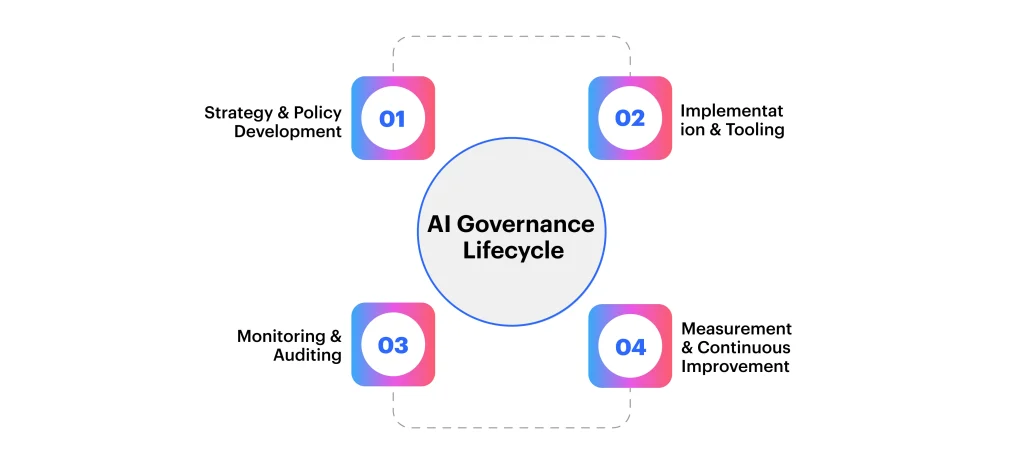
Effective AI governance isn’t just a one-time task; it is a continuous cycle that starts with planning and continues till everyday improvements. By following a structured lifecycle, organizations can confirm that their AI systems remain ethical, compliant, and aligned with business goals.
Here’s how each stage works and contributes to strong artificial intelligence governance:
1. Strategy & Policy Development
The planning phase is where companies define their business goals, rules, and values. It includes forming governance teams, creating usage policies, and setting ethical guidelines that guide AI development across departments.
2. Implementation & Tooling
Once policies are in place, shift focus to putting them into action, which means using tools to track AI models, control access to data, and make sure that all the development aligns with approved practices. Platforms such as model registries or data access control systems can be used here.
3. Monitoring & Auditing
After the implementation, the AI system must be regularly monitored to make sure it is working as expected. This step also includes detecting biases, data quality, and marking unusual behavior or outcomes. Internal audits and automated monitoring tools to maintain trust.
4. Measurement & Continuous Improvement
Finally, organizations must measure AI performance regularly and governance success. Regular reviews help to update models, refine policies, and improve over time based on new insights or risks.
This cycle keeps AI systems efficient and responsible with changing business and legal needs.
Best Practices & Real-World Examples in AI Governance
It is important to learn from leading companies to help organizations apply artificial intelligence governance effectively. The real-world examples show how different strategies can be customized to meet the specific business and compliance goals, while also keeping AI safe, ethical, and efficient.
1. IBM’s Multi-Layered Governance
IBM follows a structured and layered governance model in which ethics are embedded in every step of AI development. It is also assigned clear roles to ensure the model has accountability and compliance across departments.
2. Informatica’s Data-Centric Approach
The informatica focuses on managing high-quality data, which is the foundation of reliable AI. The tools make sure that AI models only use authorized, accurate, and compliant data and reduce risks from the ground up.
3. ServiceNow’s Governance Workspace
ServiceNow gives a dedicated dashboard to track AI usage and risks in real time, which helps organizations monitor their models, manage approvals, and stay compliant with external and internal policies.
4. Diligent’s Safe-to-Fail Pilots
The diligent encourages companies to test AI in controlled environments before launching at scale. These safe-to-fail pilots help identify problems early and improve governance without causing any real-world harm.
These practices show that effective governance isn’t about one tool; it is about building a system that is proactive, responsible, and always improving.
Additional Read: How Can Generative AI Be Used In Cybersecurity: Use Cases, Risks & More
Driving Business Success with Responsible AI Governance
In today’s digital age, businesses are greatly leaning on advanced AI technologies while providing secure, ethical, and efficient systems. For those who are still in question about what is AI governance, and how it affects business?
So, to help understand the content of an AI system, it represents a framework that guides the development and use of AI to align with organizational values and legal standards. Implementing such frameworks not only mitigates risk but also drives strategic growth.
When applied correctly, the benefits span across multiple dimensions of a business, from operational improvements to better stakeholder confidence.
- Minimizing Risk Exposure: A strong governance framework establishes strong controls and clear accountability, reducing the chance of data breaches, biased outcomes, or costly errors.
- Building Stakeholder Trust: For businesses, transparent processes and consistent ethical standards boost confidence among customers, investors, and partners, fostering longer-lasting and deeper relationships.
- Accelerating Innovation: AI systems need a clear set of guidelines, adding to experimentation within safe boundaries and leading to faster and more reliable product development.
- Enhancing Operational Efficiency: Streamlined workflows and automated oversight reduce redundant efforts and optimize resource allocation across all departments.
- Enabling Scalable Growth: The systems in place allow organizations to roll out AI solutions confidently on a large scale, adapting to new challenges and market demands while maintaining compliance.
All these benefits illustrate how investing in one strong framework, AI governance, can be a game-changer for modern businesses, securing both immediate performance gains and long-term strategic advantages.
Navigating Challenges and Trends in AI Governance
As AI adoption accelerates, organizations face new issues in keeping the system secure, ethical, and compliant. While AI governance frameworks give structure, the fast-changing tech landscape brings constant challenges and opportunities for growth.
Staying ahead needs flexibility, awareness, and correct expertise, mostly supported by AI governance certification and upskilling initiatives.
- Rapid Evolution of AI Tech: AI systems like generative models and autonomous agents are advancing faster than policies can keep up.
- Fragmented Regulatory Landscape: Different countries and industries follow varied rules, making compliance complex.
- Shadow AI: Teams often use unapproved AI tools, creating risks that go unnoticed without centralized oversight.
- Scaling Governance to Business Units: Applying consistent governance across multiple departments or regions can be difficult without a clear, scalable framework.
To succeed, businesses must treat governance as a dynamic process that evolves with technology and regulation.
Conclusion: Shaping a Responsible AI Future
As AI is continuously changing, building ethical, accountable, and scalable systems is no longer an option; it is a necessity. From understanding artificial intelligence governance and its main pillar to implementing best practices and navigating the modern challenges, businesses really need to adopt a strategic approach to give trust, compliance, and long-term value.
At Openxcell, we help enterprises design and deploy responsible AI solutions with governance at their core. Our end-to-end AI development services, LLM customization, data engineering, and compliance-driven strategies to make sure the business is AI-ready, secure, and future-proof.

FAQs on AI Governance
1. What is AI governance, and why is it important?
AI governance refers to the framework of practices and policies that ensure that your AI systems are ethically aligned and accountable with business goals. It is necessary to avoid risks like privacy violations, biases, and a lack of transparency.
2. How does artificial intelligence governance help in compliance?
Artificial intelligence ensures that AI models meet data privacy laws, emerging regulations, and industry standards, reducing reputational and legal risks.
3. What industries benefit most from AI governance?
There are some highly regulated sectors like finance, insurance, government, and healthcare that benefit significantly from strong AI governance due to higher compliance and safety requirements.
4. How can businesses get started with AI governance?
One can start by forming a governance team, defining ethical policies, tracking AI usage, and lastly, investing in monitoring tools. This is the simplest way to start with AI governance.
5. Is AI governance only for large enterprises?
No, all companies, from small to mid-size companies, need AI governance to scale responsibility, especially as AI tools become more accessible.
6. Are there certifications available for professionals in this field?Yes, many institutions now offer AI governance certification programs to help professionals understand governance frameworks and implement them effectively.

Manushi, a former literature student, now crafts content as a writer. Her style merges simple yet profound ideas. Intrigued by literature and technology, she strives to produce content that captivates and stimulates.