Model Context Protocol: A Complete Guide to AI Tool Integration
 Last updated:September 8, 2025
 11 Min Read
- The Problem: AI Model Isolation & the NxM Integration Challenge
- Visual analogy:
- Consequences of this problem include:
- Introducing MCP: Your AI’s “USB-C Port”
- Definition:
- Analogy:
- MCP Architecture & Core Components
- Client–Host–Server Architecture
- Protocols & Data Formats
- Primitives Exposed by Servers
- MCP & Function Calling: A Smarter Way to Connect AI
- Traditional Function Calling vs MCP
- The Advantages of Using MCP
- 1. Scalability & Reusability
- 2. Avoid Custom Integrations
- 3. Real-Time, Accurate Data Access
- 4. Security & Control
- 5. Ecosystem Growth
- Practical Use Cases of MCP in Action
- How to Integrate MCP into Your Project
- Step-by-Step Implementation of MCP
- Key Challenges and Considerations in MCP
- Wrapping Up: The Future with MCP


Quick Glance at Model Context Protocol:
- Definition: MCP standardizes how AI models interact with tools and resources.
- Benefits: Improves interoperability, reduces complexity, and strengthens governance.
- Implementation Flow: Build MCP server → Connect client → Query & control tools.
- Challenges: Maturity of spec, potential security risks, and ecosystem adoption.
- Business Value: Enables enterprises to scale AI adoption with confidence.
AI is changing drastically, but its biggest limitation is isolation. Many AI models operate in bubbles, powerful at reasoning but disconnected from real-time data, business workflow, or external systems. Imagine if AI could easily plug into your tools, apps, and databases without endless custom integrations. That’s exactly where the Model Context Protocol (MCP) comes in.
For developers, MCP is a breakthrough. It gives a standardized way to connect AI models with external resources, solving a messy “NxM integration problem“.
So instead of creating a separate connector for each model and tool, MCP acts like a universal adapter, simplifying integration, improving scalability, and adding more reliable, context-rich output. This makes MCP a game-changer not just for coders but also for businesses relying on AI development services to build smarter, more adaptable solutions.
In this blog, we will explain what MCP is, how it works, its architecture, benefits, real-world applications, how developers can start integrating it into their projects, and more.
But before diving into what is model context protocol let’s understand the problem of AI model isolation, the NxM integration, and its consequences.
The Problem: AI Model Isolation & the NxM Integration Challenge
It is important to dive into the technicalities of MCP and more, so let’s simplify things.
Think of AI models like powerful machines locked inside a room. They can analyze, text, solve problems, and even generate code, but they can’t see what’s happening outside unless you build a window for them. This limitation is known as LLM isolation, where large language models operate without direct access to your databases, internal tools, or APIs.
Now, here is where the NxM integration problem comes in. Imagine you have multiple AI models like GPT, Claude, and LLaMA, as well as other tools like GitHub, Slack, and Postgres. Without a standard, you need to build a different connector for each pair. That means “N models x M tools” integrations, which quickly become developers’ nightmares.
Visual analogy:
It’s like having five types of laptops ( with different AI models) and five types of chargers (with different tools). If every laptop only worked with one particular charger, you would need 25 different chargers to keep them all powered. That’s exactly what happens with AI integrations today: too many one-off connections, too much hassle.
Consequences of this problem include:
- Code duplication and wasted effort: Teams repeatedly build the same integrations for various models.
- Fragile integrations: Even small changes in APIs or tools can break workflows.
- Inconsistent behaviors: Each integration behaves differently, leading to unpredictable AI outputs.
So, all of these consequences and analogies precisely explain why model context protocol explanation is so important: It standardizes connectivity and reduces complexity. For enterprises calling Gen AI services, solving this challenge means faster deployment, easier maintenance, and more reliable AI applications.
To overcome this growing complexity, the industry needs a universal standard, something simple and reliable, like a single adapter that works for everything. This is where MCP steps in, acting like the “USB-C Port” for AI models.
Introducing MCP: Your AI’s “USB-C Port”
AI has reached a stage where its true potential lies in not just reasoning but in connecting it with your real-world apps, tools, data, and workflows. The challenge is doing this in a standardized, reusable way, without custom integrations. That’s what the Model Context Protocol delivers: a common language that lets AI models interact with external systems as smoothly as plugging a device into a universal port.
Definition:
MCP is an open standard that enables AI models to access tools, datasets, and apps consistently. Instead of writing unique connectors for every system, developers can expose their tools once through MCP, and any compatible model can use them. This makes it especially valuable for enterprises scaling AI solutions alongside their data engineering services.
Analogy:
1. Anthropic’s USB-C comparison
Anthropic explains MCP as the USB-C of AI, a universal connector that just works.
For example, just like you can use the same USB-C cable to charge your phone, headphones, or laptop, MCP allows an AI model to use a single standardized protocol to fetch data from a Postgres database, call an API, or trigger automation scripts.
2. IBM’s interoperability analogy
IBM compares MCP to the way USB-C transformed hardware interoperability. Before USB-C, every device had its own charger and port, making compatibility a nightmare. With USB-C, one cable handles it all.
Similarly, MCP gives that same simplicity to AI apps. Whether a model is working with cloud storage, Slack, or GitHub, it can ” plug in” easily without needing custom, one-off integration.
MCP Architecture & Core Components
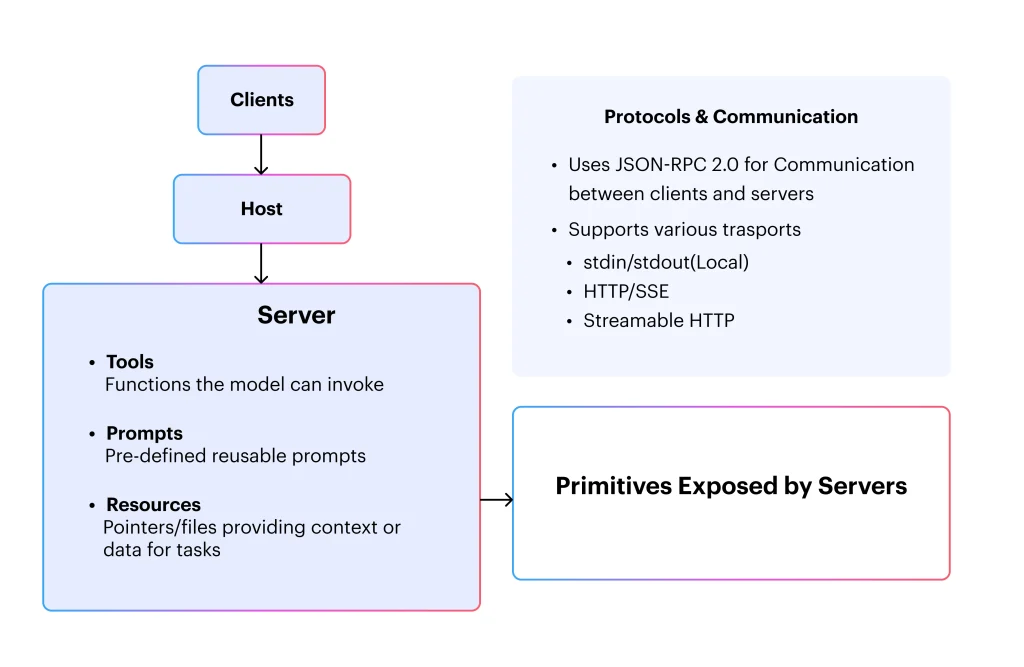
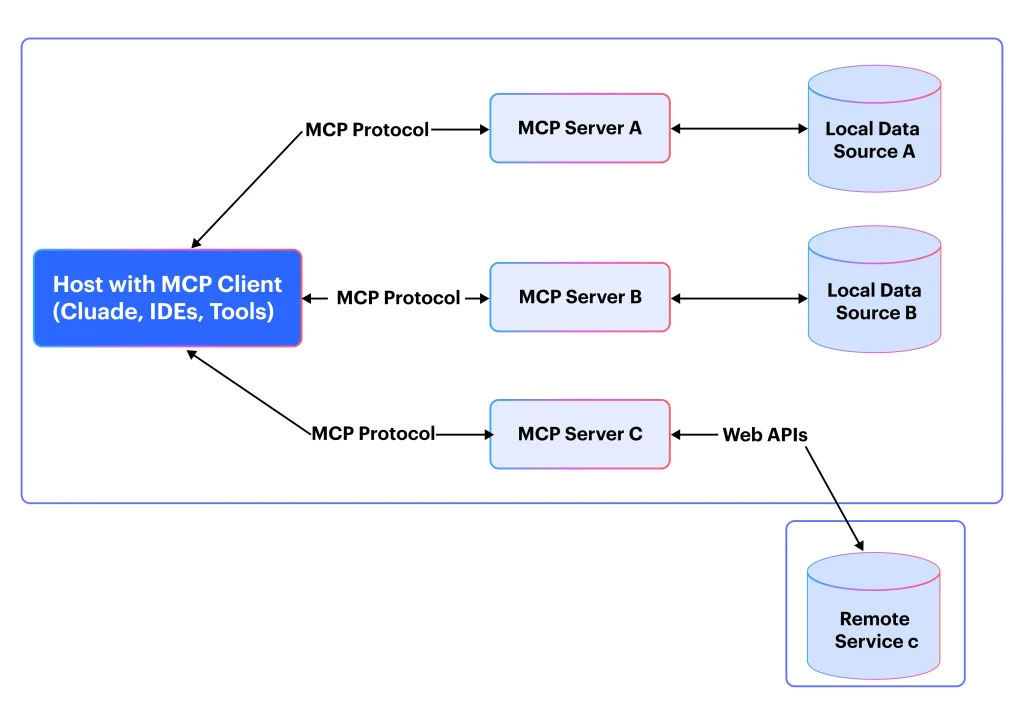
The Model Context Protocol is built on a Client–Host-Server architecture, which simplifies how AI models work with tools, data, and prompts. It adds a unified way for apps and models to communicate, making integration easy and efficient. To understand this better, let’s break down its key components and the primitives it provides.
Client–Host–Server Architecture
Host:
The Host works as the bridge between the Client and the Server. It manages communication, handles requests, and makes sure that the model can access the correct tools, prompts, and resources without friction.
Client:
The Client mainly consists of AI-powered apps or interfaces that make requests. For example, it can be a chatbot, an IDE plug-in, a productivity tool, etc., that asks the Host to perform tasks like fetching data or executing a function.
Server:
The Server is where the actual prompts, tools, and resources live. It responds to the Host’s request and gives the outputs back to the Client. In simple terms, the Server is the “library” of capabilities that AI can tap into.
Protocols & Data Formats
To maintain consistency and reliability, MCP uses standardized protocols and data formats:
- JSON-RPC 2.0 – This protocol handles communication between Clients and Servers, making sure that requests and responses follow a common structure.
- Multiple Transport Support – MCP is flexible and works across different communication channels:
- Stdin/stdout (local): For direct, local execution.
- HTTP/SSE: For real-time streaming communication.
- Streamable HTTP: For continuous and large-scale data interactions.
This design ensures interoperability across platforms like OpenAI and others, providing scalability for different use cases and making it more adaptable than many model context protocol alternatives.
Primitives Exposed by Servers
The real power of the Model Context Protocol comes from the primitives exposed by Servers. These primitives define what the model can do:
- Tools: Functions or APIs that the AI can call. For example, a weather tool, a database query function, or a file reader.
- Prompts: Predefined templates or structured instructions that guide the AI’s behavior, ensuring consistent responses.
- Resources: External data sources or files the model can access, like documents, logs, or datasets, that enrich its context and decision-making.
In summary, the MCP architecture offers a clear and modular way to connect AI models with tools and data. Separating clients, hosts, and servers gives flexibility, scalability, and security while simplifying integration for developers.
MCP & Function Calling: A Smarter Way to Connect AI
After understanding the importance of MCP architectures and how they work, it is better to learn how to connect AI models with external tools and services. The developers have long relied on function calling for the Model Context Protocol. Instead of reinventing the wheel, MCP builds on this familiar concept, making it smarter, more universal, and easier to adopt.
Traditional Function Calling vs MCP
| Aspect | Traditional Function Calling | MCP (Model Context Protocol) |
| Setup | Each AI model needs its own custom schema | One universal spec works across models |
| Consistency | Behaves differently across tools & models | Standardized behavior across platforms |
| Maintenance | Developers must update for every new model | One update works everywhere |
| Integration Speed | Slower, repetitive setup | Faster, plug-and-play style |
| Analogy | Like having a unique charger for every device | Like using a single USB-C for all devices |
Quick Analogy in Simple Words
- Traditional function calling = every gadget has its own charger (messy, repetitive).
- MCP = one universal charger (USB-C) that works everywhere, saving time and effort.
The Advantages of Using MCP
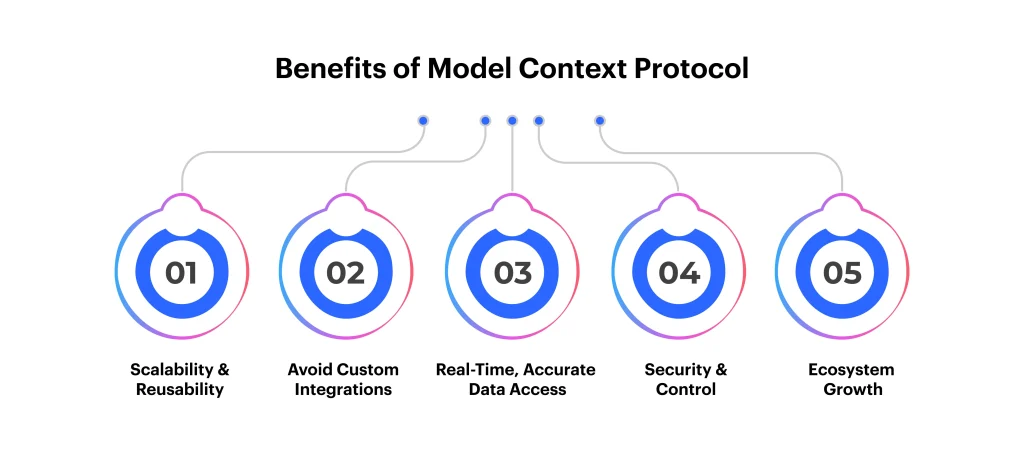
MCP is not just about standardization; it gives many benefits that make AI integrations smarter, faster, and more reliable. From scaling across platforms to strengthening security, MCP sets the foundation for a more connected AI ecosystem.
1. Scalability & Reusability
MCP allows developers to write once and use it everywhere. The same integration can work easily on multiple AI platforms, reducing repetitive work and boosting efficiency.
2. Avoid Custom Integrations
With MCP, one no longer needs to create a unique schema for every AI model, which means less fragmentation, fewer errors, and faster time to market.
3. Real-Time, Accurate Data Access
MCP standardizes how models and tools interact, ensuring consistent data flow and real-time updates. It keeps AI systems responsive and accurate.
4. Security & Control
By providing a unified spec, MCP reduces model context protocol security vulnerabilities. It offers safer interactions between tools, models, and data, strengthening organizations’ governance.
5. Ecosystem Growth
As many developers adopt MCP, it creates a thriving ecosystem where services and tools can interoperate without friction, driving collaboration and innovation.
Practical Use Cases of MCP in Action
Model Context Protocol is transforming how AI connects with data, tools, and platforms by providing easy integrations and consistent performance.
From big enterprises to content platforms, MCP makes it easy to scale AI solutions without the overhead of custom connectors.
It also plays an important role in powering advanced systems like conversational AI chatbots by giving accurate, real-time access to information.
- Enterprises & Development Tools
Companies can easily organize by using MCP to connect multiple AI models with their existing tools. It reduces integration costs, accelerates project delivery, and ensures scalable AI adoption across business units.
- AI App Platforms
Platforms that host AI-driven apps benefit from MCP’s standardized approach, which allows them to integrate various models effortlessly. Developers can build once and deploy across different providers, giving a consistent and reliable user experience.
- Publishers & Content Owners
For content-rich industries, MCP enables smooth integration with AI models for personalization, summarization, and recommendations. It creates efficient workflows while balancing both control and accuracy on different publishing channels.
How to Integrate MCP into Your Project
First, get started with the Model Context Protocol. With the right partners and tools, developers can easily adopt MCP to streamline workflows, enhance AI-driven features, and unlock interoperability across platforms.
Below is a quick model context protocol explanation of how leading providers are making integration easier.
- Getting Started
Begin by identifying the tools, data sources, and AI models your project needs to connect. MCP provides standard workflows to connect them easily.
- Anthropic
It offers official support for MCP in its ecosystem, making it easier for developers to connect AI models with external resources securely and reliably.
- Descope
Helps simplify user authentication and identify workflows while integrating MCP, giving secure access while maintaining a smooth user experience.
- Vercel
Provides deployment-ready integration with MCP, adding developers to build, scale, and ship AI-powered apps with minimal setup.
Related Read: AI Model Training: From Basics to Advanced Techniques
Step-by-Step Implementation of MCP
Adopting the Model Context Protocol becomes easy when you have a proper, structured approach. Here, we will provide you with a simple model context protocol explanation that outlines the flow, from setup to controlled execution, giving secure and efficient integration into your AI systems.
- Build or Deploy MCP Server
First and foremost, set up an MCP server to expose the necessary tools, prompts, and resources for your app.
- Configure AI Host/Client
Connect your client or AI host to the MCP server to interact with defined resources.
- Model Queries & Execution
The model discovers available tools with list_tools() and runs them via call_tool(), while the host implements necessary controls.
- Apply Filtering Controls
Use static or dynamic filtering to define which tools the AI agent can access, while maintaining security.
Key Challenges and Considerations in MCP
As we know, the Model Context Protocol brings efficiency and flexibility. However, it also comes with certain challenges, which teams must carefully evaluate.
From technical maturity to ecosystem support, these factors play an important role in successful adoption.
Addressing potential model context protocol security vulnerabilities early on is important for safe implementation.
- Spec Maturity – MCP is still growing, and ongoing changes may affect its stability and backward compatibility.
- Security Risks – Misconfigured or unprotected endpoints can expose sensitive data, making strong security controls critical.
- Ecosystem Readiness – Adoption depends on community support, tooling, and platform compatibility, which are still in early stages.
Wrapping Up: The Future with MCP
The Model Context Protocol is paving the way with its easy integration, tool access, and smarter AI-driven workflows. It covers everything from understanding its fundamentals to exploring integrating methods to addressing challenges. This blog has given you a complete understanding of MCP and helped you grasp its value. As adoption grows, businesses that embrace MCP early will be better positioned to get scalable, secure, and efficient AI-powered solutions.
At Openxcell, we specialize in building future-ready AI systems, integrating protocols like MCP, and providing enterprise-grade security and scalability. Whether designing custom AI strategies, deploying intelligent workflows, or minimizing bottlenecks, our expertise helps businesses stay ahead of the curve in this rapidly changing ecosystem.

Manushi, a former literature student, now crafts content as a writer. Her style merges simple yet profound ideas. Intrigued by literature and technology, she strives to produce content that captivates and stimulates.