AI Model Training: From Basics to Advanced Techniques
 Last updated:April 27, 2026
 16 Min Read
- What is AI Model Training?
- Essential Foundations for Effective AI Model Training
- Data Collection:
- Data Labeling & Annotation:
- Data Preprocessing:
- Infrastructure Needs:
- How to Train an AI Model: Step-by-Step Process
- 1. Define the Problem & Choose the Right Model Architecture
- 2. Split Data into Training, Validation, and Test Set
- 3. Configure Training Parameters
- 4. Start Training & Monitor Progress
- 5. Validate and Tune
- 6. Test Final Performance
- Essential Tools for AI Model Training Success
- 1. Core Frameworks
- 2. ML Libraries & Platforms
- 3. AutoML Platforms
- 4. Data Versioning & Experiment Tracking
- Key Techniques for Effective Model Training
- Challenges in Training AI Models Effectively
- Overfitting & Underfitting
- Bias in Data
- Data Scarcity or Imbalance
- Compute Constraints
- Monitoring & Reproducibility
- Ethical Implications and Transparency
- Advanced Strategies for AI Model Training
- 1. Self-Supervised Learning
- 2. Federated Learning
- 3. Curriculum Learning
- 4. Reinforcement Learning with Human Feedback (RLHF)
- 5. Distributed & Large-Scale Training
- 6. Use of Synthetic Data
- Evaluating AI Models: Metrics That Matter
- Post-Training Essentials: What Comes After Building Your AI Model
- Deployment
- Continuous Learning
- Monitoring
- Explainability
- Real-World Use Cases Across Industries
- 1. AI for Medical Imaging
- 2. E-commerce Recommendation Engines
- 3. Financial Fraud Detection
- 4. Customer Support Chatbots
- Best Practices & Tips for Effective AI Model Training
- The Future of AI Model Training
- Mastering AI Model Training for Real-World Impact


In 1997, IBM’s Deep Blue made headlines for defeating the chess grandmaster and champion Garry Kasparov, a historic moment in AI history.
But what most people didn’t understand is that this victory wasn’t about raw computing power; it was about training the AI to understand strategies, patterns, and predict human moves. Fast forward to today, AI is everywhere, from your voice assistant understanding commands to recommendation engines suggesting your next favorite movie, etc. The secret sauce behind this revolution is powerful AI model training.
As more businesses explore AI integration, the demand for reliable AI development services is skyrocketing. However, building an AI model that works flawlessly isn’t just about feeding its data; it’s about training it with precision, purpose, and performance in mind. In this blog, we will dive deep into the core of training AI models, beginning with the basics of what exactly AI model training is.
What is AI Model Training?
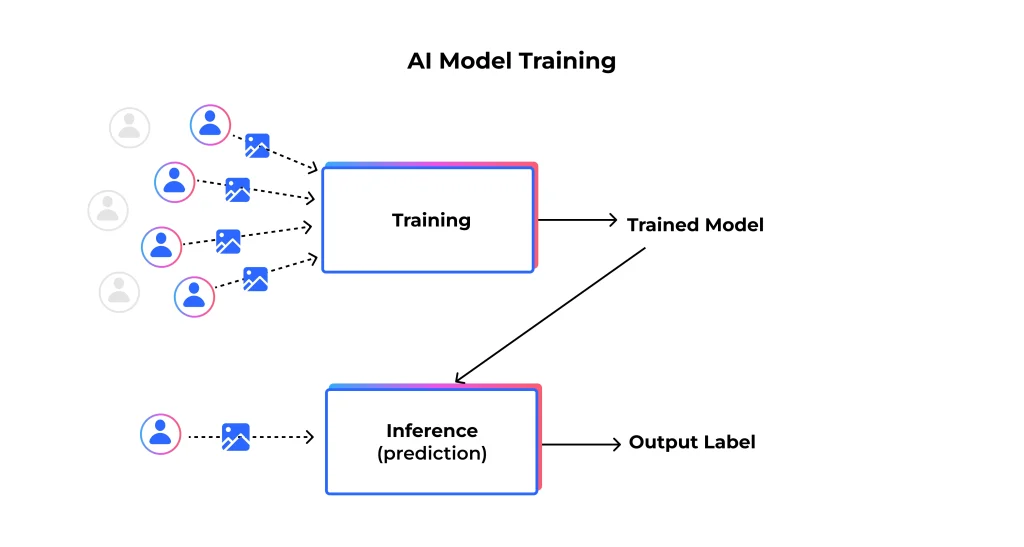
AI model training is the process of teaching a machine to recognize patterns, make decisions, and solve problems using proper data. Think of it like training a student, only instead of books, an AI learns from big datasets filled with examples. The more different and high-quality the data, the smarter the AI model becomes.
For example, if you are training an AI to recognize cats in photos, you feed it thousands of images labeled as “Cat” or “not Cat.” Over time, it learns to identify the cat features like fur, ears, or shape. If you are wondering how to train an AI model, it involves selecting the correct algorithm, preparing the data, running the training, and fine-tuning the model with results for accuracy. Before diving into the training process, it’s essential to understand the key prerequisites for AI model training that lay the foundation for successful outcomes.
Essential Foundations for Effective AI Model Training
Before you dive into how to train AI model, setting up the right groundwork is important. These foundational steps make sure that your AI learns accurately, efficiently, and at a great scale.
Data Collection:
The quality of any AI model is only as good as the data it learns from. Collect high-quality, diverse, and relevant data that represents real-world scenarios.
Data Labeling & Annotation:
Accurate labels guide the learning process. Human-in-the-loop systems, along with automation platforms, play a major role in providing reliable annotations.
Data Preprocessing:
Raw data is rarely AI-ready. Cleaning, transforming, and normalizing data gives consistency and prepares it for effective model training.
Infrastructure Needs:
Training models needs strong computing power. It uses GPUs, TPUs, cloud infrastructure, and MLOps tools to organize and scale the training process. To meet these demands efficiently, many organizations rely on gpu cloud providers to access scalable, high-performance computing resources without heavy upfront investment.
Laying these foundations allows your AI model to be set up for success from the very beginning. With the essentials in place, let’s now walk through the training workflow and the step-by-step journey of building a high-performing AI model.
How to Train an AI Model: Step-by-Step Process
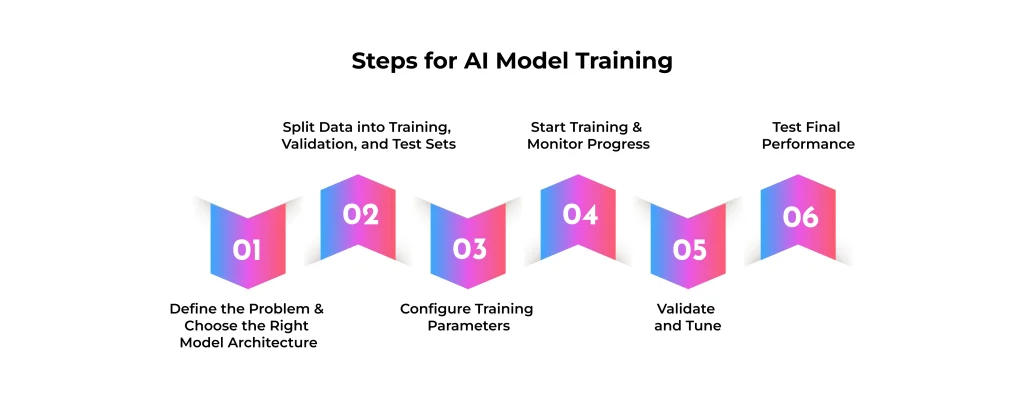
Once your data and infrastructure are ready, the real work begins. Then comes the phase of transforming raw data into an intelligent system. A structured training workflow not only gives better results but also helps identify issues early in the pipeline. Here is the step-by-step breakdown of what effective AI model training looks like:
1. Define the Problem & Choose the Right Model Architecture
Clearly outline the objective, whether it is image classification, text generation, or predictive analytics. The problem type determines the perfect model architecture, like CNNs for image tasks or transformers for language processing. Choosing the correct model is important for setting realistic performance expectations.
2. Split Data into Training, Validation, and Test Set
Divide the datasets into three parts. The training set teaches the model, the validation set helps in fine-tuning it during training, and the test set evaluates the final performance. The separation helps avoid overfitting and makes sure the model performs well on unseen data.
3. Configure Training Parameters
Adjust the key hyperparameters that control how the model learns. Epochs define how many times data passes through the model, batch size affects memory and speed, and learning rate determines how quickly the model updates. Balancing these is important to optimize results.
4. Start Training & Monitor Progress
Once the training begins, monitor the learning curves closely. Metrics like training loss, validation loss, and accuracy over time help reveal if the model is learning correctly. Tools such as TensorBoard, Weights & Biases, or MLflow provide real-time tracking and visual insights.
5. Validate and Tune
Validation allows you to test model generalization during training without influencing the final outcome. Use this set to tune hyperparameters, adjust model depth, apply regularization techniques like dropout or weight decay, and even perform early stopping if needed.
6. Test Final Performance
Once validation yields consistent results, use the test set to evaluate the model’s true performance. It is an unbiased check of how well the model will do outside the training environment. A strong performance on this set confirms your model is ready for deployment and marks the successful completion of how to train AI models end-to-end.

Essential Tools for AI Model Training Success
A strong AI tech stack significantly simplifies and accelerates your development process. Whether you are experimenting, scaling, or managing experiments, these tools are fundamental to mastering how to train an AI model efficiently and build production-ready systems.
1. Core Frameworks
- TensorFlow & PyTorch – Industry-standard deep learning frameworks known for their amazing scalability, flexibility, and active community support. It is ideal for custom model building, especially in enterprise AI applications.
- Keras – A high-level API running on top of TensorFlow, offers quick prototyping and a beginner-friendly interface to design deep learning models faster.
2. ML Libraries & Platforms
- Hugging Face – Specializes in pre-trained models for NLP and Transformers, making cutting-edge AI accessible with just a few lines of code.
- Scikit-learn – Best for classical Machine learning algorithms like decision-making, SVMs, and clustering, excellent for beginners and quick experimentation.
- XGBoost – A powerhouse for gradient boosting, known for its speed and accuracy in tabular/ structured data tasks.
3. AutoML Platforms
- Google AutoML, H2O.ai, DataRobot – Automated model selection, tuning, and training, helping rapid experimentation even without deep coding expertise or a data science background.
4. Data Versioning & Experiment Tracking
- DVC (Data Version Control) – Handles dataset versioning just like Git handles code, helping maintain consistency across teams.
- MLflow – Tracks experiments, manages model lifecycle, logs metrics, and guarantees full reproducibility and collaboration across AI projects.
With the right tools in place, the next step is mastering the techniques that make AI model training truly effective and result-driven.
Key Techniques for Effective Model Training
Training AI models is not just about feeding data into algorithms; it is about applying smart techniques that improve accuracy, generalization, and efficiency. The proven strategies make sure that models are strong and production-ready. So, how are AI models trained to perform at their best? Here are the major techniques:
- Transfer Learning & Fine-Tuning
Start with pre-trained models and fine-tune them on your exact dataset to save time and resources.
- Hyperparameter Tuning
Optimize settings like learning rate, set size, and epochs to boost model performance.
- Cross-Validation
Validates model consistency by training on multiple data splits to reduce overfitting risks.
- Regularization (L1/L2, Dropout)
It prevents overfitting by penalizing complexity and randomly disabling neurons during training.
- Data Augmentation
Expands dataset diversity with variations like rotations or flips, which is especially helpful in image-based AI.
- Early Stopping
Stops training when performance on the validation set begins to decline, avoiding unnecessary computation.
- Batch Normalization
Speeds up training and stabilizes learning by normalizing inputs across layers.
Mastering these techniques lays the groundwork, but real-world implementation comes with its own set of hurdles, so let’s explore the key challenges in AI model training.
Challenges in Training AI Models Effectively
Even with the correct strategies in place, learning how to train an AI model goes beyond applying technical methods; it requires tackling several real-world challenges that can impact the model’s performance, fairness, and reliability.
Overfitting & Underfitting
In AI model training, balancing generalization is tricky. Overfitting happens when a model memorizes training data, while underfitting means it fails to learn patterns; both reduce effectiveness in new data.
Bias in Data
If the training data reflects societal or selection biases, the model may inherit and amplify them, leading to skewed or unfair outputs.
Data Scarcity or Imbalance
Many real-world apps suffer from limited or imbalanced datasets. It can cause models to favor dominant classes and ignore minority ones, degrading performance.
Compute Constraints
Training deep models can be resource-intensive. Without sufficient GPU power or cloud infrastructure, training becomes slow, limiting experimentation.
Monitoring & Reproducibility
Inconsistent results are due to a lack of experiment tracking, which can hinder progress. Reliable workflows are important for repeatable, collaborative model development.
Ethical Implications and Transparency
A major challenge in how to train AI model lies in making sure decisions are interpretable, data privacy is maintained, and ethical standards are met.
Addressing these issues is important to building AI systems that are not only powerful but also trustworthy and sustainable. To push model performance even further, it’s time to go beyond the basics and explore advanced training strategies that unlock the full potential of AI systems.
Advanced Strategies for AI Model Training
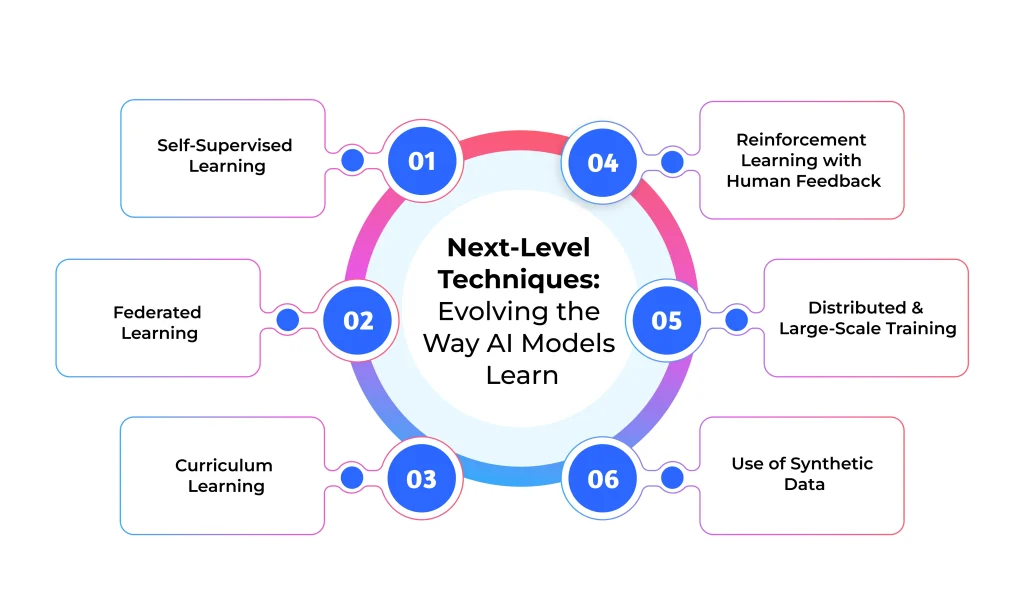
As AI applications grow more complex, traditional techniques may no longer suffice. The advanced methods are reshaping how models learn, scale, and adapt, making AI model training more efficient, strong, and capable of handling real-world complexities.
1. Self-Supervised Learning
This approach enabled models to learn from unlabeled data by generating their own training signals. It is particularly useful when labeled datasets are scarce or expensive to obtain.
2. Federated Learning
Instead of centralizing data, federated learning trains models across decentralized devices while preserving user privacy. This is ideal for industries like finance and healthcare, where data security is paramount. Concepts like these are increasingly covered in modern data science courses, reflecting their growing relevance in real-world applications.
3. Curriculum Learning
Inspired by human learning, this technique feeds models with easy tasks first, gradually increasing complexity. It helps improve convergence speed and model stability.
4. Reinforcement Learning with Human Feedback (RLHF)
By combining reinforcement signals with human-provided feedback, models learn more aligned behaviors, which is especially valuable in language generation and safety-critical apps.
5. Distributed & Large-Scale Training
Training large models like LLMs needs parallel computation across multiple GPUs or nodes. This strategy accelerates learning and helps to handle massive datasets.
6. Use of Synthetic Data
When real data is limited, synthetic data generation helps expand datasets. It enhances diversity and fills critical data gaps, especially in simulation-heavy fields.
These advanced methods are driving the next wave of intelligent, adaptable AI systems.
A Must Read: Understanding AI Models: A Beginner’s Guide
Evaluating AI Models: Metrics That Matter
Training a model is only half the equation; evaluating its performance makes sure it’s ready for real-world impact. A deep understanding of how to train an AI model must include knowing which metric best reflects model behavior and outcomes across different scenarios.
- Accuracy & F1 Score
Accuracy measures the overall correctness of projections, but it can be misleading in imbalanced datasets. The F1 score balances precision and recall, delivering a more reliable performance indicator.
- Precision & Recall
Precision shows how many predicted positives are actually correct, while recall reflects how many actual positives the model captures. These are especially important in high-risk domains like healthcare or fraud detection.
- ROC-AUC & Confusion Matrix
ROC-AUC assesses a model’s ability to distinguish between classes across points. A confusion matrix provides a clear snapshot of prediction results, highlighting true positives and false positives.
- Loss Functions
Loss functions guide learning during training. Mean Squared Error (MSE) is suited for regression tasks, while Cross-Entropy is widely used for classification.
- Generalizability
A model might perform well in experiments but be underdeliverable in the real world. Testing for generalizability ensures your model adapts beyond the lab.
Proper evaluation provides models that are not just intelligent but also reliable, balanced, and practical.
Post-Training Essentials: What Comes After Building Your AI Model
Training might be the most discussed phase in mastering AI models, but it is not only the beginning of a model’s journey. Understanding how to train an AI model is incomplete without a solid plan for deployment, adaptation, oversight, and transparency. These post-training practices allow the model to continue to deliver value, accuracy, and trust long after initial training.
Deployment
Choosing the correct deployment environment, such as cloud, edge, or hybrid, is important for performance and scalability. Cloud offers flexibility, edge gives low-latency responses, and hybrid setups balance both. The choice impacts how well the model integrates with user applications and infrastructure.
Continuous Learning
Data changes constantly, and so should the models. Regular retraining with new or updated datasets helps the models maintain high performance and relevance. This is especially important in dynamic industries like finance or e-commerce, where trends shift rapidly.
Monitoring
Deployed models are not so static; they must be actively monitored for performance issues, data drift, and anomalies. Real-time monitoring systems detect when retraining is needed and make sure the model continues to meet the expectations in live environments.
Explainability
Model decisions must be understandable to both developers and stakeholders. Explainability tools provide transparency into how predictions are made, which is essential for user trust, regulatory compliance, and debugging complex behaviors.
These considerations turn a trained model into a reliable, production-ready solution that evolves with time and use.
Real-World Use Cases Across Industries
AI model training is the foundation behind some of the most transformative solutions across different industries today. From improving patient outcomes to enhancing customer experiences, the correct training strategy allows the full potential of artificial intelligence. Let’s look at a few compelling examples of how trained models are driving real-world impact.
1. AI for Medical Imaging
AI models are revolutionizing diagnostics by detecting anomalies in X-rays, MRIs, and CT scans with remarkable accuracy. These training systems easily assist radiologists by flagging early signs of diseases like cancer, leading to faster and more accurate treatment decisions.
2. E-commerce Recommendation Engines
Online retailers use AI to analyze user behavior and preferences, giving personalized product recommendations. These trained algorithms boost engagement, increase conversion rates, and give better customer satisfaction by tailoring shopping experiences.
3. Financial Fraud Detection
In the finance and banking sectors, AI helps to identify unusual transaction patterns in real time. The trained models immediately flag suspicious activities, reduce fraud risks, and provide secure financial operations.
4. Customer Support Chatbots
AI-powered chatbots are trained to understand and respond to customers’ queries naturally in human-like conversations. By handling repetitive questions efficiently, it frees up human agents from more complex issues and improves service speed and consistency.
These applications show that mastering AI model training leads to smarter, faster, and more accurate systems across different sectors.
To achieve such impactful results, it’s essential to follow the right approach; it’s time to see some of the best practices and pro tips that can elevate your model training process.
Best Practices & Tips for Effective AI Model Training
Training AI models isn’t just about powerful algorithms; it is more about adopting smart strategies that give accuracy, scalability, and real-world relevance. The right practices make the difference between a promising model and a production-ready solution.
- Start small, scale gradually
Start with a minimal functional version of your model. This helps to test the feasibility and uncover the flows early before starting large-scale training.
- Validate with diverse data
Use a wide range of datasets to expose your model to different patterns and scenarios. It improves the generalization and reduces the risk of bias.
- Monitor training metrics regularly
Keep a close watch on key metrics like loss, accuracy, and validation score during training. Real-time tracking helps detect convergence issues earlier.
- Collaborate with domain experts
Involving industries or subject matter experts strengthens the relevance and quality of the model. Its insights guide better feature selection and evaluation criteria.
- Document everything
Maintain clear records of experiments, hyperparameters, and observations. Proper documentation offers reproducibility and smooth knowledge transfer across teams.
By implanting these best practices into your workflow, you lay a strong foundation for efficient and strong AI model training, setting the stage for long-term success.
An Interesting Read: SLM vs LLM: Choosing the Right AI Model for Your Business
The Future of AI Model Training
As AI landscapes evolve, so do the methods used to train smarter, faster, and more ethical models. The future of AI training is all about automation, efficiency, transparency, and adaptability, pushing the limits of what’s possible.
- Automated Model Training & AutoML
Automation and AutoML are making model training faster and more accessible, reducing the need for deep technical expertise.
- Energy-Efficient Training
As sustainability becomes a priority, new techniques are arising to cut down computational load and low carbon footprints during training.
- Explainable AI (XAI)
Building trust in AI means understanding how it works. XAI focuses on making model decisions more transparent and understandable.
- Foundation Models & Continual Learning
Large-scale foundation models are being pre-trained on extensive data and filtered continually, helping systems to adapt over time without retraining from scratch.
These trends are reshaping how to train an AI model and directly impact questions like how long it take to train an AI model. Staying ahead means adapting to these innovations early.
Mastering AI Model Training for Real-World Impact
Training AI models isn’t just a technical task; it’s a business-critical process that requires proper strategies, expertise, and correct resources. Without a strong foundation and clear understanding of AI models, businesses risk building systems that miss the mark.
Whether it’s data quality, model performance, or ethical considerations, successful AI outcomes depend on having the right team and an honest approach from the start.
At Openxcell, we help you get it right. Our team of AI specialists brings deep experience in AI model training, along with powerful solutions like custom LLMs, Gen AI services, RAG, AI-powered chatbots, and end-to-end AI consulting. We don’t just train AI models; we create intelligent systems to build scalable and adaptive models to drive value across industries.


Manushi, a former literature student, now crafts content as a writer. Her style merges simple yet profound ideas. Intrigued by literature and technology, she strives to produce content that captivates and stimulates.