AI in Talent Acquisition: Redefining Hiring in the Digital Age
 Last updated:May 28, 2026
 15 Min Read
- What Is AI Recruiting?
- AI’s Takeover of Talent Acquisition
- The Rise of Unified AI Recruitment Platforms
- How Does Artificial Intelligence Recruiting Work?
- 1. Intelligent AI-Powered Screening Systems
- 2. Automated Communication Tools
- 3. Recruiters Instantly Schedule Interviews
- Core Technologies Used in AI Recruitment Tools
- 1. Natural Language Processing (NLP)
- 2. Automated Sourcing
- 3. Video Interview Analysis
- 4. Predictive Analytics
- 5. Conversational HR Chatbots
- AI Recruitment Implementation: A Practical Checklist
- Benefits of Using AI in Talent Acquisition
- Key Challenges in AI Recruitment
- How Top Companies Are Winning with AI in Talent Acquisition
- Training for Digital Growth
- Transform Your Recruitment with AI
- FAQs About AI in Recruitment


We all have heard the classic corporate jokes about HR, funny, yes, but they often miss the reality of how demanding and high-stakes their role truly is.
The recruiters’ shoulders bear an immense responsibility of ensuring that the right people are hired for the designated roles, while juggling countless applications, interviews, and follow-ups. To solve this complex process more efficiently and accurately, HR professionals now have a powerful ally, which is AI in talent acquisition.
By integrating advanced algorithms, predictive analytics, and automation, AI is transforming the recruitment process into a data-driven and bias-free one. AI organizes candidate screening, enhances engagement, and saves valuable time without compromising on quality.
With the support of cutting-edge AI development services, companies are now easily able to identify top talent faster, reduce hiring costs, and focus more on human connection where intuition meets innovation.
In this blog, we’ll walk you through:
- What AI recruiting really means
- How AI is taking over (or augmenting) traditional talent acquisition
- The inner workings of AI recruiting
- Core technologies behind AI in recruitment
- The benefits and challenges of adopting AI in hiring
- Challenges for AI in talent acquisition
- Real-world success stories
- A practical checklist for integrating AI into your existing recruitment workflows
- FAQs and concluding thoughts
Let’s dive in.
What Is AI Recruiting?
Building upon the growing role of automation in HR, AI recruiting refers to the use of AI technologies to organize, optimize, and improve the various stages of the hiring process. It helps from sourcing candidates to screening resumes and even conducting preliminary interviews; AI acts as an intelligent assistant that simplifies repetitive tasks.
The AI helps analyze a large volume of data, including skills, experiences, and behavioral traits, to match candidates with suitable roles more efficiently.
“For example, AI tools can quickly scan thousands of resumes, shortlist the most relevant profiles, and also predict the candidates’ likelihood of success in a given role.”
In simple terms, AI for talent acquisition is like having a data-driven hiring partner, which enables recruiters to make smarter and faster decisions. So instead of spending hours on manual sorting or scheduling, HR teams can now focus on human aspects like cultural fit, engagement, and employee well-being, striking the perfect balance between empathy and technology.
Now it’s time to deep dive into how AI is taking over talent acquisition.
AI’s Takeover of Talent Acquisition
The hiring landscape has now changed far beyond posting regular job ads and waiting for applications. Today’s organizations are learning how to use AI in talent acquisition to make the recruitment process faster, smarter, and more personalized.
The AI has shifted talent acquisition from a traditional, manual process to an automated, insights-driven strategy, which helps companies to stay ahead in the competitive job market.
- From reactive to proactive sourcing: AI tools easily scan through online platforms, portfolios, and professional networks to identify potential candidates before they have even applied.
- Intelligent assistants and copilots: Recruiters now rely on AI copilots that help draft job descriptions, personalize outreach messages, and instantly recommend top candidates.
- Autonomous agents: These AI-powered bots handle repetitive tasks like scheduling interviews or sending follow-ups with minimal human effort.
- Embedding into core HR tech: Modern HR systems come with built-in AI features, seamlessly integrating automation into everyday workflows through reliable AI consulting companies.
The Rise of Unified AI Recruitment Platforms
As AI continues to evolve, recruiters are increasingly moving away from fragmented tools toward unified systems. Instead of managing separate platforms for candidate tracking, client management, and outreach, modern solutions like Jarvi now bring all critical workflows into a single interface.
This shift not only reduces operational complexity but also improves data accuracy, as all interactions and insights are stored in one place. For recruitment agencies in particular, having a centralized system allows for better collaboration, faster decision-making, and more personalized candidate engagement at scale.
How Does Artificial Intelligence Recruiting Work?
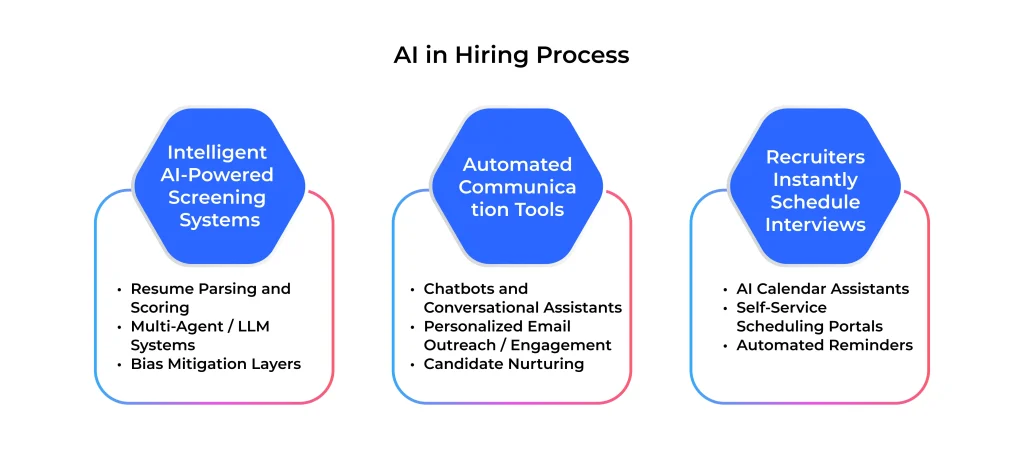
The rise of AI in talent acquisition has completely redefined how businesses attract, screen, and hire candidates. Now, HRs are using AI-powered recruitment software like x0pa, Keka, factoHR, and Recooty. Which, rather than relying on traditional review and guesswork, utilize data-driven algorithms, automation, and natural language understanding to identify the best candidates fairly and efficiently.
Here is a closer look at how modern AI-powered recruitment works and how advanced technologies are driving it.
1. Intelligent AI-Powered Screening Systems
AI-powered screening systems are at the heart of an innovative recruitment process. They help recruiters quickly evaluate large applicant pools and identify top talent based on skill relevance, experience, and potential fit. In addition, many organizations now integrate credentialing software to automate the verification of candidate qualifications, certifications, and compliance records.
- Resume Parsing and Scoring:
AI tools, by themselves, extract key details such as education, experience, and skills from resumes. These details are then compared against job descriptions, ranking candidates based on how closely they align with role requirements. It ensures no qualified applicant is overlooked due to manual errors or time constraints. However, remember that for roles demanding highly subjective and qualitative judgment, such as reviewing a CEO resume, human recruiters are indispensable for assessing cultural fit and nuanced leadership capabilities.
- Multi-Agent / LLM Systems:
The advanced recruitment platforms integrated LLM development and multi-agent AI systems to simulate human reasoning. For example, one AI agent may extract information, another might evaluate it, while a third one summarizes insights for recruiters. This whole collaboration among AI agents strengthens accuracy and eliminates bias-prone guesswork.
- Bias Mitigation Layers:
Ethical AI systems incorporate features that anonymize sensitive data like name, gender, or age. This helps reduce unconscious bias and promotes diversity in hiring. AI models also continuously learn from unbiased datasets to provide fair and transparent evaluations of candidates.
2. Automated Communication Tools
Maintaining timely communication with candidates can be challenging, particularly during high-volume recruitment periods. Here, AI for talent acquisition comes to the rescue, playing a crucial role in assuring that every applicant feels valued and informed throughout the process.
- Chatbots and Conversational Assistants:
AI-powered chatbots amazingly engage with candidates 24/7, answering their questions, collecting basic information, and even conducting preliminary screening conversations. This helps guarantee that no query goes unanswered and keeps candidates connected to the organization.
- Personalized Email Outreach / Engagement:
AI tools craft personalized messages based on the candidate’s data, such as their skills, interests, or previous interactions. These emails can adjust tone, timing, and content to increase response rates and improve engagement.
- Candidate Nurturing:
AI gives automated workflows, helps to send tailored updates, company news, or relevant job suggestions to keep potential candidates engaged over time. It is especially useful for building talent pipelines for future hiring needs.
As automation and personalization work hand in hand, recruiters can maintain stronger connections with candidates while saving valuable time.
3. Recruiters Instantly Schedule Interviews
One of the most time-consuming stages in the hiring process is scheduling interviews. And AI eliminates this bottleneck by automating coordination between candidates and interviewers. When synced with existing applicant tracking software, these scheduling systems automatically log interview activity and candidate progress.
- AI Calendar Assistants:
These virtual assistants sync with calendars, look for availability, and propose optimal time slots for interviews. They also manage rescheduling automatically and minimizing back-and-forth communication.
- Self-Service Scheduling Portals:
Candidates can access the real-time availability to select their preferred interview slots directly. It helps to accelerate scheduling and also to enhance candidate satisfaction by giving them control and flexibility.
- Automated Reminders:
The AI system sends automated reminders to candidates and interviewers, reducing no-shows and providing a smooth hiring experience. The recruiters also use analytics to track attendance and follow-up efficiency.
By simplifying these repetitive administrative tasks, recruiters can give more time to assessing candidates and improve hiring outcomes.
By working with automation, predictive intelligence, and AI in talent acquisition, businesses can enhance the hiring process, give fairness, and deliver a better experience from start to end. This new era of AI-driven recruiting is not about replacing people, but empowering them to hire smart, faster, and more effectively.
Additional Read: AI Agentic Workflows: The Next Leap in Business Automation
Core Technologies Used in AI Recruitment Tools
Artificial intelligence recruitment tools mainly rely on multiple core technologies that organize the hiring journey, from candidate discovery to final onboarding. These innovations help organizations to automate repetitive tasks, get deeper insights into talent, and make smarter, data-driven decisions, ultimately redefining AI in talent acquisition.
1. Natural Language Processing (NLP)
NLP helps systems understand and interpret human language in resumes, online profiles, and cover letters. It helps tools identify relevant skills, job titles, and experience levels, allowing recruiters to find the most qualified candidates immediately. NLP also powers natural AI writing, enabling systems to generate clear, human-like messages and communications for candidates
2. Automated Sourcing
AI algorithms continuously scan job boards, professional networks, and social media to find potential candidates that fit the open roles. The proactive approach reduces time to hire and gives consistent talent pipelines.
3. Video Interview Analysis
AI-driven video analytics assess candidates’ facial expressions, tone, and language to understand their communication and emotional intelligence, providing another layer of insights beyond their resumes.
Some candidates now use tools like AI Interview Companion to prepare for these assessments and improve their interview performance through practice sessions.
4. Predictive Analytics
The predictive models forecast candidates’ success, turnover risk, and cultural fit based on the historical data, helping recruiters make informed decisions.
5. Conversational HR Chatbots
The chatbots engage with candidates in real-time, answering queries and guiding them through application steps, while keeping them informed to improve the overall candidate experience.
So, we are questioning – how do we implement AI effectively?
AI Recruitment Implementation: A Practical Checklist
While AI offers numerous advantages in hiring, implementing it effectively requires careful planning. Here’s a quick checklist of best practices to integrate AI tools seamlessly and responsibly into your recruitment workflow:
| Step | Best Practice | Why It Helps |
| 1 | Define clear objectives & scope | Focus on specific pain points like screening, scheduling, or sourcing instead of trying to automate everything at once. |
| 2 | Pilot small, prove value | Test AI modules on a limited scale to measure impact before full rollout. |
| 3 | Ensure data quality & governance | Clean, representative, and unbiased historical data is critical for AI accuracy. |
| 4 | Select explainable & auditable AI tools | Choose solutions that provide transparency so decisions can be understood and explained. |
| 5 | Maintain human-in-the-loop oversight | Use AI to assist recruiters, but allow human review and overrides when needed. |
| 6 | Design candidate transparency & consent | Inform candidates about AI usage, request consent, and offer opt-out options. |
| 7 | Blend human & AI touchpoints | Combine personal check-ins and empathetic communication with automated processes. |
| 8 | Monitor bias and performance continuously | Audit hiring outcomes regularly and recalibrate models to maintain fairness. |
| 9 | Integrate with existing systems | Ensure AI tools work with your ATS, HRIS, and communication platforms to avoid silos. |
| 10 | Train your team & manage change | Prepare recruiters with training, address concerns, and highlight AI as an enabler. |
| 11 | Iterate & learn | Continuously refine AI scoring models, feedback loops, and modules for better outcomes. |
| 12 | Ensure compliance & data security | Follow GDPR, DPDP, and local labor/privacy laws, with proper encryption, logging, and deletion protocols. |
Benefits of Using AI in Talent Acquisition
AI in talent acquisition is revolutionizing the hiring landscape by making the process faster, faster, and more effective.
The companies adopt AI to gain a competitive edge by using data-driven insights, streamlining workflows, and improving the overall candidate journey. It is better to understand how to use AI in talent acquisition, which can unlock numerous advantages for both HR teams and candidates.
- Faster Resume Screening: AI fastly scans and ranks resumes, identifying the best-fit candidates in a fraction of a second, removing the manual screening bottlenecks. Many teams now add an AI writing detector on top of automated screening to flag unusually generic résumé text for a brief, human second look.
- Automation of Time-Consuming Tasks: Routine tasks such as scheduling interviews and sending notifications are automated, freeing HR teams to focus on strategic decision-making.
- Actionable Insights: The advanced analytics give valuable insights into candidate trends, hiring effectiveness, and skills gaps for better workforce planning.
- Diversified Talent Pool: AI tools reduce unconscious biases, helping organizations attract a wider and more diverse range of qualified candidates.
- Improved Candidate Experience: Chatbots and automations provide timely responses, creating a smoother and more engaging recruitment journey.
- Lower Costs and Improved ROI: AI processes reduce recruitment costs, also improving efficiency and quality of hires.
- Better Retention Forecasting & Enhancement: Predictive models identify candidates likely to stay longer, making strategic hiring decisions.
- Staying Ahead Technologically: It is important to use AI positions, organizations at the forefront of modern recruitment practices, fostering innovation and competitiveness.
To illustrate the real-world impact of AI in recruitment, consider RecruitRobo, an intelligent hiring solution built by us. This AI-powered platform automates multiple interview rounds, conducts candidate assessments, and provides unbiased evaluations. With the use of advanced technology, our RecruitRobo enhances the operational efficiency and decision-making in the hiring process
Key Challenges in AI Recruitment
Until now, we are aware of the advantages of AI for the talent acquisition hiring process; however, organizations must also be aware of its limitations to maximize the benefits.
- AI Lacks Deep Human Understanding: While AI excels at analyzing resumes and data, it may not fully grasp the nuances of soft skills or the cultural fit required by companies.
- AI Can Create Impersonal Experiences: Automated interactions all the time, can feel robotic, reduce engagement and connection with candidates.
- Bias & Fairness Risks: As AI systems are trained on historical data, they can unintentionally perpetuate biases and impact the fair evaluation of candidates.
- Data Privacy & Security: Regardless of how much we train and trust AI, protecting sensitive candidate information remains crucial to prevent breaches and maintain trust.
- Cost & Maintenance Overhead: Building and maintaining AI recruitment tools involves significant investment and ongoing updates to stay effective.
An interesting Read: AI Integration: The Business’s Future is Here
How Top Companies Are Winning with AI in Talent Acquisition
AI is changing the hiring process and speeding it up, also improving candidates’ experience, and making more intelligent decisions. Here are examples of how some leading organizations are using it successfully:
- Hilton Hotels: AI chatbots interact with applicants, answer questions, and simplify the hiring process for hotel staff roles.
- Siemens: AI screens all the resumes thoroughly, identifies top talent, and reduces manual effort.
- Paradox + Workday: Conversational AI streamlines interview scheduling and candidate communications.
- OptimHire: The AI-driven assessments rate candidates’ skills and fit, helping recruiters make faster and more accurate decisions.
- Chipotle & Seasonal Hiring Bots: AI bots manage high-volume seasonal recruitment, providing timely staffing and better candidate engagement.
These examples showcase how AI is making recruitment smarter, faster, and more efficient across industries.
Training for Digital Growth
After changing the talent acquisition sphere, AI’s next contribution to the hiring ecosystem is improving employee training. Platforms like ClickLearn show how technology is changing workforce education. ClickLearn, a digital adoption platform, enables the rapid creation of training materials by automating work processes within enterprise software to produce content in seven formats and over 45 languages.
ClickLearn provides organizations with a customizable eLearning portal, creating an easy learning experience for employees. Being able to update documentation with automated tools, platforms like ClickLearn enable employees to adapt quickly to new systems and workflows while cultivating skill development and increasing productivity.
Transform Your Recruitment with AI
AI in talent acquisition is reshaping hiring by pipelining the processes, improving candidate experience, and providing data-driven insights. From faster resume screening to predictive analytics and intelligent chatbots, organizations that work with AI gain a competitive edge in attracting and retaining top talent.
Implementing an AI-powered recruitment platform guarantees efficiency, accuracy, and a more engaging hiring process.
Our company, Openxcell, offers cutting-edge AI solutions, Gen AI services, and custom recruitment platforms designed to optimize your talent acquisition journey. Our expertise helps businesses harness AI effectively, reduce hiring challenges, and make smarter decisions.
FAQs About AI in Recruitment
1: Will AI replace human recruiters?
No, AI won’t replace recruiters; instead, it will improve their efficiency by automating repetitive tasks, so humans can focus on relationship-building and decision-making.
2: How can AI bias be mitigated in recruiting?
Biases can be reduced by training AI models on diverse, unbiased data and regularly auditing algorithms for fairness and transparency.
3: Is facial or voice analysis ethical in hiring?
It is tricky, but ethical only when used transparently, with candidate consent, and when it doesn’t discriminate or invade privacy.
4: How do I begin adopting AI in my recruitment?
Start small by first identifying specific pain points, choosing a reliable AI for talent acquisition tools, and ensuring they integrate simply with your existing HR systems.
5: Does AI improve retention or quality of hire?
Yes, AI in talent acquisition helps match candidates to roles more accurately, improving cultural fit, retention, and overall quality of hire.
6: What legal or regulatory issues should I watch out for?
Ensure compliance with data privacy laws, such as the GDPR, DPDP, and EEOC guidelines, to maintain transparency and fairness in AI-driven recruitment processes.

Manushi, a former literature student, now crafts content as a writer. Her style merges simple yet profound ideas. Intrigued by literature and technology, she strives to produce content that captivates and stimulates.