AI Agentic Workflows: The Next Leap in Business Automation
 Last updated:November 5, 2025
 9 Min Read
- The Rise of Agentic AI
- Demystifying Agentic Workflows
- Key Components Powering Agentic Workflows
- #1 Perception
- #2 Reasoning
- #3 Memory
- #4 Planning
- #5 Tool Utilization
- Architecture & Frameworks Behind Agentic AI Workflows
- #1 Modular Agent Architecture
- #2 Popular Frameworks for Building Agentic Workflows
- #3 Agent-Oriented Patterns
- #4 Deployment Considerations
- Real-World Use Cases Across Industries
- Key Benefits of Agentic Workflows
- Navigating Challenges in Agentic AI
- The Future is Now: Embracing AI Agentic Workflows


In 2024, one of the major fintech firms deployed an internal AI assistant to automate customer onboarding. The result was surprising; what used to take five employees usually took three hours and was now completed in just 12 minutes without any human involvement; this wasn’t just automation. It was an AI agentic workflows in action.
According to McKinsey, businesses that use autonomous AI systems have reported up to 40% gains in operational efficiency, signaling a seismic shift from static automation to intelligent, goal-driven agents. As all industries are racing to adopt the next-gen AI solutions, AI services are evolving to build more context-aware decision-making agents that don’t just follow commands but also think, play, and act.
The Rise of Agentic AI
The traditional AI models operate under fixed scripts; agentic AI mimics a human-like tone and autonomy. These systems perceive their environment, reason through challenges, and dynamically adapt their behavior to achieve goals. The emergence of this paradigm, what we now call the AI agent workflow, marks a turning point in intelligent automation.
It is no longer about having AI tools; it is more about orchestrating intelligent agents that work collaboratively, iterate through decisions, and execute tasks across complex workflows.
In this blog, we will give you a deep dive into the architecture, use cases, and strategic insights that are reshaping the future of work through agentic AI workflows and how AI development services are key enablers in this transformation.
Demystifying Agentic Workflows
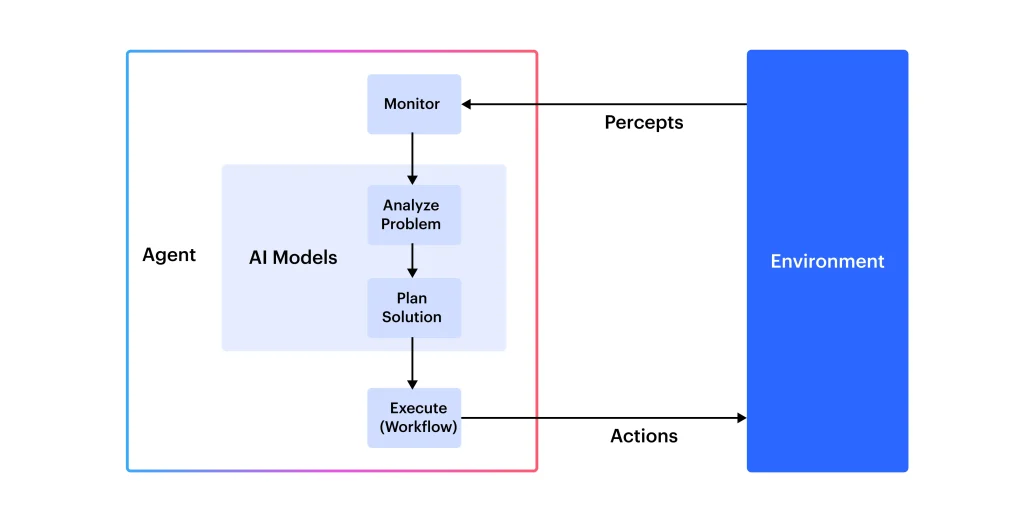
At the core, an AI agentic workflow refers to a system where AI operates not like a tool but as an autonomous “agent” that makes decisions, takes actions, and adapts based on its environment. Unlike traditional automation, which executes pre-set rules, agentic workflows involve AI models that can plan tasks, monitor outcomes, and dynamically adjust steps to meet the goal, just like a human worker might.
These agentic AI workflow are designed to mimic humans in a way that allows them to reason and respond. They break large objectives into smaller tasks, use memory to learn from past interactions, and even collaborate with other AI agents or systems.
Whether it’s managing customer support tickets or optimizing supply chains, agentic workflows help AI to operate in a loop of sensing, deciding, and acting, offering agility and intelligence across complex operations.
To fully understand how these intelligent systems function so easily, let’s break down the core components that power agentic workflows and make autonomous decision-making possible.
Key Components Powering Agentic Workflows
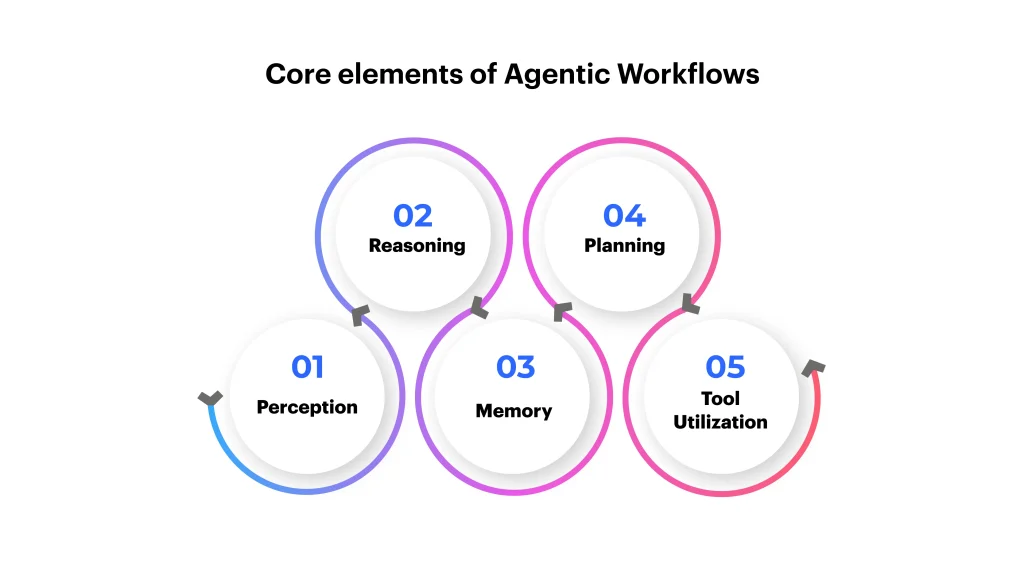
Agentic workflows in AI are created as a combination of interconnected capabilities to give human-like autonomy. These components work together to help AI agents sense, understand, decide, and act effectively within dynamic environments.
#1 Perception
The component perception is the agent’s ability to observe and interpret outputs from its environment, be it in text, audio, visual data, or system signals. Perception allows the agent to stay aware of context and real-time changes.
#2 Reasoning
Reasoning helps the agent to make informed decisions by evaluating data, drawing logical conclusions, and identifying patterns. It gives actions that are not just reactive but also goal-aligned.
#3 Memory
Agents use memory to store, retrieve, and learn from past interactions. It helps in improving responses over time and maintains context throughout long-running tasks.
#4 Planning
Planning allows the agent to break down goals into actionable steps, sequence tasks logically, and prioritize actions based on changing conditions or constraints.
#5 Tool Utilization
Agents often access external tools like APIs or databases to complete tasks efficiently. This tool’s use makes them more versatile and capable of handling complex workflows.
With a clear understanding of the building blocks, let’s explore the architecture and frameworks that bring these AI agentic workflows to life and enable its seamless execution at scale.
Architecture & Frameworks Behind Agentic AI Workflows
Behind every high-performing autonomous agent lies a thoughtfully designed system’s architecture. These frameworks define how agents perceive, reason, plan, and act, coordinating different components in harmony.
As AI agentic workflows grow more complex, scalable, and flexible, architecture becomes important to ensure adaptability, security, and performance across tasks and industries.
#1 Modular Agent Architecture
In any AI agent workflow, the modular architecture makes sure that every function of the agent is handled by a dedicated layer, making the system flexible, scalable, and easy to manage; here’s how the key modules work together.
- Input Layer (Perception): Captures and processes data from text, visuals, and APIs to understand the environment.
- Memory Layer: It stores past interactions and context for more thoughtful decision-making.
- Planning & Reasoning Engine: Analyzes data, sets goals, and breaks them into steps.
- Execution Layer (Action): Carries out tasks by interacting with users, tools, or systems.
- Feedback Loop (Learning): Uses outcomes to learn and improve future responses.
#2 Popular Frameworks for Building Agentic Workflows
As agentic AI continues to change, a growing number of frameworks are making it easy to build, deploy, and manage intelligent agents. These platforms provide the foundational tools and structure needed to implement an AI workflow, allowing developers to focus on designing behavior rather than reinventing the wheel.
Below is a quick overview of some of the most widely used frameworks:
| Framework | Use Case | Highlights |
| LangChain | Building LLM-powered agents | Chain multiple tools and memories into autonomous workflows |
| AutoGPT | Autonomous goal-driven agent execution | Plans and executes tasks based on high-level prompts |
| ReAct (by Google) | Reasoning + Acting fusion | Combines LLM reasoning with decision-action loops |
| CrewAI | Multi-agent coordination | Orchestrates task delegation and communication between specialized AI agents |
| n8n + AI nodes | Low-code automation with agentic intelligence | Combines traditional workflows with AI decision-making |
| Retool + AI | Internal tools enhanced with agent actions | Allows embedding agent capabilities into enterprise UIs |
These frameworks mainly connect with powerful AI infrastructure to better its capabilities:
- LLMs like GPT-4, Claude, LLaMA, or Mistral are used for understanding, reasoning, and generating outputs.
- Vector stores such as Weaviate, Pinecone, or Qdrant help agents recover appropriate knowledge or memory based on semantic understanding.
- Toolkits/APIs allow agents to perform real-world tasks, like browsing the web, running code, querying databases, or sending emails.
- Orchestration platforms like Airflow or Prefect help manage complex workflows, providing agents follow logic, dependencies, and scheduling rules.
Together, these tools form a strong ecosystem that powers smart, autonomous, and context-aware AI agents across use cases like secure email delivery solutions.
A Must Read: Top AI Agent Frameworks to Build Powerful AI Agents
#3 Agent-Oriented Patterns
To make AI agents truly autonomous and effective, developers follow specific behavioral patterns that guide how agents think, act, and collaborate. These agent-oriented patterns help structure decision-making and task execution within AI workflows.
- Looping Pattern: Agents continually observe, plan, act, and re-evaluate in a feedback loop.
- Tree of Thoughts: Agents explore multiple reasoning paths before choosing the best course of action.
- Function-calling with Tool-use: Agents call external tools or APIs to complete specific sub-tasks.
- Multi-Agent Systems: Multiple agents with specialized roles work together to solve complex problems.
These patterns create flexible, dynamic workflows that adapt to changing contexts and tasks.
#4 Deployment Considerations
Deploying an AI agent workflow into production involves more than just building the model; it needs thoughtful implementation to provide better performance, safety, and control. These factors are important for businesses investing in AI agent development services.
- Observability: Track agent behavior, decisions, and outcomes for transparency and debugging.
- Version Control: Manage updates and test changes safely without breaking existing workflows.
- Security & Governance: Protect data, enforce access controls, and comply with regulatory standards.
- Human-in-the-Loop (HITL): Allow human oversight for sensitive decisions or fail-safes when needed.
These considerations confirm that agents operate responsibly, reliably, and in alignment with business goals.
Real-World Use Cases Across Industries
As AI matures, industries are adopting AI agentic workflows to handle tasks that need autonomy, adaptability, and real-time decision-making. These workflows are changing traditional operations by enabling intelligent agents to perceive, plan, and act with minimal human intervention.
- Financial Services: AI agents assist in fraud detection by monitoring transactions continuously, flagging anomalies, and even initiating alerts. In wealth management, it personalizes investment advice by analyzing market trends and client behavior in real time.
- Software Development: Agentic workflow helps automate debugging, generate code snippets, and manage project timelines. Agents can collaborate with developers, suggest improvements, and even run tests, accelerating the software delivery lifecycles.
- Cybersecurity: Intelligent agents monitor networks, detect threats, and respond instantly. They can triage incidents, isolate systems, and support threat hunting by correlating data across endpoints and logs.
These use cases showcase the power of agentic AI in delivering efficiency, accuracy, and resilience.
Additional Read: The Best AI Agent Companies Transforming Industries in 2025
With real-world applications proving their value, it’s clear that AI agentic workflows offer significant advantages. Let’s explore the key benefits driving their rapid adoption across industries.
Key Benefits of Agentic Workflows
As AI adoption grows, businesses are turning to Agentic AI workflow to organize operations and boost productivity. These intelligent, autonomous systems unlock new levels of efficiency and agility across different domains.
- Enhanced Efficiency: Agents automate repetitive tasks, respond in real-time, and reduce manual workloads, leading to faster execution.
- Scalability: Once deployed, agentic workflows can easily expand across systems, teams, or regions without major redesign.
- Adaptability: Agents adjust to dynamic data and changing environments, learning and evolving with every interaction.
- Improved Decision-Making: By combining real-time perception with reasoning and memory, agents deliver faster, data-driven decisions with minimal oversight.
Together, these benefits empower organizations to operate smarter and respond more quickly in an increasingly complex world.
Navigating Challenges in Agentic AI
While agentic workflows in AI give immense promise, implementing them at a scale that comes with some challenges that require careful planning and oversight.
- Accountability: Determining who is responsible for an agent’s autonomous decisions can be complex, especially in high-stakes environments.
- Security: Agents interacting with sensitive data or external tools must be safeguarded against issues and breaches.
- Ethical Concerns: Bias, fairness, and transparency must be addressed to ensure responsible agent behavior.
- Integration: Seamlessly connecting agentic workflows with legacy systems, APIs, and data pipelines remains a technical hurdle.
Overcoming these challenges is important to build trustworthy and effective AI systems.
The Future is Now: Embracing AI Agentic Workflows
From understanding core components to exploring real-world apps, AI agentic workflows have proven to be a game-changer for modern enterprises. These workflows give autonomy, adaptability, and intelligence to tasks across finance, software, cybersecurity, and more; this unlocks better efficiency, scalability, and innovation.
As industries change, embracing agentic workflows is no longer optional but essential to stay competitive and future-ready.
At Openxcell, we specialize in offering Gen AI services, ranging from intelligent chatbot development to custom LLM integration and scalable AI agentic architectures. Whether you are starting out or scaling up, our AI services help businesses harness the full potential of next-gen technologies.

Manushi, a former literature student, now crafts content as a writer. Her style merges simple yet profound ideas. Intrigued by literature and technology, she strives to produce content that captivates and stimulates.