Top AI Tools for Data Analysis to Watch in 2026
 Last updated:May 6, 2026
 10 Min Read
- The AI Revolution in Data Analysis
- Why AI is Transforming Data Analysis
- 1. Automation of Repetitive Tasks
- 2. Real-Time Insights
- 3. Smarter Data Visualization
- 4. Predictive Analytics
- Top 10 AI Tools for Data Analysis in 2026
- Tool-by-Tool Breakdown
- Key Benefits of Using AI Tools for Data Analysis
- 1. Improved Decision Making
- 2. Reduced Time to Insights
- 3. Cost Efficiency
- 4. Scalability
- How to Choose the Right AI Tool for Your Business
- The Future of AI in Data Analysis
- Summing UP: Data Analysis Enters the AI-Driven Era
- FAQs


In this blog, you will:
- Understand why AI-powered tools matter for data analysis in 2026.
- Discover 10 top AI tools for data analysis, with features, strengths, and potential limitations.
- Get guidance on selecting and implementing the right tool for your organisation.
- Find key statistics and a compelling call to action to move forward.
The AI Revolution in Data Analysis
In a world where businesses generate data faster than we can comprehend it, AI has become the catalyst, transforming raw information into actionable intelligence. From the real-time dashboards to automated predictions, organizations today are no longer just collecting data; they are interpreting the future.
According to IDC, global data creation is expected to reach 180 zettabytes by 2025, making advanced analytics not just valuable but essential for survival.
As this data explosion intensifies, companies are shifting towards intelligent systems that simplify the complex workflows, automate insights, and accelerate decision-making. This is where the best AI tool for data analysis and modern data analytics services redefine what’s possible.
In 2026, AI-driven data analysis won’t just support system for business strategies, but it will shape them, empowering organizations with speed, accuracy, and competitive foresight.
As businesses embrace intelligent systems to navigate data-driven decisions, the next major question becomes clear: what exactly makes AI indispensable in modern analytics? This brings us to the core.
Why AI is Transforming Data Analysis
AI is reshaping the analytical landscape by enabling faster, smarter, and more accurate insights than traditional methods ever could. In 2026, the growing adoption of an AI tool for data analysis is helping companies move from reactive reporting to proactive, prediction-led decision-making. Here’s how:
1. Automation of Repetitive Tasks
AI eliminates hours of manual work by automating data cleansing, preparation, formatting, and transformation. This is why many modern analytics platforms are also considered powerful ai productivity tools, helping teams streamline workflows and focus more on strategic decision-making. It reduces human error and speeds up the analytics workflow, allowing teams to focus on strategy and not spreadsheets.
2. Real-Time Insights
The modern AI system processes massive datasets in just seconds, giving live dashboards and instant insights. Businesses can respond to market changes, customer behaviour, or operational issues the moment they occur.
3. Smarter Data Visualization
AI tools change the complex data into intuitive charts, visual stores, and narratives. This makes insights more accessible even to non-technical users, democratizing data understanding across the organization.
4. Predictive Analytics
Using the machine learning algorithms, AI tools for data analysis uncover patterns, forecast trends, and predict future outcomes with high accuracy, helping businesses plan ahead with confidence.
Additional Read: AI for Data Analytics: From Raw Data to Real Impact
As AI continues to revolutionize how organizations interpret data, the next significant step is identifying which platforms truly deliver the most value. This brings us to the curated list of top AI tools for data analysis.
Top 10 AI Tools for Data Analysis in 2026
AI-powered platforms are becoming the backbone of data-driven decision-making. In 2026, businesses are increasingly adopting intelligent solutions to automate workflows, accelerate insights, and scale analytics across teams.
Whether you are involved in a startup or an enterprise, selecting the right AI tools for data analysis can significantly transform how you extract, interpret, and act on your data.
Below is a curated list of the most impactful platforms shaping the future of analytics, every offering unique strengths in automation, predictive intelligence, and usability.
To make the comparison easier, here is a quick overview table:
Quick Comparison Table: Top 10 AI Data Analysis Tools (2026)
| Tool | Best For | Key Strength | Difficulty Level |
| IBM Watson Studio | Enterprise AI | Auto ML + visualization | Medium |
| Google BigQuery AI | Real-time analysis | NLP-driven queries | Easy |
| Azure Synapse | Unified analytics | Scalable big data | Medium |
| DataRobot | AutoML | Fast model deployment | Easy |
| H2O.ai | Open-source ML | High scalability | Medium |
| Tableau GPT | Visual insights | Ask-AI dashboards | Easy |
| Polymer | No-code analytics | AI visualizations | Very Easy |
| Numerous.ai | Spreadsheet AI | Natural language commands | Very Easy |
| Splunk AI | IT & security analytics | Anomaly detection | Medium |
| Sigma Computing | Business teams | AI-assisted queries | Easy |
Tool-by-Tool Breakdown
1. IBM Watson Studio
- Overview: It is a great enterprise-grade platform for ML, AutoML, and data visualization.
- Why a Great Choice: Powerful for organizations that need scalable AI pipelines.
- Feature Highlight: Automated data preparation and model building.
- Use Case: It is Ideal for enterprises deploying large AI models across cloud ecosystems.
2. Google Cloud AI & BigQuery
- Overview: Cloud native analytics combine with BigQuery ML for advanced modeling.
- Why a Great Choice: Fast, real-time processing for massive datasets.
- Feature Highlight: Natural language querying without coding.
- Use Case: Perfect for marketing analytics, forecasting, and automated reporting.
3. Microsoft Azure Synapse Analytics
- Overview: Microsoft Unified Workspace combines data integration, warehousing, and AI.
- Why a Great Choice: Highly scalable for complex enterprise data workloads.
- Feature Highlight: Built-in AI models that automate insight generation.
- Use Case: Finance and retail teams use it for performance and risk analytics.
4. DataRobot
- Overview: A leading AutoML platform that automates the full ML lifecycle.
- Why a Great Choice: Non-technical teams can easily build and deploy models.
- Feature Highlight: Model explainability and monitoring.
- Use Case: Used in banking, insurance, and healthcare for predictive decisions.
5. H2O.ai
- Overview: Open-source AI platform offering robust machine learning capabilities.
- Why a Great Choice: Highly scalable and flexible for data science teams.
- Feature Highlight: H2O AutoML for rapid forecasting.
- Use Case: Best for enterprises building custom ML models.
6. Tableau GPT
- Overview: AI-powered extension of Tableau enabling conversational analytics.
- Why a Great Choice: Transforms questions into instant visual dashboards.
- Feature Highlight: GPT-driven trend insights and predictions.
- Use Case: Ideal for leaders seeking quick and clear visual intelligence.
7. Polymer
- Overview: A no-code AI visualization tool that automates dashboards.
- Why a Great Choice: Converts raw spreadsheets into smart, interactive visuals.
- Feature Highlight: AI-powered categorization and anomaly spotting.
- Use Case: Startups and SMBs with limited analytics teams.
8. Numerous.ai
- Overview: An AI spreadsheet assistant for Excel and Google Sheets.
- Why a Great Choice: Makes analysis as simple as typing prompts, similar to modern prompt engineering tools that help users interact with data using natural language and structured instructions.
- Feature Highlight: Automated summaries, predictions, and data cleanup.
- Use Case: Ideal for marketing teams and small businesses.
9. Splunk AI
- Overview: AI-driven operational and IT analytics platform.
- Why a Great Choice: Exceptional at detecting anomalies and system risks.
- Feature Highlight: Real-time alerts powered by predictive algorithms.
- Use Case: DevOps, IT, and cybersecurity teams.
10. Sigma Computing
- Overview: A cloud-based analytics platform for business users.
- Why a Great Choice: Spreadsheet-like simplicity with powerful AI.
- Feature Highlight: AI-assisted query builder.
- Use Case: Ideal for teams that need quick, self-service analytics.
With so many intelligent platforms available, choosing the best AI tool for data analysis depends on your scale, team expertise, and goals, and this is where the right AI development services can help you make an informed decision.
Key Benefits of Using AI Tools for Data Analysis
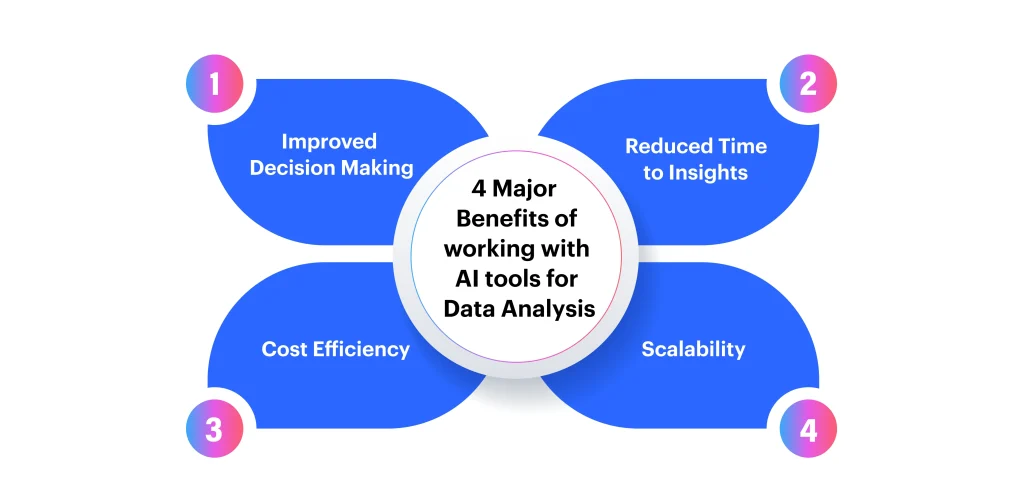
As the volume of data continues to grow, businesses are increasingly turning to AI tools for data analysis to uncover deeper insights and make smarter decisions. These technologies enhance the speed, accuracy, and overall efficiency of data-driven operations.
1. Improved Decision Making
Modern platforms give clarity to complex datasets by identifying patterns and correlations that humans might miss. With the right AI tool for data analysis, organizations can base decisions on real evidence, reducing risks and improving outcomes.
2. Reduced Time to Insights
AI automates data processing workflows, cutting down the time required to analyze, clean, and interpret information. To build a competitive advantage, companies are increasingly using web scrapers to collect
niche, real-time industry data that isn’t available in standard training sets.
3. Cost Efficiency
It minimizes manual work and optimizes analytical processes; AI reduces operational expenses. Companies can easily organize their resources to avoid the costly inefficiencies associated with traditional data analysis.
4. Scalability
As businesses expand, the best AI tools for data analysis can handle the growing data volumes without slowing down. They maintain performance, deliver real-time insights, and support long-term analytical needs.
How to Choose the Right AI Tool for Your Business
Select the right analytics platform that can significantly impact how effectively your teams extract insights and make decisions. With numerous options, businesses must evaluate tools strategically, particularly when seeking to utilize the most effective AI tools for data analysis that support long-term growth and success.
- Ease of Use
Choose the platform that empowers both technical analysts and non-technical business users, ensuring accessibility across teams.
- Integration
Make sure that the tool fits smoothly into your current tech stack, avoiding disruptions and reducing reliance on complex migrations.
- Scalability
Select the solutions that can adapt as your data volume, operations, and analytics needs grow over time.
- Features
Lastly, focus on tools that offer strong automation, intuitive visualizations, and predictive capabilities to support deeper insights, backed by reliable data engineering services when needed.

The Future of AI in Data Analysis
The next era of analytics is set to be faster, autonomous, and significantly more intuitive. With the integration of top LLM tools, analytics platforms will enable conversational data exploration, automated reporting, and real-time insight generation, making data analysis accessible to both technical and non-technical users. As organizations continue to adopt the best AI tools for data analysis, the landscape is shifting toward systems that not only process information but also understand context, learn patterns, and deliver insights immediately.
AI-powered analytics will also play an important role in sdlc requirement analysis by helping organizations identify patterns, understand user behavior, and define precise functional and technical requirements. This ensures more efficient development cycles and reduces the risk of project delays or requirement gaps.
As AI adoption grows, these platforms are becoming increasingly valuable as ai tools for developers. They enable faster integration of analytics capabilities into applications, support automated decision-making, and help developers build smarter, more scalable software solutions powered by real-time data.
By 2026, and beyond, AI will become an everyday decision-making companion rather than just a technical resource.
- Self-Learning AI Models for Predictive Analytics
AI systems will continuously learn from new data, refine their prediction without manual intervention, making each AI tool for data analysis smarter over time.
- Real-Time Data Integration Across Platforms
Businesses will access unified dashboards where data from cloud apps, IoT devices, CRM systems, and operations sync instantly to give continuous insights.
- AI Democratization
Non-technical users will generate complex insights through conversational interfaces, reducing dependency on data specialists.
- Rise of AutoML Tools
Model selection, training, tuning, and deployment will become automatic, allowing teams to accelerate analytics without deep machine-learning expertise.
To see how AI-driven innovation creates real business impact, explore our latest case study on AI-powered recruitment, where intelligent automation transformed hiring efficiency, accuracy, and decision-making for a global enterprise. Discover the full journey here.
Summing UP: Data Analysis Enters the AI-Driven Era
The future of analytics is smarter, speedier, and more intuitive than ever before. With the rise of advanced AI tools for data analysis, businesses now have the power to turn the massive datasets into real-time, predictive, and highly actionable insights.
From automation to self learning systems, AI is changing how businesses identify trends, optimize performance, and make informed decisions.
At Openxcell, we help companies unlock their potential through advanced data analysis and AI-driven solutions. Our experts design and build scalable, insight-rich systems that streamline workflows, strengthen accuracy, and drive measurable business growth.
Whether you need AI-powered dashboards, a custom analytics platform, or end-to-end data modernization, Openxcell makes sure your business stays ahead in the AI-first era.

FAQs
1. What are AI tools for data analysis?
The software platforms work with machine learning and automation processes, interpret, and visualize data more effectively and accurately than traditional methods.
2. How do AI tools improve data analysis?
AI tools automate repetitive tasks, identify hidden patterns, and provide predictive insights that help companies make informed decisions.
3. What are the best AI tools for data analysis in 2026?
Some of the leading options include IBM Watson Studio, Google Cloud AI, DataRobot, H2O.ai, and Tableau GPT, recognized for their advanced automation and intelligent insights.
4. Are AI tools suitable for small businesses?
Yes, many solutions offer flexible pricing, easy interfaces, and cloud deployment, making them ideal even for small teams.
5. How secure are AI tools for data analysis?
Most platforms adhere to strict encryption, access control, and compliance standards to ensure that sensitive data remains protected when using any AI tool for data analysis.
6. Can AI tools handle big data?
Modern systems are designed to process large, complex datasets efficiently, especially when supported by scalable architectures and the best AI tools for data analysis.

Manushi, a former literature student, now crafts content as a writer. Her style merges simple yet profound ideas. Intrigued by literature and technology, she strives to produce content that captivates and stimulates.