How Much Does It Cost to Develop an App? 2026 Pricing Explained
 Last updated:January 20, 2026
 15 Min Read
- How Much Does It Cost to Develop an App in 2026
- Average App Development Cost in 2026
- The “AI Factor” in 2026 Pricing
- App Development Cost Based on App Complexity
- 1. Simple Apps
- 2. Medium-Complexity Apps
- 3. Complex or Enterprise-Level Apps
- App Development Cost by Platform: Choosing the Right Foundation
- Key Factors Affecting App Development Cost in 2026
- 1. App Features and Functionality
- 2. UI/UX Design Complexity
- 3. Backend Infrastructure
- 4. Technology Stack
- 5. Development Team Location
- 6. Security and Compliance
- App Development Cost Breakdown by Development Stages
- 1. Discovery & Planning (10–15%)
- 2. UI/UX Design (15–20%)
- 3. Development (40–55%)
- 4. Testing & Quality Assurance (15–20%)
- 5. Deployment & Launch (5–10%)
- Hidden and Ongoing App Development Costs
- Cost-Saving Strategies for App Development in 2026
- Is App Development Worth the Investment in 2026?
- Conclusion: Navigating Your App Journey in 2026


Quick Glance
- Building an App in 2026 needs striking a balance between features, technology, and long-term scalability.
- The cost varies widely depending on complexity, platforms, and the level of AI adoption.
- This guide will help founders and entrepreneurs to evaluate how much does it cost to develop an app, identify key cost drivers, and plan development budgets more efficiently.
Imagine Sarah, a founder, launching a revolutionary health platform in 2026. She doesn’t need just a digital presence; she needs an app that predicts a user’s symptoms before they even sneeze. This is the new reality: the global mobile app market is projected to skyrocket to $378 billion this year, with a staggering $1 trillion revenue forecast by the end of 2026. Global app usage is contributing today, carrying a greater financial and strategic weight than ever before.
Navigating the financial roadmap of this evolution is important for any business leader. In this blog, we will pull back the curtain on the mobile app development cost landscape for 2026.
From understanding the “AI Premium” through professional AI development services to breaking down regional hourly rates and hidden maintenance fees, and more, we will explore everything you need to know to budget for a scalable, future-proof application.
How Much Does It Cost to Develop an App in 2026
In 2026, the mobile app market is a trillion-dollar frontier where advanced features such as personalized AI and edge computing are no longer optional. But how much does it cost to develop an app in this high-tech era?
The answer depends on your vision; it ranges from a lean of $25,000 to a functional MVP to $50,000+ for an enterprise-grade ecosystem.
To help you navigate these 2026 market rates, here is a quick overview of what to expect based on project scope:
| App Complexity | Estimated Cost (2026) | Avg. Timeline | Best For |
| Simple MVP | $25,000 – $50,000 | 2–4 Months | Validating startup ideas |
| Mid-Level Business | $50,000 – $150,000 | 5–8 Months | Scaling SMEs & e-commerce |
| Complex/Enterprise | $150,000 – $500,000+ | 9+ Months | AI-native & global platforms |
Average App Development Cost in 2026
In 2026, the average cost to build a mobile app is changing from a static screen toward “intelligent” architecture. According to the standard application, the cost mainly falls between $25,000 and $500,000+. Still, the true average is increasingly influenced by how deeply an app communicates with external data sources and internal logic engines.
The key elements that are currently defining average price points are:
- Intelligence Layer: High-end projects now frequently include LLM development to power sophisticated, context-aware user interactions.
- Infrastructure: Modern backends must support real-time data streaming and high-concurrency 5G traffic.
- Security Standards: Compliance with 2026 data privacy mandates adds a mandatory “security floor” to the average budget.
The “AI Factor” in 2026 Pricing
In 2026, AI is no longer an optional enhancement; it is a core component of modern app development. From personalized user experiences to intelligent automation, AI greatly reshapes how apps are created, scaled, and processed. As a result, understanding AI’s role is essential when evaluating how much does it cost to have an app developed in today’s technology-driven landscape.
- The “Plug-and-Play” Integration ($15,000 – $40,000): Adding basic intelligence using third-party APIs (like OpenAI or Google Gemini) for chatbots or sentiment analysis.
- Custom Model Fine-Tuning ($50,000 – $150,000): Training existing models on your proprietary data to provide specialized, brand-specific expertise.
- Enterprise-Grade AI Ecosystem ($250,000+): Developing custom neural networks, computer vision, or predictive analytics that require heavy GPU compute power and large-scale data pipelines.
App Development Cost Based on App Complexity
When it comes to budgeting an app, complexity is the primary driver for your final budget. In this day and age, complexity is no longer about the number of screens or buttons in apps; it is defined by the depth of data processing and the intelligence behind it.
Primarily, the integration of AI chatbot development services has become the standard benchmark for modern applications, introducing a layer of conversational logic that affects both development time and server infrastructure costs.
Determining how much does it cost to develop a mobile app needs a complete look at your project through these three distinct lenses of complexity.
1. Simple Apps
Simple applications focus on a single core utility, making them ideal for businesses seeking to validate the concept without incurring high technical overhead.
Examples:
- Calculator apps: A Particular tool for specific mathematical or financial formulas.
- Basic fitness trackers: An app to log daily steps, water intake, diet, etc, without external wearable syncing.
- To-do list apps: Personalized, productive tool with local storage and basic reminder features.
- Informational apps: Digital brochures or catalogs that display static content to users.
Key Features:
- Basic UI: A standard, clean interface design using native platform components.
- Limited screens: Small and easy navigation flow usually consisting of 5 to 10 screens.
- No or minimal backend: Data is stored locally on the device rather than on a remote server.
- Standard APIs: Integration of basic system services like the camera or social sharing buttons.
Estimated Cost: $25,000 – $50,000
2. Medium-Complexity Apps
Medium complexity apps are the sweet spot for many growing businesses. At this level, many companies work with generative AI services to automate content creation or provide personalized user recommendations, significantly increasing the mobile app development cost due to the integration of complex logic engines.
Examples:
- E-commerce apps: These are full-featured retail platforms for managing multichannel inventory.
- Food delivery apps: The entire system connects customers, restaurants, and drivers in real-time.
- Booking and scheduling apps: An Interactive platform for managing appointments, tickets, and service reservations.
- Social networking apps (basic): Community-focused apps with user profiles and activity feeds.
Key Features:
- User authentication: Have proper secure sign-in systems, including all social login and two-factor authentication.
- Payment gateways: Integration with processors like Stripe, PayPal, or any other apps for secure financial transactions.
- Real-time notifications: Automated push alerts and in-app messages based on users’ activities.
- API integrations: Easy connects with third-party services for maps, weather, or CRM data.
- Admin dashboards: Web-based portals for business owners to manage their users and view analytics.
Estimated Cost: $50,000 – $150,000
3. Complex or Enterprise-Level Apps
Enterprise-grade applications are created for high concurrency and deep data intelligence, often working as the primary infrastructure for global organizations.
Examples:
- Fintech apps: Advanced fintech platforms provide transaction security and also a payment gateway in many ways, like money exchange, AI-powered crypto, etc
- Healthcare apps: These apps provide content monitoring for patients and safeguard their information via the cloud, and are deemed HIPAA-compliant systems.
- AI-powered platforms: There are numerous AI-powered apps that utilize advanced AI technologies and tools, such as GPT-4, Gemini, and Copilot, to streamline the workflow for users.
- On-demand marketplaces: High-traffic service platforms require complex, real-time matching algorithms for improved outcomes.
- IoT-based applications: Plenty of apps control smart hardware or industrial sensor networks and provide complete data to users.
Key Features:
- AI/ML integration: Custom algorithms for predictive analytics, image recognition, or natural language processing.
- Real-time data processing: Handles massive streams of data instantly for live trading and updates.
- Advanced analytics: Dive deep into reporting tools that visualize complex business metrics and user behaviour.
- High-level security compliance: Strict adherence to global standards such as GDPR, HIPAA, or PCI-DSS.
- Cloud scalability: Architecture design to handle millions of users by auto-scaling cloud resources.
Estimated Cost: $150,000 – $500,000+
Understanding these tiers helps you to align your business goals with a realistic financial roadmap. Whether you are starting a small project or aiming for a global launch, your choice of complexity will ultimately dictate how much does it cost to develop a mobile app that stands out in the market in 2026.

App Development Cost by Platform: Choosing the Right Foundation
Choosing the platform is a strategic pivot that defines your technical debt and market reach. Here is the mobile app development cost breakdown by platform to help you choose the most effective path for the 2026 launch:
- iOS App Development ($30,000 – $300,000+):
iOS app development requires strict adherence to Human Interface Guidelines and premium design standards, often resulting in higher upfront costs but faster testing cycles.
- Android App Development ($25,000 – $280,000+):
While initial Android app development is competitive, the big fragmentation of 24,000+ device types in 2026 can increase your QA budget by nearly 20%.
- Cross-Platform App Development ($40,000 – $200,000+):
Using different frameworks like Flutter or React Native allows for a single codebase, mainly achieving 30 to 40 % compared to building two separate native applications.
Key Factors Affecting App Development Cost in 2026
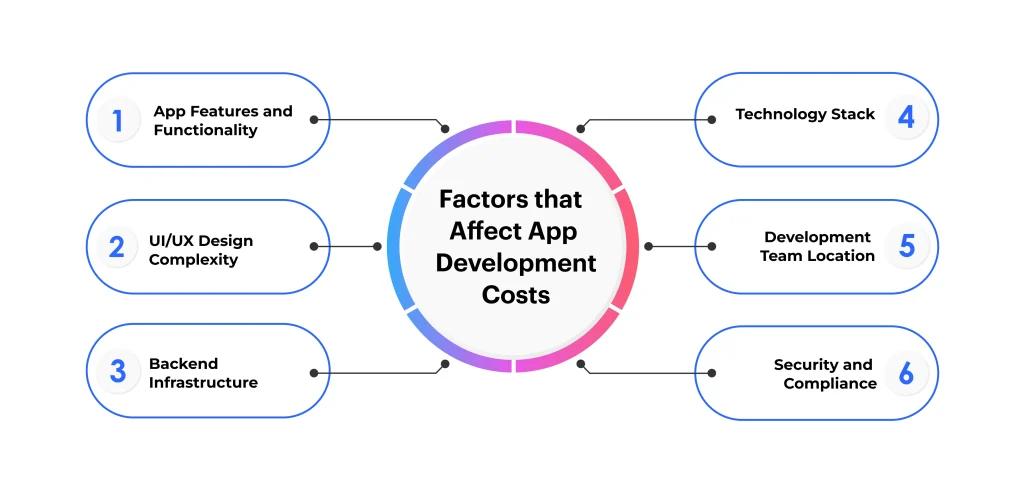
As we talk about budgeting for a digital product, there are several variables that influence the final price tag beyond simple coding hours. In 2026, understanding how much does it cost to develop an app requires a deep dive into functional requirements, design depth, and the geographic landscape of the talent pool.
1. App Features and Functionality
The scope of the feature list has the largest influence on the total budget. Adding high-end capabilities can quickly shift a project from a simple utility to a complex ecosystem.
Cost-Driving Features Include:
- AI-based recommendations: Implement ML models to suggest products or content based on user behavior.
- Real-time chat: Builds a low-latency messaging system to support file sharing and status indicators.
- Payment processing: Integrating secure, PCI-compliant gateways for easy global transactions.
- Location tracking: Utilizes GPS and geofencing for real-time logistics or proximity-based alerts.
- Video/audio streaming: Sets up high-bandwidth infrastructure for live or on-demand media playback.
2. UI/UX Design Complexity
A user interface is the bridge between your brand and your customer. Determining how much does it cost to get an app developed mainly depends on whether you choose a template-based design or a bespoke, animated experience.
- Design Cost Range ($5,000 – $30,000+): Design investment covers everything from initial user research and wireframing to high fidelity prototyping and also custom iconography.
Related Read: How Much Does it Cost to Design an App? Your Budget Breakdown
3. Backend Infrastructure
The invisible part of your app is the server-side logic, which ensures data stays synced and the system remains stable under heavy traffic.
- Databases: Architecturing secure structures to store and retrieve user information efficiently.
- APIs: Establish internal and external links that enable different software components to communicate effectively.
- Cloud services: Using platforms like AWS or Azure for scalable hosting and data storage.
- Admin panels: Build web-based dashboards that allow your team to manage users and view analytics.
4. Technology Stack
The choice of tools, from programming language to specialized frameworks, dictates long-term scalability and maintenance costs.
High-Cost Technologies:
- AI and machine learning: Training custom neural networks or integrating large language models.
- Blockchain: Implements decentralized ledgers for transparency and high-level transaction security.
- AR/VR: Makes immersive 3D environments that interact with the physical world.
- IoT integrations: Connects the app with smart hardware and sensor networks.
5. Development Team Location
In pricing the development of cost, where the developers are based is one of the biggest factors in the final quote. When you ask how much does it cost to hire an app developer, the answer changes dramatically across continents.
Hourly rates vary by region:
- North America: $100 – $200 per hour for high-tier architectural and strategic leads.
- Western Europe: $70 – $150 per hour for strong engineering standards and GDPR compliance expertise.
- Eastern Europe: $40 – $80 per hour for a high-quality balance of technical skill and competitive pricing.
- Asia: $25 – $60 per hour for the most cost-effective scaling and a vast talent pool.
6. Security and Compliance
Apps that handle sensitive data must comply with strict regulations like GDPR, HIPAA, or PCI-DSS to avoid legal penalties.
Additional Cost ($5,000 – $50,000+): This budget is allocated for end-to-end encryption, regular security audits, and implementing data privacy protocols.
Case Study: Smart AI Health App
Openxcell’s Smart AI Health App showcases a high-complexity 2026 build. By integrating LLMs (GPT-4) and RAG architecture, it delivers personalized symptom analysis and medication guidance. This project exemplifies how strategic AI investment transforms reactive medical tools into proactive, accessible healthcare ecosystems.
App Development Cost Breakdown by Development Stages
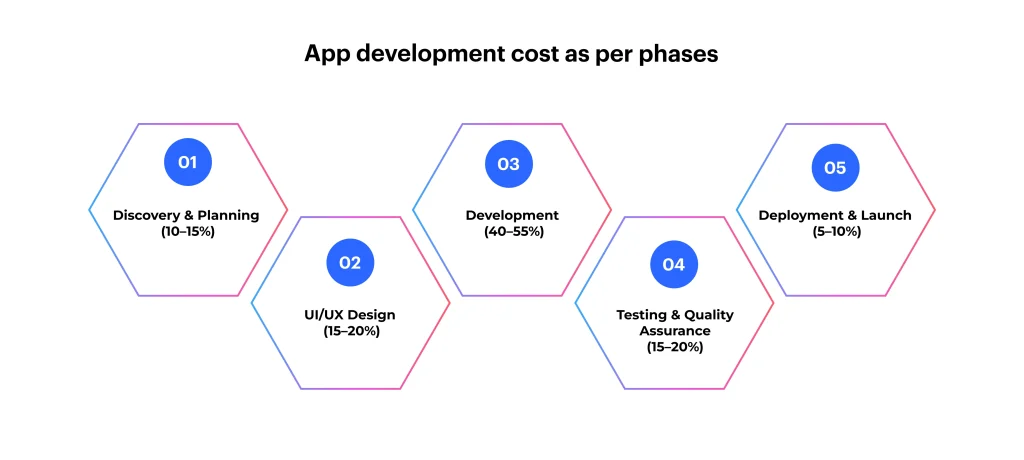
To be confident that the project remains on budget, it is important to understand that capital is not spent all at once. In 2026, the mobile app development cost is distributed across a structured lifecycle, making sure that each dollar contributes to a stable and scalable end product.
The following breakdown illustrates how the mobile app development cost is typically allocated across five main stages of production.
1. Discovery & Planning (10–15%)
The foundational stage involves deep strategic alignment to ensure that the technical roadmap aligns with your business goals.
- Market research: Analyze competitor apps and identify unique market gaps for your product.
- Requirement analysis: Defining the full functional scope and technical specifications for the developers.
- Wireframing: Creating low-fidelity skeletal blueprints of the app to map out the user journey.
2. UI/UX Design (15–20%)
Designers focus on neurodesign principles to make sure that the interface is intuitive and reduces the user’s cognitive load.
- User flows: Maps out every possible path a user takes within the application.
- Visual design: Craft high-fidelity mockups with custom branding, typography, and color schemes.
- Prototyping: Develop clickable models to test the look and see it before every single line of code is written.
3. Development (40–55%)
As the most resource-intensive phase, this is where the “heavy lifting” of building the actual logic and interface occurs.
- Frontend and backend coding: Build the user-facing screen and the invisible server-side infrastructure.
- API integration: Connects the app to third-party services, such as payment gateways or social logins.
- Feature implementation: Coding the main functionalities, like specialized AI or real-time data engines.
4. Testing & Quality Assurance (15–20%)
Testing is no longer an afterthought; it is a vital aspect of app development, and QA is crucial in preventing costly post-launch bugs.
- Manual testing: Human testers interacting with the app to find edge-case glitches.
- Automated testing: Use of scripts to run repetitive checks on core functions for faster verification.
- Performance testing: Stress-testing the app to ensure it handles high traffic without crashing.
5. Deployment & Launch (5–10%)
The final push involves preparing the application for public release and giving a seamless transition to live servers.
- App store submission: Managing the rigorous review process for the Apple App Store and Google Play.
- Server configuration: Setting up the final cloud environment for hosting and database management.
- Final optimizations: Polishing the code for speed and verifying that all analytics trackers are live and functioning properly.
Hidden and Ongoing App Development Costs
Building an app is the first half of the journey. In 2026, the digital landscape moved so fast that a set-and-forget-it approach led to rapid obsolescence. To stay competitive, businesses need to understand that how much does it cost to have an app developed includes a long-term commitment for stability, security, and performance.
As the initial launch is a major milestone, one should budget the following ongoing expenses to make sure your product survives the first year:
- App Maintenance and Updates
Mobile OS and updates, iOS and Android, need frequent, regular maintenance to make sure that the app doesn’t crash when a new version rolls out.
- Cloud Hosting
As the user base grows, your server costs will scale. Professional AI consulting can help to optimize the cloud architecture to prevent monthly bills from spiraling.
- Third-Party APIs
Many modern apps rely on external services for maps, payments, or SMS; these services typically incur recurring subscription or per-transaction fees.
- Bug Fixes
No software is perfect at launch; dedicated support is needed to monitor crash reports and resolve user-reported glitches in real time.
- Feature Upgrades
To retrain users, one must iterate on the users’ feedback, which includes adding new tools or refining existing workflows to match the market trends.
Estimated Annual Maintenance Cost: 15–25% of the initial development cost.
Ultimately, when calculating how much does it cost to develop an app, failing to account for these hidden layers can stall your growth. A proactive maintenance strategy is the difference between an app that fades away and one that scales into a market leader.
Cost-Saving Strategies for App Development in 2026
In this rapidly changing landscape, smart budgeting is more than just cutting costs; it is about strategic allocation. By optimizing the mobile app development cost breakdown, one can build a premium product without the enterprise-level price tag.
Here are four proven strategies to manage how much mobile app development cost effectively:
- Build an MVP First: Validate your core concept by launching an MVP with Real Users. This prevents overinvesting in complex features that may not resonate with your target market.
- Use Cross-Platform Frameworks: Use tools like Flutter or React Native to maintain a single codebase for both Android and iOS; this approach can reduce the initial development expense by 40%.
- Prioritize Features Strategically: Use a “MoSCoW” (Must-have, Should-have, Could-have, Won’t-have) analysis to focus on high-impact features. This keeps the initial scope lean and accelerates your time-to-market.
- Choose the Right Development Partner: Partner with an experienced agency that offers transparent pricing and a proven track record of success. The right partner helps avoid costly reworks by getting the architecture right the first time.
Is App Development Worth the Investment in 2026?
In 2026, app development continues to be a worthwhile investment for businesses aiming to stay competitive in the digital space. As we know, mobile app development has transitioned from a digital luxury to a primary source of revenue.
With global mobile app revenue projected to exceed $935 billion this year, the ROI is more compelling than ever. Users nearly spend 88% of their mobile time in apps, where average order values are consistently 10% to 50% higher than on the mobile website.
While businesses repeatedly question how much does it cost to develop an app, the long-term returns, like improved brand loyalty, data-driven insights, and scalability, often outweigh the initial costs. With advancements in AI, automation, and cross-platform technologies, these developments have become more efficient and outcome-focused.
Conclusion: Navigating Your App Journey in 2026
Budgeting a digital product in this day and age landscape needs innovation with fiscal responsibility. As we have explored, determining how much does it cost to develop an app in 2026 involves more than just counting features; it needs proper accounting for specialized AI integrations, regional talent shifts, and long-term maintenance.
At Openxcell, we turn these complex variables into an organized path for your business. As a CMMI level 3 certified partner with 15 years of experience, we specialize in optimizing the mobile app development cost for our clients through transparent pricing and top-tier engineers. From custom LLM development to high-performance native apps, our team of 500+ experts is ready to change your vision into a future-proof reality.

Manushi, a former literature student, now crafts content as a writer. Her style merges simple yet profound ideas. Intrigued by literature and technology, she strives to produce content that captivates and stimulates.