Exploring AI in Daily Life: Smarter Choices, Easier Living
 Last updated:November 13, 2025
 12 Min Read
- What is AI and Its Capabilities?
- How is AI Used in Everyday Life
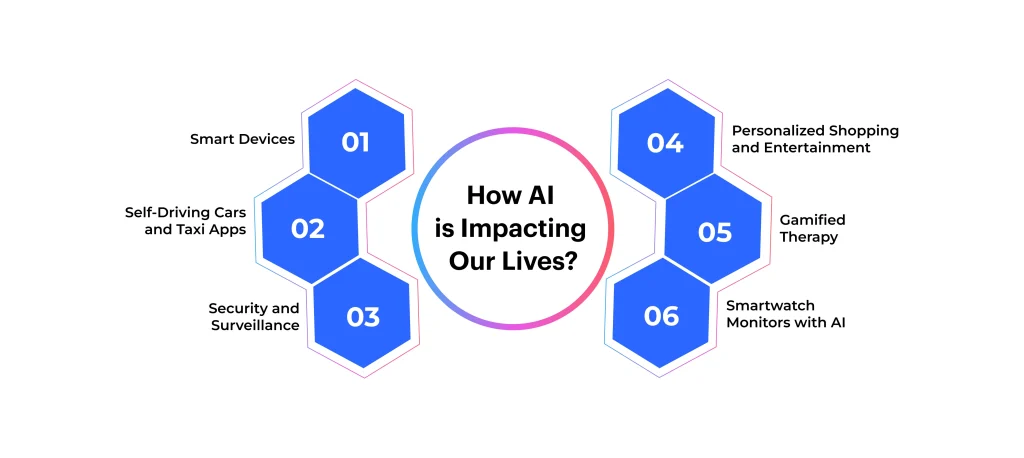
- 1. Smart Devices: From Morning Alarms to Daily Assistance
- 2. Self-Driving Cars and Taxi Apps: Smarter Transportation
- 3. Security and Surveillance: Protecting What Matters Most
- 4. Personalized Shopping and Entertainment: Tailored Experiences
- 5. Gamified Therapy: Making Mental Health Accessible
- 6. Smartwatch Monitors with AI: Health at Your Fingertips
- Bringing It All Together
- How Mobile and AI Create Smarter Everyday Experiences
- 1. Voice Assistants on the Go
- 2. Smarter Photography
- 3. Real-Time Translation
- 4. Personalized Apps & Content
- The Bigger Picture: How AI is Shaping Industries Worldwide
- 1. AI in Personal Finance
- 2. AI in Healthcare
- 3. AI in Education
- 4. AI in Transportation
- 5. AI in Ecommerce
- The Wider Impact
- The Road Ahead: Future of AI in Daily Life
- Frequently Asked Questions on AI in Daily Life


Quick Glance: Smarter Living with AI
-
- Everywhere, Every Day – AI is now quietly powering routines, from home to workplace.
-
- What It Is – The machines smartly mimic human intelligence with powerful capabilities.
-
- Always Around Us – AI is embedded in our devices, apps, and services we rely on.
-
- Beyond Daily Life – AI is strongly reshaping the healthcare, finance, and education industries.
-
- Looking Ahead – A future of smarter, personalized, and ethical AI integration.
-
- Why It Matters – Artificial Intelligence is not just convenience, but a path to growth and innovation.
Recent studies show that over 80% of smartphone users rely on AI-based apps every day, from navigation tools to shopping assistants, etc. Whether you are curating your playlist, commuting through maps, or monitoring your fitness, AI has easily become a trusted companion.
Now, AI is not limited to tech experts. AI in daily life is empowering ordinary people by automating tasks, boosting convenience, and improving decision-making. This blog will explore how AI surrounds us, from home to work to play, making our lives easier and smarter every day.
As we know, AI surrounds us daily. Let’s take a close look at what AI really is and what makes its powerful capabilities so transformative.
What is AI and Its Capabilities?
Artificial Intelligence refers to the computer systems that are designed to mimic human intelligence, their learning, reasoning, and adapting to perform tasks with minimal human input.
You have already interacted with AI in everyday life through Siri answering your queries, Alexa controlling smart homes, or, for instance, Netflix recommending your favorite series. These interactions show how AI blends into our routine tasks to make life easier and intuitive.
The strength of AI lies in different capabilities; NLP allows voice assistants to understand and respond in human-like ways. Machine learning enables apps to learn from users’ behavior and improve it over time.
The predictive analytics powers tools like Google Maps to forecast traffic. Computer vision helps with facial recognition in phones and smart surveillance, and automation drives efficiency in tasks ranging from banking fraud detection to chatbots offering AI services around the clock. Together, these capabilities make AI a cornerstone of modern living.
How is AI Used in Everyday Life
AI is no longer a buzzword; it is quietly becoming a daily partner of ours, making life more efficient, personalized, and convenient. From the moment we wake up to the time we go to bed, AI is embedded in the devices, apps, and services we rely on.
Whether through AI examples in everyday life like voice assistants, navigation apps, or fitness trackers, the role of AI continues to grow stronger. So now let’s explore how different AI apps have become an integral part of modern living.
1. Smart Devices: From Morning Alarms to Daily Assistance
There are so many smart devices like Amazon’s Alexa, Google Home, and Apple Siri that showcase how AI can easily be part of our homes. The devices help in everyday tasks like setting an alarm, providing weather forecasts, controlling lighting, playing music, ordering groceries, and more.
These smart assistants use NLP to understand commands and ML to improve over time. With Gen AI services, these devices are becoming more conversational companions, anticipating needs and offering proactive solutions.
2. Self-Driving Cars and Taxi Apps: Smarter Transportation
AI is now changing the way we travel. Ride-hailing apps such as Uber and Lyft use AI to calculate fares, give optimal routes, and match riders with drivers. The real-time traffic updates and accident predictions powered by AI make the journey safer and faster.
On the other hand, self-driving cars like Tesla and Waymo rely heavily on computer vision and predictive algorithms to navigate roads, recognize obstacles, and make decisions in a split second, aiming to reduce human error and transform mobility.
3. Security and Surveillance: Protecting What Matters Most
We unlock smartphones with facial recognition and secure bank accounts with AI-powered fraud detection. Security is an important area where AI shines immensely. The smart surveillance cameras detect suspicious activities, identify intruders, and give instant alerts to homeowners.
Majorly, financial institutions use AI to flag unusual transactions and prevent fraud. The cybersecurity platforms use AI to identify malware and phishing attempts in real time. These systems demonstrate how AI is not just about convenience but also about safety and trust.
Majorly, financial institutions use AI to flag unusual transactions and prevent fraud. The cybersecurity platforms use AI-powered fraud detection to identify fake receipts, phishing attempts, and other fraudulent activities in real time. These systems demonstrate how AI is not just about convenience but also about safety and trust.
4. Personalized Shopping and Entertainment: Tailored Experiences
AI has completely changed how we consume entertainment and shop. Platforms like Amazon suggest products based on our browsing history, while Netflix and Spotify curate recommendations based on past behavior. The chatbots on ecommerce websites give instant answers to customer queries and better shopping experiences.
This system relies on recommendation engines and predictive analytics, providing a level of personalization that saves time and enhances satisfaction. This personalization is one of the most impactful examples of AI examples in everyday life, as millions of people interact with it daily without realizing it. This omnichannel personalization strategy seamlessly integrates customer preferences across all touchpoints, creating a unified shopping experience.
5. Gamified Therapy: Making Mental Health Accessible
There are so many mental health apps that are increasingly turning to AI for innovative solutions. Apps like Woebot and Wysa use conversational AI to give therapy-like experiences, helping users manage stress and anxiety through gamified interactions.
These platforms combine psychology with AI to deliver supportive conversations and exercises that feel approachable and engaging. By making therapy accessible on smartphones, AI is reducing stigma and extending support to people who may not seek professional help.
6. Smartwatch Monitors with AI: Health at Your Fingertips
The wearable technology powered by AI is revolutionizing healthcare monitoring. Devices like Apple Watch and Fitbit track heart rate, sleep patterns, and oxygen levels, and also detect irregularities such as atrial fibrillation.
For elderly individuals, AI-powered watches send fall alerts and health notifications to caregivers, providing an extra layer of safety. These tools empower individuals to take charge of their health, giving insights that were once only available through medical checkups.
Bringing It All Together
AI has woven itself into the fabric of daily living, improving convenience, personalization, and safety in numerous ways. From the simple act of asking a smart assistant for directions to the complex tasks of analyzing health patterns, AI is present in nearly every sphere of modern life.
The combination of intelligent devices, predictive technologies, and Gen AI services confirms that AI continues to evolve, shaping a future where life is not just easier but also smarter and more connected than ever.
How Mobile and AI Create Smarter Everyday Experiences
Mobile phones are around us every time, and in our hands all the time; they are the most powerful medium where AI meets daily convenience. Today, smartphones are not just communication tools; they are intelligent companions shaping how we live, work, connect, and more. Let’s look at how AI enhances mobile experiences.
1. Voice Assistants on the Go
Voice assistants like Siri, Google, and Bixby help with hands-free texting, reminders, and quick searches.
2. Smarter Photography
AI-powered cameras, such as those on iPhones and Samsung devices, can adjust lighting, detect scenes, and even edit images automatically.
3. Real-Time Translation
Apps like Google Translate break language barriers instantly, making global communication smoother.
4. Personalized Apps & Content
From Spotify music suggestions to YouTube video recommendations, personalization is at the core of mobile AI.
| Mobile Feature | AI Benefit | Example |
| Voice Commands | Hands-free productivity | Google Assistant |
| Camera Enhancements | Clearer, smarter photos | iPhone Camera AI |
| Real-Time Translation | Breaking language barriers | Google Translate |
| Personalized Content | Tailored entertainment | Spotify, YouTube |
By implanting AI in everyday life, mobile phones demonstrate the most relatable AI in daily life applications, turning devices into intelligent partners that simplify and enrich modern living.
The Bigger Picture: How AI is Shaping Industries Worldwide
Artificial Intelligence is not only changing our personal routines but also shaping major industries on a global scale.
What was started with simple chatbots and voice assistants has now expanded into lifesaving medical tools, intelligent financial systems, and smart city infrastructure.
The main companies like OpenAI and Google’s Gemini are pushing boundaries, proving that AI’s impact extends far beyond everyday convenience; it is more about innovation, efficiency, and better decision-making.
Understanding these apps helps us see not just AI in day-to-day life but also how it can potentially revolutionize the entire sector.
Here is a closer look at the bigger picture.
1. AI in Personal Finance
- There are some amazing money management apps and smarter AI-powered apps. From budgeting tools to robo advisors, financial planning is now more precise, easier, and data-driven.
- Some renowned platforms like Cleo and Mint use AI to analyze spending patterns and give personalized suggestions.
- Fraud detection systems in banks safeguard transactions in real-time, where stock trading bots analyze market trends instantly to guide investment decisions.
- For individuals exploring how to use AI in daily life, financial apps are a perfect starting point to track expenses, save smarter, and invest wisely.
2. AI in Healthcare
- Healthcare is one of the most promising areas for AI adoption. It helps in early disease detection through imaging tools to AI-powered chatbots giving basic medical advice; the industry is undergoing a digital revolution.
- Wearables like Fitbit, Apple Watch, etc., help monitor vital health stats, while predictive algorithms assist doctors in identifying risks before they become critical.
- AI is also accelerating in drug discovery, reducing years of research into months. AI gives large-scale data insights supporting research, and healthcare is experiencing breakthroughs that save lives and improve accessibility.
Related Read: How AI in Drug Development Is Accelerating Drug Discovery
3. AI in Education
- Education systems are becoming more personalized and interactive thanks to AI.
- Adaptive learning platforms adjust the study material to each student’s pace, while tools like Duolingo use gamification and AI to make language learning better.
- The teachers benefit from an automated grading system, which saves time and reduces biases.
- Virtual tutors powered by AI are available 24/7, giving continuous support for learners.
- These innovations bridge gaps in access to quality education and create customized learning experiences worldwide.
4. AI in Transportation
- The transportation industry is undergoing a smart makeover. AI powers real-time traffic prediction systems such as Google Maps, helping commuters avoid congestion.
- Logistics companies use AI to optimize delivery routes, saving both time and fuel.
- Self-driving vehicles like Tesla, Waymo, and others are advancing the vision of safer roads with fewer accidents caused by human errors.
- Predictive maintenance powered by AI ensures the vehicles are serviced before breakdowns occur.
- Whether it is catching a flight on time or receiving a package faster, transportation demonstrated AI’s large-scale impact on modern living.
5. AI in Ecommerce
- Online shopping is the most visible space where AI has shine amazingly.
- Recommendation engines suggest products based on users’ browsing history, increasing convenience for customers and boosting sales for businesses.
- AI-powered chatbots handle the customer service queries instantly, ensuring the support is available 24/7.
- AI also helps inventory management systems by predicting demand trends and assisting businesses in avoiding stock shortages or excess.
- AI-generated personalized marketing campaigns ensure that ads are relevant to each shopper, making ecommerce experiences smooth, tailored, and efficient.
The Wider Impact
From securing finances to advancing medicine, from transforming classrooms to revolutionizing how we move and shop, AI is the driving force behind countless innovations.
Leaders like ChatGPT and other AI platforms are setting new standards, so AI’s influence is only going to expand. These bigger-picture applications highlight that AI in daily life is not just about making routines easier; it’s about shaping smarter industries, building sustainable systems, and creating growth opportunities.
By exploring how to use AI in daily life, individuals and businesses alike can unlock its full potential to shape a brighter future.
The Road Ahead: Future of AI in Daily Life
The future promises even deeper integration of AI in daily life, where technology won’t just assist you but anticipate your needs.
Now, smart homes will become an energy-efficient ecosystem, AI-driven healthcare will provide predictive treatments before symptoms appear, and autonomous vehicles will redefine urban mobility.
Education, too, will majorly evolve with hyper-personalized learning experiences tailored to each student. Looking forward, AI examples in everyday life will expand into sustainability and smart cities, with AI optimizing waste management, energy usage, and public safety.
Ethical AI is designed to minimize bias and protect privacy, which will be equally critical, making sure progress aligns with human values.
AI in Everyday Life: Shaping a Smarter Tomorrow
AI has easily woven into our routines through smart devices, healthcare wearables, ecommerce recommendations, and financial planning tools. What was once futuristic is now essential, as AI in daily life makes every task easier, decisions smarter, and experiences more personalized.
In all the major industries, like education, transportation, and healthcare, AI examples in everyday life show us how technology is changing the way we live, work, or interact with the world.
As businesses and individuals look ahead, the need for innovative AI services is only growing. The companies need customized solutions beyond off-the-shelf tools, whether automation, custom platforms, or predictive analytics. This is where Openxcell comes to guide you.
With expertise in AI integration for app and software development and more, we help organizations harness AI to improve efficiency, innovate faster, and stay competitive. So, it will be great to partner with Openxcell, which means preparing for today’s challenges and a smarter AI-driven future.
Frequently Asked Questions on AI in Daily Life
- What does AI in daily life mean?
AI in daily life refers to using smart technologies that simplify everyday tasks, such as voice assistants, personalized recommendations, and navigation apps.
- How can I use AI in my daily life?
There are numerous ways to easily use AI for time management, financial planning, online shopping suggestions, language translation, health monitoring by wearable devices, etc.
- What are some common examples of AI in daily life?
There are major examples of AI in daily life, such as Netflix recommendations, Alexa, Siri, Google Maps, and automated spam filters in emails.
- Is AI safe to use in everyday life?
Yes, it is safe to use AI in everyday life, but you should also be mindful of data privacy and use trusted platforms that prioritize your security.
- How is AI changing industries like healthcare and finance?
AI is changing industries by helping with accurate diagnoses in healthcare, fraud detection in finance, and predictive insights that help improve customer experience and efficiency.
- Will AI replace human jobs in the future?
AI will automate repetitive tasks, but it’s more likely to create new roles that require creativity, critical thinking, and human decision-making.

Manushi, a former literature student, now crafts content as a writer. Her style merges simple yet profound ideas. Intrigued by literature and technology, she strives to produce content that captivates and stimulates.