What Is Data Annotation and Why It Matters in the AI Era?
 Last updated:October 16, 2025
 9 Min Read
- What is Data Annotation?
- Why is Data Annotation Important?
- Types of Data Annotation
- Text Annotation
- Image Annotation
- Audio Annotation
- Video Annotation
- Steps in the Data Annotation Process
- 1. Data Collection
- 2. Annotation Tools Selection
- 3. Labeling Guidelines
- 4. Annotation Execution
- 5. Quality Assurance
- Tools and Platforms for Data Annotation
- Challenges in Data Annotation
- Best Practices for Effective Data Annotation
- Set Clear Objectives
- Use Domain Experts
- Implement Quality Checks
- Fully Automation
- The Future of Data Annotation
- Final Words on Data Annotation


Have you ever wondered how self-driving cars” see” the road or how your phone understands voice commands? The magic behind these technologies lies in data annotation, but what is data annotation?
Well, it is a meticulous process of labeling and classifying data to make it understandable for machines. Without labeled data, machines would struggle to understand text, speech, or images, leaving innovation at a standstill.
Data annotation is the process of labeling or tagging data – whether text, videos, images, or audio so machines can understand, interpret, and act on it. This vital step trains AI models to recognize patterns and make decisions, building the backbone of apps for sentiment analysis, voice recognition, and object detection.
What is Data Annotation?
Data annotation provides ground truth labels to data, enabling supervised machine learning algorithms to learn from labeled examples and generalize to unseen data. By adding meaningful tags or markers, data annotation AI systems recognize and understand patterns, classify information, and make accurate predictions.
Whether it’s tagging objects in an image for self-driving cars or categorizing customers’ sentiments in reviews, data annotation is a critical step in training AI to perform real-world tasks with precision.
But apart from this, there are so many branches and parts that need to be understood to answer the question of what is data annotation. Here, we will give you in-depth information on data annotation, starting with its importance, types, tools, and more.
Why is Data Annotation Important?
Data Annotation is the backbone of any successful AI project. It involves labeling and categorizing raw data and transforming it into a structured format that machine learning models can understand and learn from.
This process is important for training accurate and reliable AI models, as the quality of the annotated data directly impacts their performance. Without high-quality annotated data, AI models cannot effectively recognize patterns, perform complex tasks, or make predictions.
The global data annotation market was valued at USD 1.97 billion in 2022 and is projected to grow at a compound annual growth rate (CAGR) of 28.7% from 2023 to 2030.
This significant growth is driven by the increasing demand for data annotation tools and AI and machine learning applications across different industries, such as automation, finance, and healthcare. As AI continues to advance, the need for high-quality annotated data will only increase, making data annotation a critical and rapidly evolving field.
Types of Data Annotation
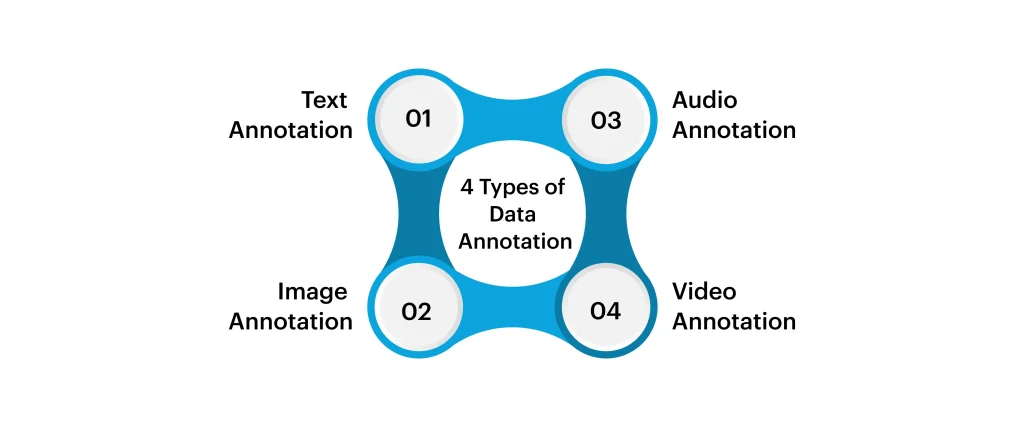
When it comes to understanding data annotation, the first thing you need to learn is the types of data annotation. Each type of annotation serves a unique purpose in improving the functionality and accuracy of AI-driven applications. Partnering with a reliable data annotation company ensures that these types of annotations are implemented effectively, enhancing the quality of datasets for AI development.
Text Annotation
Text annotation labels textual data so that machine learning models can comprehend and derive meaning. It is widely used in NLP tasks.
- Sentiment Analysis: Determines the sentiment behind the piece of text, aiding in customer feedback analysis or brand monitoring.
- Entity Recognition: This process identifies specific entities like names, locations, and dates, which is important for chatbots, document praise, and search engines.
- Intent Annotation: Labels the intent behind user queries, helping virtual assistants and search engines better understand user needs.
Image Annotation
Image annotation enables AI models to recognize objects, classify images, and understand visual contexts for computer vision tasks.
- Bounding Boxes: It marks objects within images using rectangular boxes, often used in retail applications and autonomous vehicles.
- Semantic Segmentation: It divides an image into small regions by assisting each pixel to a specific class, which is useful in environmental monitoring and medical imaging.
- Image Classification: This process assigns labels to entire images, helping AI identify categories like vehicles, plants, and animals.
Additional Read: 13 Best Image Annotation Tools for Efficient Data Labeling
Audio Annotation
Audio annotation involves labeling the audio data to add speech and sound recognition technologies.
- Speech to Text: Converts spoken language into text, powering transcription services and voice commands.
- Speaker Identification: This function differentiates and identifies speakers within an audio file, which is important for security and call center analytics.
- Emotion Recognition: It analyzes tone and pitch to determine emotions, sentiment analysis, and enhance customer service.
Video Annotation
Video annotation helps data notation AI models track objects and recognize activities within video streams for dynamic analysis.
- Object Tracking: Tracks the movement of objects across video frames, which is critical for sports analytics and surveillance.
- Activity Recognition: Identifies specific actions or activities in videos, enabling applications in fitness tracking and behavioral studies.
Each of the data annotation tools and types plays a pivotal role in tailoring AI systems to solve real-world challenges effectively.
Steps in the Data Annotation Process
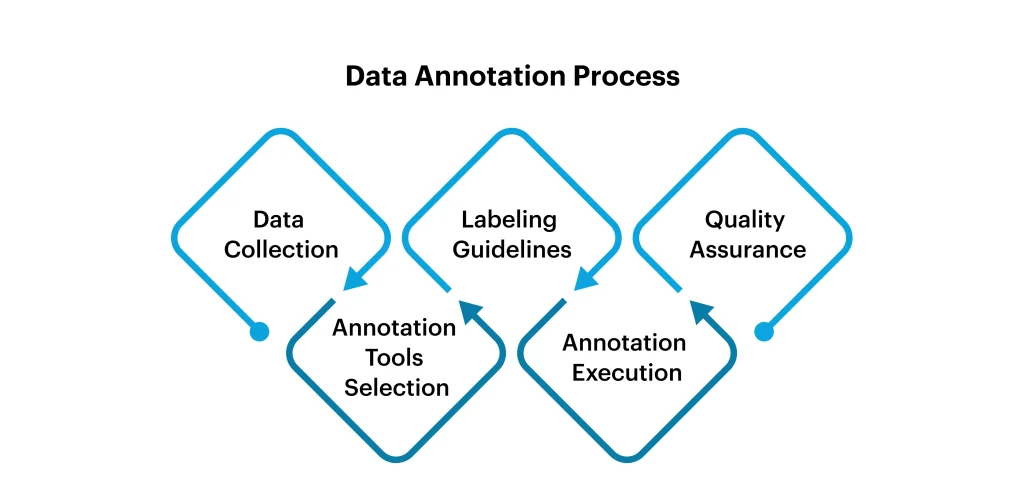
The data annotation process is essential for understanding what is data annotation and preparing high-quality datasets to power AI and ML models. By following a structured approach, organization, and data annotation companies ensure efficient, accurate, and scalable labeling for different applications.
1. Data Collection
Gather raw data from reliable sources, including images, text audio, or videos, to create a foundation for training AI models. The quality and diversity of collected data directly influence the model’s performance.
2. Annotation Tools Selection
Choose data annotation tools that fit the project’s complexity and scale. The modern tools offer features like automated labeling and integration with ML workflows to speed up the process.
3. Labeling Guidelines
Define clear and consistent labeling guidelines to make sure annotations align with project goals. Detailed instructions reduce ambiguity and improve accuracy across teams.
4. Annotation Execution
Perform the actual labeling using trained annotators or automated techniques. Each data point is meticulously tagged to prepare it for AI training.
5. Quality Assurance
Conduct rigorous quality checks to verify annotation consistency and accuracy. This step ensures the data meets the high standards required for machine learning models.
Tools and Platforms for Data Annotation
Data annotation is the spine of machine learning and AI, enabling accurate model training through labeled data. Data annotation tools like Scale AI, Labelbox, Prodigy, and SuperAnnotate empower teams to label datasets efficiently and precisely. These platforms make the process smooth, offering features tailored to diverse annotation needs across industries.
- Labelbox
Labelbox is a collaborative platform for data annotation. It offers customizable workflows, automation tools, and easy integration with AI pipelines. It is ideal for teams looking for ease of use and scalability.
- Scale AI
Scale AI specializes in high-quality data annotation services and tools, proving that large-scale datasets are prepared for machine learning and AI. Its solid API and automation features speed up the labeling process.
- SuperAnnotate
SuperAnonotate provides a versatile solution for video, image, and text annotation. It combines AI-assisted labeling with intuitive user interfaces, supporting teams aiming for accuracy in complex annotation projects.
- Prodigy
Prodigy is a lightweight, Python-based annotation tool designed for quick iterations and active learning. It’s perfect for smaller projects or those that require flexibility in workflows.
Understanding what is data annotation and using the right data annotation tools is crucial for building AI-ready datasets efficiently.
Challenges in Data Annotation
Partnering with a data annotation company can help address common issues, like maintaining consistency, managing costs, and using domain expertise that persists. Utilizing data annotation, AI offers potential solutions but requires careful implementation to ensure accuracy.
Time-Consuming
Manual efforts in data labeling can be slow, as meticulous attention to detail across large datasets is needed.
Subjectivity
Without data annotation AI, human interpretations can vary, leading to inconsistencies and biases affecting quality.
Cost
The data annotation significantly increases costs, particularly for large-scale projects with high-quality requirements.
Best Practices for Effective Data Annotation
To achieve high-quality labeled datasets, it’s crucial to follow best practices like involving domain experts, setting clear goals, and maintaining strict quality controls. By understanding what is data annotation and using tools or services provided by data annotation companies can organize the process. To visualize and track the resulting insights, businesses often consider Databox alternatives for more effective dashboarding.
Set Clear Objectives
Define precise goals and labeling criteria to ensure all annotators work toward a unified dataset structure. This clarity reduces errors and aligns outcomes with project requirements.
Use Domain Experts
Engage professionals with specific domain knowledge to enhance the accuracy of labeled data. Context ensures relevancy and minimizes misinterpretation in complex datasets.
Implement Quality Checks
Incorporate multi-layered reviews and validation processes to uphold annotation consistency. It is important to employ automated tools and manual reviews to maintain high-quality outputs.
Fully Automation
Integrate advanced data annotation AI solutions to accelerate labeling while reducing manual effort. These tools are particularly effective for large datasets, offering scalability and precision unmatched by traditional methods.
The Future of Data Annotation
The future of data annotation lies in integrating advanced technologies like machine learning and AI to optimize and automate labeling processes. As datasets grow in size and complexity, businesses will highly rely on tools and services provided by data annotation companies to achieve accuracy and speed.
Hybrid approaches combining human expertise and AI-driven automation will dominate the data annotation landscape. These methods will enable organizations to scale efficiently while maintaining high-quality outcomes, solidifying AI companies’ role as key players in building AI-ready datasets. especially when paired with efficient data ingestion pipelines that ensure seamless flow of raw data into annotation systems. This solidifies AI companies’ role as key players in building AI-ready datasets.
Final Words on Data Annotation
Data annotation is essential for AI and ML. It involves the complete process of labeling datasets to train intelligent systems. Data annotation provides consistency and accuracy, enabling AI models to deliver reliable and actionable insights.
Openxcell excels in delivering high-precision, scalable data annotation services customized to your specific requirements. We are your trusted partner in understanding and implementing data annotation solutions. Our AI models are built upon expertly labeled datasets, ensuring superior performance and quality


Manushi, a former literature student, now crafts content as a writer. Her style merges simple yet profound ideas. Intrigued by literature and technology, she strives to produce content that captivates and stimulates.