How LLM Benchmarks Help You Build Better, Smarter AI Models?
 Last updated:July 9, 2025
 9 Min Read
- What Are LLM Benchmarks?
- Why LLM Benchmarks Matter
- Key Types of LLM Benchmarks
- 1. Knowledge & Reasoning Benchmarks
- 2. Multimodal Benchmarks
- 3. Code Understanding & Generation Benchmarks
- 4. Bias, Fairness & Safety Benchmarks
- 5. Instruction Following / Alignment Benchmarks
- Widely Used LLM Benchmarks and What They Evaluate
- Challenges and Limitations of LLM Benchmarking
- Choosing the Right LLM Benchmark for Your Use Case
- The Future of LLM Benchmarking
- Why LLM Benchmarks Are More Than Just Numbers


Quick Takeaways
This blog explains what exactly LLM benchmarks are, why they are essential, and how they help to evaluate models across tasks like reasoning, coding, and safety. The blog also covers key benchmark types, common examples, their limitations, and how to choose the right one for your use case. You will also get a glimpse into the future of benchmarking with real-world testing and community feedback.
In 2023, over 150 new LLMs were released, each promising to be faster, smarter, and more aligned than others. However, the major question is how we actually measure their performance. It is exactly like hiring an employee without checking their qualifications or past work. Deploying AI models without measuring LLM benchmarks easily puts the business at risk.
As LLMs rapidly change industries and power everything from customer support to medical insights, the need for standardized evaluation is more important than ever. In this blog, we’ll break down what LLM benchmarks are, why they matter, and how they can help you make smarter choices, especially if you are exploring AI development services or choosing between leading models.
What Are LLM Benchmarks?
LLM benchmarks are standardized frameworks designed to evaluate the performance of large language models across various tasks and domains. These benchmarks utilize the given datasets and carefully structured tasks to assess the LLM’s capabilities in various tasks like understanding language, coding, reasoning, and more.
By highlighting the strengths and uncovering limitations, benchmarks provide transparency and a consistent way to measure and compare model performance.
In the expanding world of LLM development, benchmarking plays a vital role in making sure that models perform amazingly and also align with the expectations of real-world apps.
Additionally, benchmarking helps to identify the more suitable models for particular use cases and drives the development of more adaptable, reliable, and intelligent systems.
To give a comprehensive evaluation, LLMs are mainly assessed on these four key dimensions.
1. Accuracy
Measures how closely a model’s outputs align with ground truth or expected answers. This includes factual correctness, relevance, and task-specific success rates. The accuracy is typically evaluated using datasets with known answers and metrics like recall and precision.
2. Reasoning
This evaluates the model’s logical thinking, inferencing capabilities, and problem-solving. The reasoning follows multi-step instructions, pattern recognition, and making sound judgments under ambiguity.
3. Bias
It assesses the model’s tendency to generate skewed or unfair content that favors particular groups or ideologies. Evaluating bias involves analyzing outputs across different demographics using specialized diagnostic tools.
4. Safety
The safety ensures that the model avoids making harmful, offensive, or risky content. The safety assessments focus on how well the model can refuse unsafe prompts and handle the sensitive topic responsibly.
By measuring these dimensions, the LLM benchmarks provide the foundation for building AI systems that are not only powerful but also trustworthy, fair, and safe for widespread adoption.
Why LLM Benchmarks Matter
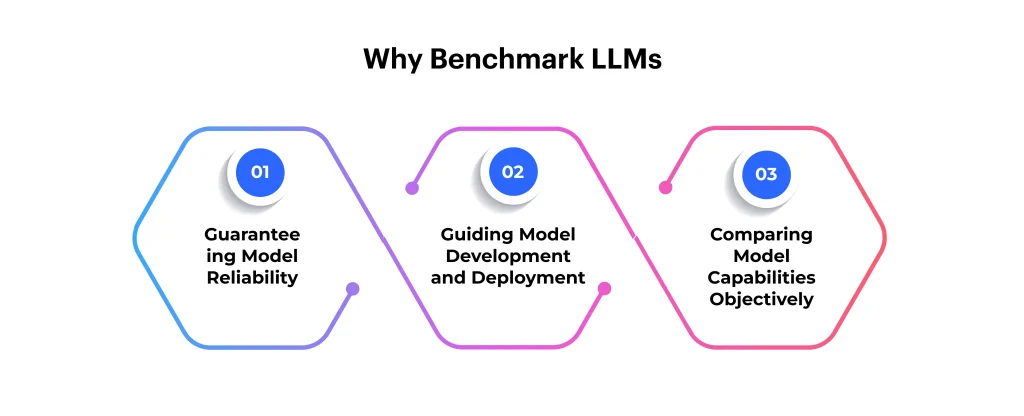
As LLM is becoming integral for products and services in different industries, evaluating its performance goes beyond curiosity; it is a necessity. It improved user experiences to ensure responsible AI behavior, and LLM benchmarking plays an important role in shaping how these models are used and built.
- Guaranteeing Model Reliability
Benchmarking validates the models, such as whether the LLM is consistently producing relevant, accurate, and safe responses in different situations. Without these reliable benchmarks, it is hard to trust the models that will behave predictably when deployed in real-world apps.
- Guiding Model Development and Deployment
During training and LLM fine-tuning, benchmarks work as checkpoints to measure progress and identify areas for improvement. It also helps determine when a model is ready for production, guaranteeing that only capable and strong models reach end users.
- Comparing Model Capabilities Objectively
As there are multiple LLMs available in the market, benchmarks give a fair and data-driven way to compare them. This empowers developers, researchers, and businesses to choose appropriate models for particular use cases based on measurable performance rather than just hype.
By grounding these decisions in benchmark data, teams can confidently build, improve, and deploy LLMs that deliver value.
Key Types of LLM Benchmarks
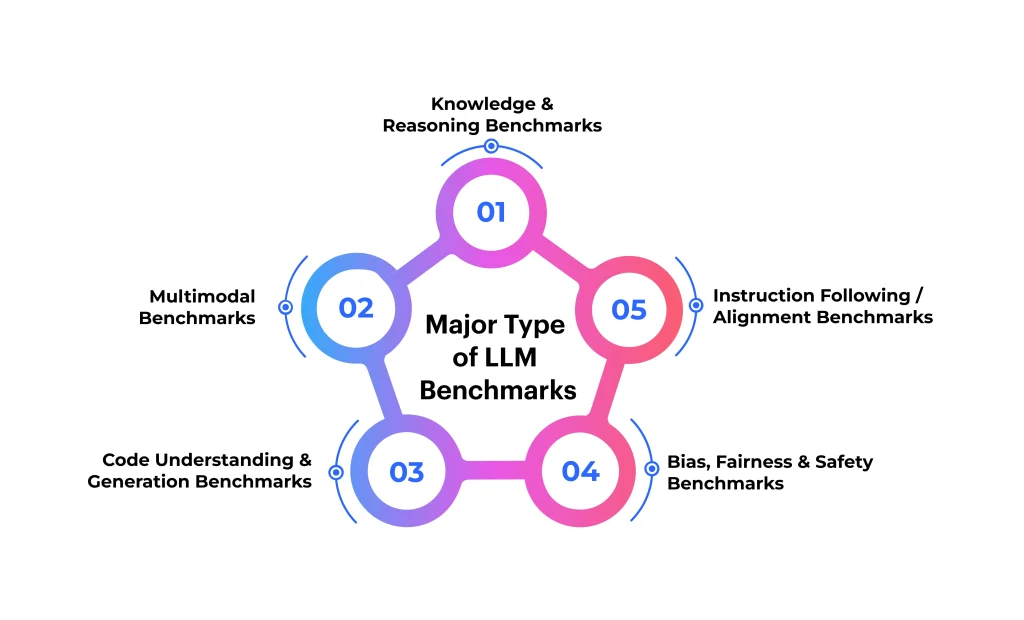
LLMs are made to perform a wide range of tasks like answering trivia, solving math problems, writing, analyzing images, and more. Different categories of LLM benchmarks have been developed to evaluate these different capabilities.
Each type of benchmark targets specific types of skills to make sure that models are tested across various spectrums of real-world requirements.
Below are the main categories of LLM benchmark types, along with their popular examples.
1. Knowledge & Reasoning Benchmarks
These benchmarks evaluate how well models understand factual knowledge and apply it to logical reasoning.
- MMLU (Massive Multitask Language Understanding): Tests models across 57 academic subjects.
- TruthfulQA: Focuses on whether a model provides factually correct and honest answers to tricky questions.
- ARC (AI2 Reasoning Challenge): Measures a model’s grade-school level reasoning capabilities.
- HellaSwag: Assesses commonsense reasoning by asking models to complete sentence sequences.
2. Multimodal Benchmarks
These are designed for models to process both text and images.
- MMMU (Massive Multimodal Multitask Understanding): A broad benchmark that tests general knowledge and perception tasks.
- VQAv2 (Visual Question Answering): Evaluates a model’s ability to answer questions based on images.
3. Code Understanding & Generation Benchmarks
These are specialized LLM coding benchmarks that test a model’s programming skills.
- HumanEval: Requires models to write functioning code based on problem descriptions.
- MBPP (Mostly Basic Python Problems): Focuses on smaller coding tasks with specific input/output requirements.
4. Bias, Fairness & Safety Benchmarks
This category ensures that the model gives a harmful product, is biased, or has offensive content.
- BBQ (Bias Benchmark for QA): Tests for social bias in question-answering tasks.
- WinoBias: Measures gender bias in pronoun resolution.
- RealToxicityPrompts: Evaluate how often models generate or amplify toxic language.
5. Instruction Following / Alignment Benchmarks
These test how well models follow user prompts or align with human intent.
- AlpacaEval: Measures model performance on instruction-following tasks.
- MT-Bench: Evaluates conversational abilities and alignment through multi-turn dialogue tasks.
Each LLM benchmark plays a crucial role in pushing models toward greater usability, safety, and intelligence. By utilizing the right benchmarks, developers can create more targeted, ethical, and effective LLMs ready for real-world deployment.
A Must Read: LLM Security: Protecting AI Models from Attacks & Data Leaks
Widely Used LLM Benchmarks and What They Evaluate
As there are dozens of LLM benchmarks are available, only a few have emerged as per the industry standards for evaluating core model capabilities. Here are some of the most commonly used LLM model benchmarks to help developers understand a model’s strengths in depth, with its reasoning, accuracy, and generation.
- MMLU (Massive Multitask Language Understanding):
It tests the model’s ability to handle questions from 57 academic and professional subjects, reflecting its general knowledge and task diversity.
- HellaSwag:
This measures commonsense reasoning by asking the model to choose the most plausible sentence to complete a scenario.
- TruthfulQA:
It evaluates how accurately a model responds to tricky or misleading questions, revealing its susceptibility to generating falsehoods.
- GSM8K (Grade School Math 8K):
GSM8K particularly focuses on math word problems to test its multi-step logical reasoning and arithmetic skills.
- HumanEval:
Assesses code generation quality by questioning the model to write different functions based on natural language prompts, with correctness validated through test cases.
These benchmarks give critical insights into when an LLM excels or falls short. These benchmarks aren’t just regular academic tools. They are used in real-world implications.
For instance, Openxcell’s Smart AI Healthcare App uses LLMs to provide intelligent health insights, which requires a careful evaluation of the model’s reasoning and factual accuracy. Benchmarks like TruthfulQA and MMLU play a critical role in selecting and finding the right model to give reliable, medically aligned responses.
This highlights how benchmark-driven choices directly impact the performance and safety of AI-driven applications in sensitive domains like healthcare.
Challenges and Limitations of LLM Benchmarking
LLM benchmarking has advanced the way we measure language models without any flaws. But to a surprise, many experts are now questioning how well these LM evaluation benchmarks reflect real-world performance.
- Overfitting to Benchmarks
Many models are mainly trained to excel at certain benchmark tasks, which may lead to inflated scores that don’t reflect their true capability in different environments.
- Lack of Real-World Generalization
Benchmarks are now mostly tested on narrow and static tasks that don’t capture dynamic, open-ended, real-world interactions, which limits their practical insights.
- Gaming Benchmark Scores
Developers tweak models to perform well on tests without improving the general reasoning or usability, which skews the perception of progress.
- Language and Cultural Biases
Many benchmarks are built in English and reflect the Western context, which may lead to bias and reduce model fairness in its global interpretation.
Understanding these limitations is key to using benchmarks wisely rather than blindly trusting the scores.
A Good Read: Understanding LLM Parameters: The Backbone of Smart AI Models
Choosing the Right LLM Benchmark for Your Use Case
Not all the LLM benchmarks created are equal or the same in any manner. The correct benchmarks depend on what you are building and for what purpose you are building it. Selecting the correct evaluation criteria makes sure that your model delivers real-world impact, not just high scores.
Based on Application Type
First and foremost, start by identifying the model’s core purpose, whether it is assisting in healthcare, generating code, or creating content. Choose benchmarks that reflect the critical performance areas relevant to your application.
Consider Task Type, Domain & Audience
Use LLM benchmarking tools that align with your domain, for example, law, finance, education, etc., and test how the model performs with your target audience. The context matters as much as capability.
Choosing the tool wisely leads to more responsible, tailored, and effective AI solutions.
The Future of LLM Benchmarking
As LLMs change, so must the way we evaluate them. Static tests are no longer just enough to capture a model’s full capabilities in ever-changing environments.
The future of LLM benchmarking lies in real-time, strong evaluations that reflect real-world use cases. These benchmarks will move beyond predefined datasets to assess the model performance in production, opening the door to deeper insights through LLM observability.
Also, there is a growing shift toward community-driven evaluations, where users contribute feedback and insights. It is combined with a mix of qualitative reviews and quantitive scores, which will enable a more balanced and trustworthy assessment process, shaping more responsible and adaptive AI systems.
Why LLM Benchmarks Are More Than Just Numbers
From understanding what LLM benchmarks are to exploring their types, limitations, future, and more, it is clear that they play an important role in developing reliable, safe, and high-performing language models. In a landscape crowded with LLMs, benchmarks provide the clarity needed to choose, evaluate, and improve models effectively.
As businesses increasingly rely on AI, thoughtful benchmarking becomes essential in it. At Openxcell, we help organizations to work with the full potential of AI with end-to-end services, from AI chatbot development to custom LLM solutions to scalable deployment, model fine-tuning, and more.


Manushi, a former literature student, now crafts content as a writer. Her style merges simple yet profound ideas. Intrigued by literature and technology, she strives to produce content that captivates and stimulates.