How AI in Nursing Is Redefining Modern Patient Care
 Last updated:December 8, 2025
 17 Min Read
- What is AI in Nursing?
- Why is AI needed in Nursing?
- 1. Operational Challenges
- 2. Clinical & Safety Challenges
- 3. Financial & Access Pressures
- 4. Data Overload
- 5. Workforce Burnout & Retention Issues
- How is AI Used in Nursing?
- 1. Automated Documentation
- 2. Clinical Decision Support
- 3. Virtual Nursing Assistants and Chatbots
- 4. Staff Scheduling & Workflow
- 5. RAG (Retrieval-Augmented Generation) for Clinical Knowledge & Decision Support
- 6. Remote Patient Monitoring & Vitals Surveillance
- 7. Training, Simulation & Clinical Education
- 8. Medication Safety & Smart Alerts
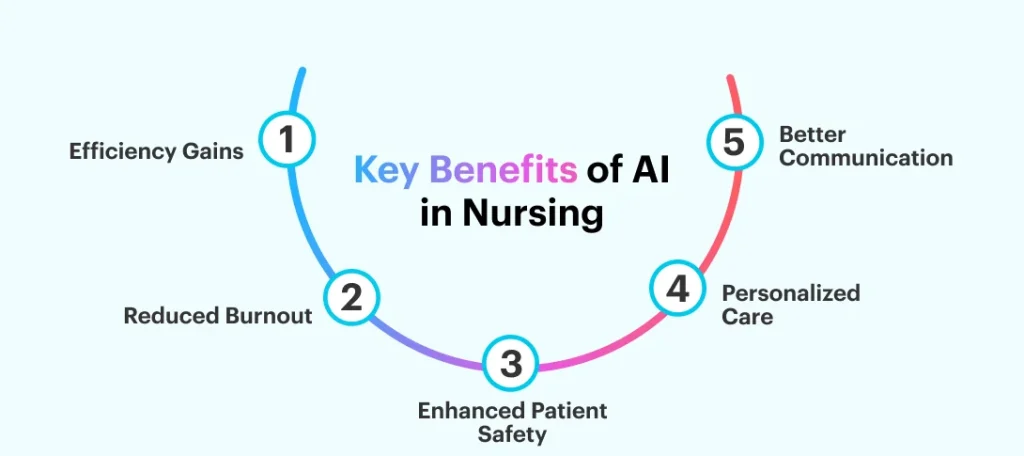
- Key Benefits of AI in Nursing
- 1. Efficiency Gains
- 2. Reduced Burnout
- 3. Enhanced Patient Safety
- 4. Personalized Care
- 5. Better Communication
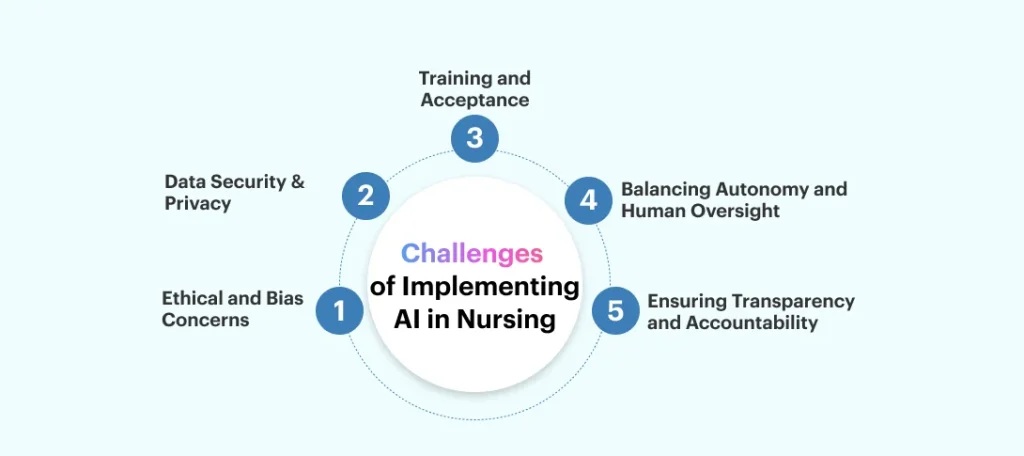
- Challenges of Implementing AI in Nursing
- 1. Ethical and Bias Concerns
- 2. Data Security & Privacy
- 3. Training and Acceptance
- 4. Balancing Autonomy and Human Oversight
- 5. Ensuring Transparency and Accountability
- Skills Nurses Should Learn for an AI-Enabled Workspace
- 1. Practical AI Literacy
- 2. Data Interpretation & Validation
- 3. Workflow Adaptability
- 4. Communication & Patient Reassurance
- 5. Human-in-the-Loop Decision Making
- 6. Digital Safety & Data Responsibility
- 7. Continuous Digital Learning Mindset
- Implementation Roadmap: How Hospitals Should Deploy Nursing AI
- 1. Start with Clinical Pain Points
- 2. Data Readiness Audit
- 3. Choose the Right Use Case
- 4. Technology & Vendor Selection
- 5. Human-in-the-loop Design
- 6. Governance & Compliance
- 7. Training & Change Management
- 8. Measure Outcomes
- 9. Scale & Iterate
- AI in Nursing: Revolutionizing Healthcare Delivery
- Frequently Asked Questions


TL;DR
AI in nursing is transforming the way nurses prioritize, document, and provide patient care. This guide walks you through the technologies shaping everyday workflows, helping you make informed decisions, as well as the skills, benefits, and challenges nurses should be aware of to thrive in the healthcare space. It even highlights the most essential steps hospitals should take to implement AI effectively and responsibly.
Over time, Artificial intelligence technology has made tremendous advancements and innovations. As a result, it has been adopted in multiple sectors and disciplines, and healthcare is no exception.
Nursing professionals face numerous challenges in healthcare, including increasing patient loads, extensive documentation, staffing shortages, and constant pressure to deliver safer and faster care. That’s precisely when AI in nursing comes into play to enhance nurse efficiency, accuracy, and patient outcomes.
AI enables nurses to focus on compassionate care and informed decisions, while automating time-consuming administrative tasks.
Here are some stats that showcase the rise of AI in nursing.
- According to a report, nurses spend 19% to 35% of their time on documentation.
- Over time, nurses are leaving their jobs. According to NCSBN, nearly 138,000 nurses left the workforce, and around 40% are expected to go by 2029.
Due to these challenges, many hospitals, healthcare service providers, and care networks have adopted AI. Moreover, they are considering AI development services to create a solution that streamlines their operations and meets the needs of end-users.
In this blog, we will explain the basics of AI in nursing and discuss how to implement AI in a hospital setting. We will also talk about the benefits and challenges of artificial intelligence in nursing.
So, let’s start.
What is AI in Nursing?
AI in nursing is the use of technologies like machine learning, natural language processing, and automation to analyze data and provide insights. These tools streamline repetitive tasks, support clinical decisions, and help manage workload.
AI tools empower nurses to accurately interpret patient information, efficiently generate documentation, and make informed decisions to support patient care. These systems even alert nurses to identify early signs of health deterioration that humans might miss, leading to timely intervention. By automating administrative and clinical tasks, nurses can focus on patient care.
Integrating AI into nursing can help providers improve efficiency and patient outcomes. AI assists rather than replaces nurses, enhancing their expertise and judgment. Together, humans and AI can help transform healthcare systems.
Why is AI needed in Nursing?
The demand for nursing is increasing faster than the available resources and workforce. These growing pressures underscore the importance of understanding the role of AI in nursing.
1. Operational Challenges
Nursing faces numerous challenges, including overwhelming workloads, staffing shortages, multitasking, and high administrative burdens, all of which impact patient care. AI can efficiently manage these administrative tasks, enabling nurses to devote more time to patient care and less to paperwork.
2. Clinical & Safety Challenges
Delays in the manual clinical check can result in missed deterioration, delayed interventions, and safety risks. AI’s real-time tracking enables early detection, resulting in faster and more accurate clinical responses.
3. Financial & Access Pressures
Healthcare systems face financial pressures and resource limitations. AI offers scalable support through remote monitoring technologies, helping to address these issues.
4. Data Overload
Nurses manage large amounts of data daily, which can be overwhelming. AI analyzes and interprets this data rapidly, supporting informed decisions without adding to nurses’ workload.
5. Workforce Burnout & Retention Issues
Emotional fatigue, high stress, and constant workloads cause nurses to leave and increase retention problems. AI-based scheduling and task automation help balance workloads and improve nurse retention.
How is AI Used in Nursing?
AI in nursing is transforming the way teams work and respond to the patient’s needs. Here are the different ways AI is implemented in real nursing workflows.
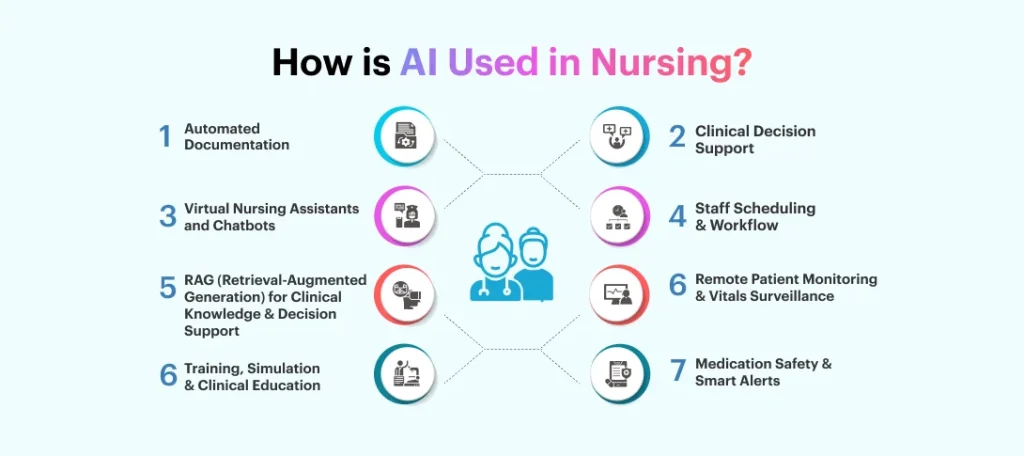
1. Automated Documentation
Documentation burden is one of the significant challenges in nursing. AI is transforming this reality through ambient scribe technology and note-completion assistants. These tools listen to patient interactions and automatically generate precise, real-time clinical notes, reducing manual effort.
For instance, AMA indicated that Permanente Medical Group has released ambient augmented intelligence (AI), also known as artificial intelligence, scribes, which have helped physicians save more than 15,000 hours of documentation and ease the documentation burden, reduce burnout, and enhance communication.
Subsequent peer-reviewed studies found that ambient AI scribes save documentation time and improve note accuracy. For best results, connect the scribe to the EHR, regularly check AI output, and use a sign-off process to ensure accuracy and compliance.
Want to integrate AI scribes into your EHR to improve documentation efficiency? Check out the tailored AI healthcare solutions today. Our team is here to help.
2. Clinical Decision Support
AI-based clinical decision support systems (CDSS) help nurses by analyzing large volumes of patient data, lab results, and medical histories in real-time. These systems then compare this data with existing medical knowledge, identify patterns, and provide real-time guidance. As a result, nurses can make timely, informed decisions in fast-paced environments.
Predictive models include an extra layer of safety by determining patients at risk of emergency conditions, such as sepsis or health deterioration, at an early stage. This early warning detection enables nurses to take preventive measures, achieve different outcomes, decrease complications, and improve safety. AI-powered CDSS are increasingly integrated into nursing workflows to fine-tune personalized care and automate clinical judgment.
3. Virtual Nursing Assistants and Chatbots
The use of telehealth services, such as virtual nursing assistants (VNAs) and chatbots, is increasing, particularly following the COVID-19 pandemic, and AI plays a crucial role in enhancing these services. Virtual nursing assistants (VNAs) and chatbots can improve patient care by streamlining tasks such as onboarding, remote monitoring, and administrative triage. They decrease nurse interruptions, reduce patient wait times, and ensure detailed admission documentation.
For nurses, VNA staff, and chatbots, reduce continuous interruptions by handling repetitive, non-clinical queries throughout the day. They even ensure a flawless admission process and automatic workflows. To make these things possible, AI assistants are available round-the-cock, passing on complex issues to human nurses whenever required, and maintaining strict privacy protections.
Also Read: Healthcare Chatbots – Their Benefits, Use Cases, And Examples
4. Staff Scheduling & Workflow
AI-powered staffing tools enable hospitals to accurately predict patient surges and schedule shifts efficiently. These advanced algorithms analyze a large amount of historical data, along with staff availability, patient acuity, and patterns, then build optimized staffing schedules that meet the needs of both healthcare professionals and patients. By implementing this approach, hospitals can reduce their reliance on staff, allowing nurses to allocate more time to patient care and thereby improve overall patient satisfaction.
Beyond scheduling, AI automates nursing workflows by tracking tasks and sending necessary alerts. Updated alarm systems reduce fatigue by prioritizing the most important notifications. With fewer distractions, nurses can provide safer, more focused care.
5. RAG (Retrieval-Augmented Generation) for Clinical Knowledge & Decision Support
Retrieval-Augmented Generation (RAG) combines AI reasoning with real-time, verified medical documents to produce accurate and straightforward answers. Nurses can ask challenging questions related to policies, drug interactions, or clinical procedures and receive credible responses from trustworthy sources, such as guidelines and protocols. This technology reduces the guesswork, enabling nurses to make informed decisions for their patients.
Healthcare leaders, such as those represented by HIMSS and JAMA, indicate that RAG plays a vital role in enhancing access to clinical information and reducing cognitive load. In practice, RAG enables nurses to obtain accurate guidance in a few seconds by analyzing various manuals, PDFs, or outdated intranet pages. It also supports secure decision-making by examining evidence-based references from built-in protocols or medical literature.
For best-in-class implementation, the organization leverages private sector stores, applies complex governance rules, and requires human validation to prevent errors and hallucinations.
For healthcare organizations navigating the AI landscape, RAG as a Service from a leading AI development company offers a practical path forward. These specialized providers build and manage RAG-based solutions that address all technical complexities, allowing your teams to focus on clinical excellence and evidence-based patient care without being hindered by infrastructure challenges.
6. Remote Patient Monitoring & Vitals Surveillance
AI-based remote patient monitoring analyzes continuous data streams from multiple wearables and bedside devices, flagging deterioration before it occurs. Nurses receive instant notifications about changes in vital signs, enabling them to take preemptive measures and save lives. This shift in nursing care from reactive to predictive care transforms patient safety.
Various studies indicate that AI models can outperform traditional ones in detecting arrhythmias and identifying abnormal patterns in real-time data. For example, deep-learning ECG systems indicate high accuracy in continuous arrhythmia detection, and AI-enabled wearable monitors identify more as compared to standard Holter devices. When this information is available in real-time, nurses can make more informed decisions and provide advanced patient care.
7. Training, Simulation & Clinical Education
AI-driven training tools transform the way nurses learn and practice clinical skills. Virtual patients mimic real-world role-play scenarios, enabling nurses to make informed decisions, conduct tests, and review results instantly.
Role-play simulations and personalized learning paths provide excellent training for every nurse, regardless of their level of expertise. This speeds up the onboarding process for both new and existing employees who wish to upgrade themselves. With training becoming more interactive and accessible, it becomes pretty easy to retain nurses by providing them with the necessary tools and resources for their roles.
8. Medication Safety & Smart Alerts
AI-based medication safety is changing the way nurses verify and administer medications. These tools inherently verify the dos, contraindications, and allergies, thereby reducing preventable medication errors. In comparison to traditional systems that bombard clinicians with constant pop-ups, AI-powered smart alerts prioritize the latest risk-cutting measures, reducing noise and easing alert fatigue.
Key Benefits of AI in Nursing
Artificial intelligence for nursing is crafting a smooth and patient-centered care environment. Here are some of the benefits that are changing the way nurses work and provide patient-centered care.
1. Efficiency Gains
AI streamlines various day-to-day tasks of nurses, such as documentation, scheduling, and data entry, thereby enabling nurses to reclaim their clinical time. Hence, nurses can provide better patient care.
2. Reduced Burnout
By removing administrative tasks and reducing cognitive fatigue, AI eases the stress on nurses. They can ensure higher job satisfaction and better retention with the use of innovative workflow tools.
3. Enhanced Patient Safety
AI in nursing constantly tracks patients’ data, identifies issues of deterioration, and reduces medication errors via early interventions. Nurses obtain instant alerts to make valuable decisions in any emergency.
4. Personalized Care
AI analyzes a vast amount of patient histories, vital signs, and behavioral patterns to provide personalized interventions and care plans. Nurses offer enhanced patient care without having to juggle data.
5. Better Communication
AI tools automate handoffs, facilitate collaboration on various updates, and ensure nurses receive proper patient education. It decreases misunderstandings, ensures clinicians and patients remain in the loop for information, and reduces errors.

Challenges of Implementing AI in Nursing
As AI for nurses becomes more prevalent, healthcare teams must navigate the complexities of technology and patient care. Here are some of the significant challenges hospitals should address to provide a safe, ethical, and practical adoption.
1. Ethical and Bias Concerns
AI models can inadvertently highlight the biases in the training data, leading to unfair outcomes across different patient groups. To address this challenge, nurses must focus on continuous tracking, diverse datasets, and transparent model governance.
2. Data Security & Privacy
AI systems rely heavily on a massive amount of data, which increases the risk of breaches and compliance violations. Next-gen encryption, access controls, and compliance frameworks are needed to protect patient trust.
3. Training and Acceptance
Nurses require adequate training to become familiar with AI tools, interpret their outputs, and implement them safely in practice. Without proper education, adoption becomes slow and may even decrease nurses’ confidence in technology.
4. Balancing Autonomy and Human Oversight
AI in nursing should enhance decision-making; however, it should never override a nurse’s judgment. Nurses should have the power to make final decisions, ensuring patient care is a combination of empathy, ethics, and situational awareness.
5. Ensuring Transparency and Accountability
Clinicians should be aware of the way AI suggestions are generated to trust and validate them. In-depth audit trails, explainable models & their outputs, and accountable ownership structures ensure the safe & responsible use of these systems.
Skills Nurses Should Learn for an AI-Enabled Workspace
Current and next-generation nurses have to deal with work involving AI technologies. It means they need to have the necessary technical and non-technical skills to survive and thrive in the healthcare landscape.
1. Practical AI Literacy
Nurses require technical expertise to operate, interact with, and utilize AI-driven tools in their everyday workflow. This enables them to use technology with utmost confidence to enhance patient care without worrying about complexity.
2. Data Interpretation & Validation
Nurses should read and validate the AI-generated output against the clinical judgment. They should be aware when the data appears to be flawed. This skill prevents blind trust in AI and supports safe clinical decisions.
3. Workflow Adaptability
With time, new AI technologies and tools will be introduced in the field of nursing. These are launched with the intention of enhancing performance. The leading nurses are always ready to adapt new workflows and processes abruptly. This level of flexibility leads to better patient care delivery.
4. Communication & Patient Reassurance
Patients might feel nervous about the integration of AI in their care. Robust communication skills enable nurses to explain the role of AI to patients effectively. Reassuring patients builds trust and decreases anxiety about AI involvement.
5. Human-in-the-Loop Decision Making
AI offers support, but nurses remain the final decision-makers. Maintaining clinical judgement alongside the AI insights leads to balanced patient care. Moreover, the blend of human and AI enhances the outcomes.
6. Digital Safety & Data Responsibility
Nurses should be aware of the latest cybersecurity best practices in the industry. It allows them to protect patients’ data in multiple AI tools and digital systems. This reduces the possibility of data breaches and improves trustworthiness.
7. Continuous Digital Learning Mindset
With the advent of new-age advancements and AI technologies, nurses need to remain at the forefront and engage in continuous learning. They should be aware of the latest tools, features, innovations, and best practices. This enables them to remain effective, informed, and ready to tackle upcoming challenges in their work with confidence.
Implementation Roadmap: How Hospitals Should Deploy Nursing AI
Configuring artificial intelligence in nursing requires a highly organized approach that combines technology with the real clinical needs. Here is the step-by-step process of how hospitals can build and deploy AI responsibly, efficiently, and with measurable impact on patient care.
1. Start with Clinical Pain Points
Hospitals should start identifying the sudden nursing challenges that disrupt care quality. Leaders need to focus on the most potent issues, such as the documentation overload,
delayed triage decisions, and increasing medication errors. Addressing these challenges through mapping helps to reach desirable solutions without adding workflow complexity.
2. Data Readiness Audit
Reliable AI requires a robust data foundation; therefore, hospitals should thoroughly evaluate EHR access, data quality, and labelling requirements before deploying an AI project. Teams should determine missing values, documentation gaps, and integration limitations. This level of monitoring prevents any technical issues during deployment.
Strong data governance and privacy practices are essential for achieving long-term success. All of these lead to safer AI adoption and better implementation.
3. Choose the Right Use Case
Hospitals should begin with a pilot that provides a quick and measurable impact. These pilots should handle repetitive tasks, such as documentation, triage support, or medication checks. It results in evidence-based scaling and resource optimization.
4. Technology & Vendor Selection
Choosing the right technical approach is more than essential to achieve the desired performance and compliance. First of all, hospitals need to compare and choose between cloud and on-premise deployment using factors like security, cost, latency, and control. Secondly, they should verify whether a pre-built API or a custom model is suitable for their project.
The vendor’s maturity directly affects the deployment success. Hospitals give importance to partners that have experience in delivering healthcare environments. OpenXcell offers customizable and compliant AI solutions in healthcare, as well as other industries, tailored to meet diverse needs.
5. Human-in-the-loop Design
Design AI workflows that maintain nurse oversight and clinical judgement. These workflows promise that the nurse will check suggestions, manage exceptions, and resolve errors. Escalation paths and audit trails ensure safety and accountability throughout the entire process.
6. Governance & Compliance
A strict governance framework helps to maintain patients’ safety and even the hospital’s integrity. Hospitals should implement strong protocols on data access, model explainability, and algorithmic fairness. HIMSS considers governance as the most important pillar for any organization.
All compliance requirements should be clearly stated from the beginning. Ensures that hospitals follow HIPAA, GDPR, and local regulations. Detailed documentation, audit logs, and transparent behavior reduce legal and ethical risks.
7. Training & Change Management
A robust onboarding process ascertains whether nurses are ready to utilize AI willingly. Hospitals should maintain a connection with nurse champions from the outset and provide them with hands-on training tailored to their workflows. A straightforward communication can build trust & loyalty during the transition.
There should be constant changes even after the training has ended. Organizations should continually gather feedback, optimize their workflows, and address any issues related to adoption and implementation. A seamless support fosters confidence and sustainability.
8. Measure Outcomes
Impact measures assure that the investment delivers real clinical value. Hospitals should monitor key indicators, including documentation time, medication error rates, readmission reductions, and overall nurse satisfaction. A clear set of quantitative and qualitative metrics guides iterative enhancements, demonstrating clinical value and ROI.
9. Scale & Iterate
As soon as a pilot becomes successful, hospitals should then focus on expanding AI in multiple units. Teams should fine-tune processes, update integrations, and adapt new-age AI models across various clinical environments. Iteration on regular time intervals ensures that AI remains relevant and practical in response to changing healthcare needs.

AI in Nursing: Revolutionizing Healthcare Delivery
Artificial intelligence in nursing is transforming the way care is delivered, documented, and optimized. Moreover, it has helped streamline the nursing workload, improving patient safety and offering better care. We have understood the practical applications, benefits, challenges, and skills that AI requires for nurses to survive & thrive in the healthcare industry.
With hospitals adopting new-age AI tools and technologies, nurses can receive better education and deliver enhanced patient care, which in turn increases trust and loyalty. The future of nursing will likely be a combination of human expertise with AI technology.
As more & more healthcare organizations consider AI, partnering with the right technology team is essential. Openxcell offers the best solutions in the healthcare sector through its Gen AI development services. We understand your requirements and deliver an AI nursing solution that enhances workflow efficiency and enables nurses to provide high-quality patient care.
Frequently Asked Questions
1. Will AI replace human nurses or clinical judgment in the future?
No, AI will not replace human nurses, as nurses depend heavily on empathy, connection, critical thinking, and compassionate care that machines cannot replicate and deliver. AI can handle repetitive tasks, assist in decision-making, and conduct data analysis, thereby enabling nurses to allocate more time to patient care.
2. Can AI in nursing work reliably well in different patient populations?
Not possible. Why? AI models heavily depend on the training data, which can be biased or incomplete. Hence, it might not deliver the desired results for the specific groups.
3. How does AI protect patients’ privacy and security?
There is a constant risk of vulnerabilities and data breaches, as AI systems have access to sensitive patient data. Hence, AI systems should comply with regulations like HIPAA or GDPR. Using encryption, secure servers, data privacy controls, and clear content practices is necessary before deploying AI tools.
4. Do nurses need special training to work with AI tools?
Definitely, nurses need extensive training that emphasizes understanding why AI is required, how algorithms generate recommendations, and how AI can inform patient care decisions, rather than just focusing on technical workflow training. This enables nurses to become aware of the pros and cons and use technologies effectively as per the standards.
5. Can AI tools adapt to particular nursing specialties and environments?
Definitely, AI tools can be customized for different nursing settings and specialties, aligning with unique protocols and workflows to support diverse nursing roles.


Girish is an engineer at heart and a wordsmith by craft. He believes in the power of well-crafted content that educates, inspires, and empowers action. With his innate passion for technology, he loves simplifying complex concepts into digestible pieces, making the digital world accessible to everyone.