How Enterprise Chatbots Are Revolutionizing Business Operations
 Last updated:April 21, 2026
 12 Min Read
- What Are Enterprise Chatbots?
- How Enterprise Chatbots Differ from Regular Chatbots
- 1. Scalability
- 2. Data Security & Compliance
- 3. Integration with Enterprise Tools
- 4. Advanced NLP & Contextual Understanding
- Underlying AI Technologies Powering Enterprise Chatbots
- How Enterprise Chatbots Work
- Workflow of Enterprise Chatbots
- Architecture Overview of Enterprise Chatbots
- Key Benefits of Enterprise Chatbots
- 1. 24/7 Availability
- 2. Operational Efficiency
- 3. Cost Reduction
- 4. Faster Decision-Making
- 5. Employee Productivity
- 6. Consistency & Compliance
- 7. Multilingual Support
- Real-World Use Cases of Enterprise Chatbots
- 1. Customer Support Automation
- 2. HR & Employee Assistance
- 3. IT Helpdesk
- 4. Sales & Marketing
- 5. Healthcare & Insurance
- 6. Finance & Compliance
- Challenges and Ethical Considerations
- How to Overcome These Challenges
- The Future of Enterprise Chatbots
- Emerging Trends Shaping the Future:
- Transforming Business with Enterprise Chatbots
- Frequently Asked Questions (FAQs)


TL;DR:
In this blog, we will explain how enterprise chatbots are transforming modern business by automating customer support, enhancing internal communication, and delivering more personalized interactions. These innovations have helped companies to boost efficiency and stay ahead in today’s digital landscape.
Imagine an AI assistant that can handle 10,000 customer queries a day,
- Onboard new employees,
- Generate real-time reports,
- Schedule a meeting – all at once.
This is not a futuristic fiction; it is the new reality powered by enterprise AI chatbots. These intelligent virtual assistants are refining how organizations communicate, operate, and scale. Unlike traditional chatbots, enterprise AI chatbots are designed for large-scale operations, capable of understanding complex queries, integrating with enterprise systems, and delivering data-driven insights to improve efficiency across departments.
The rise of LLMs, generative AI, and the wave of enterprise automation following ChatGPT has accelerated this change. Today’s businesses are adopting these AI-driven tools not just for customer support, but also as strategic assets to enhance collaboration, decision-making, and productivity.
With the right AI development services, enterprises can now build custom chatbot solutions that easily align with their workflows, resulting in faster response times, reduced operational costs, and an overall more innovative way of doing business.
First, let’s start with the basics, like understanding enterprise chatbots.
What Are Enterprise Chatbots?
In this day and age, a digital ecosystem business requires an intelligent system that goes beyond simple question-and-answer bots. That’s where enterprise chatbots come in, AI-powered virtual assistants designed to meet the complex needs of large organizations.
Unlike regular chatbots, which handle basic customer queries, enterprise chatbots are built to operate at scale, giving simple communication, automation, and integration across multiple business functions.
These chatbots combine advanced AI capabilities with enterprise-grade security, compliance, and contextual understanding to provide meaningful, human-like interactions. From HR and IT support to sales and customer services, enterprise AI chatbots help businesses automate repetitive tasks while strengthening efficiency, accuracy, and user experience.
How Enterprise Chatbots Differ from Regular Chatbots
1. Scalability
Enterprise chatbots handle thousands of interactions simultaneously across multiple departments, languages, and regions. They are designed to grow with the organization, managing vast user bases without compromising performance or accuracy.
2. Data Security & Compliance
Unlike consumer chatbots, enterprise versions adhere to stringent data protection standards, including GDPR, HIPAA, and SOC 2. It makes sure that sensitive enterprise data is securely processed, stored, and transmitted, making it suitable for industries like healthcare, banking, and insurance.
3. Integration with Enterprise Tools
These chatbots seamlessly integrate with core business platforms, including Salesforce, SAP, Microsoft 365, Slack, and ServiceNow, enabling employees to perform tasks, retrieve data, and trigger workflows directly within chat interfaces.
4. Advanced NLP & Contextual Understanding
Enterprise chatbots utilize sophisticated Natural Language Processing (NLP) to interpret context, tone, and intent, enabling more accurate, natural, and context-aware responses that improve over time through continuous learning.
Underlying AI Technologies Powering Enterprise Chatbots
- Machine Learning (ML): It enables chatbots to learn from users’ interactions, refine responses, and improve accuracy with every conversation.
- Natural Language Processing (NLP): This helps chatbots to understand human language, including slang, sentiment, and context, for more human-like communication.
- Large Language Models (LLMs): Give deep contextual intelligence that allows chatbots to generate coherent, conversational, and insightful responses.
- Retrieval-Augmented Generation (RAG): Combines the reasoning power of LLMs with enterprise data retrieval, ensuring chatbots deliver accurate, up-to-date, and domain-specific answers.
By utilizing enterprise AI chatbot development services, organizations can design custom, secure, and scalable chatbot solutions that seamlessly integrate with existing systems, transforming everyday conversations into powerful, data-driven business outcomes.
Additional Read: Guide to AI Chatbot Development: Revolutionizing Customer Interactions
Now that we have understood what enterprise chatbots are and the technologies that power them, let’s explore how these intelligent systems actually function behind the scenes to deliver real-time, context-aware, and personalized interactions.
How Enterprise Chatbots Work
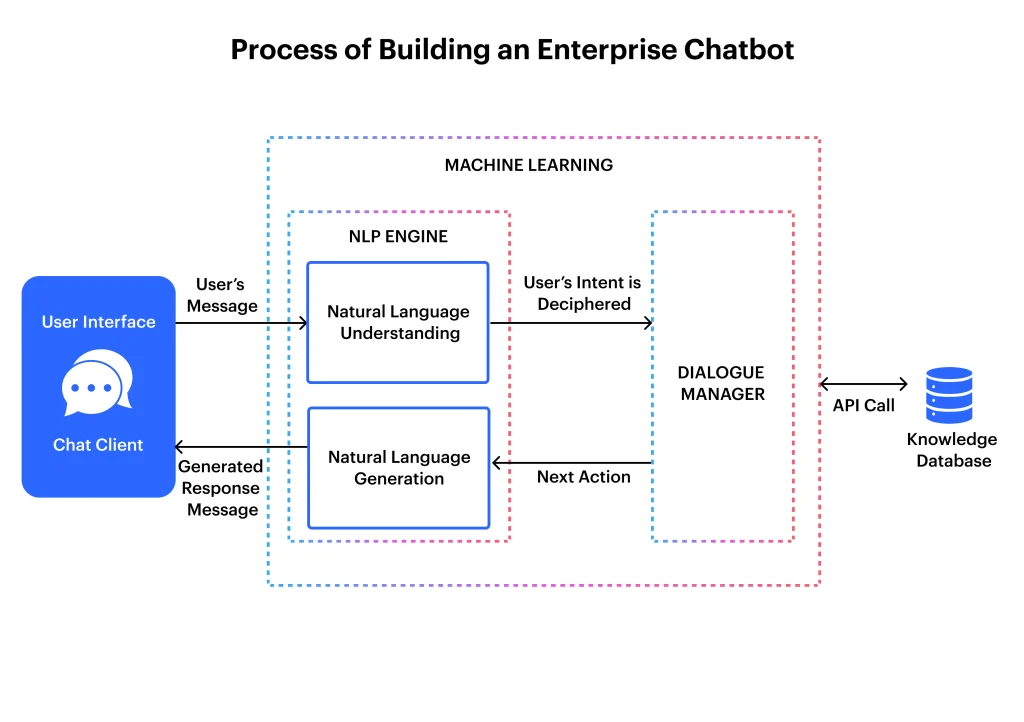
Enterprise chatbots operate by sophisticated workflow and layered architectures that enables them to understand queries, access relevant data, and deliver accurate responses, all in seconds.
These systems combine AI automation and integration to make a good conversational experience that feels natural yet highly intelligent.
Workflow of Enterprise Chatbots
The workflow defines how an enterprise chatbot processes, understands, and responds to user inputs in real time.
- User Sends a Query (Text/Voice):
The first interaction begins when a user submits a question or command via a chat window, web app, or voice interface.
- Chatbot Processes via NLP & LLM:
The chatbot interprets the user’s intent and tone using NLP and LLM to give contextual understanding.
- Contextual Data Fetched from Databases/CRMs via APIs:
Through API integrations, the chatbot securely retrieves relevant data from CRMs, databases, or ERP systems to provide accurate and personalized answers.
- Response Is Generated and Personalized:
Finally, the system crafts a natural, human-like response customized to the user’s profile, preferences, and content, giving meaningful engagement.
Architecture Overview of Enterprise Chatbots
The architecture behind enterprise AI chatbot solutions is designed to ensure reliability, scalability, and data security across all touchpoints.
- User Interface:
The front-end interface, such as a chat window, mobile app, or voice assistant, acts as the interaction layer between users and the AI system.
- NLP Engine:
This component handles intent detection, entity extraction, and language understanding to accurately interpret user queries.
- Integration Layer:
APIs connect the chatbot to enterprise platforms, such as CRM systems, ERP systems, and HR systems, enabling it to access and update business data.
- LLM Integration:
Models like GPT, Claude, or Gemini are integrated to enhance reasoning, contextual accuracy, and conversational fluency.
- Analytics Dashboard:
This module tracks performance metrics, user satisfaction, and conversation trends, allowing enterprises to optimize chatbot performance continuously.
Through robust AI chatbot development, businesses can build enterprise-grade assistants that go beyond simple automation, transforming conversations into intelligent workflows that drive efficiency, insight, and growth.
Key Benefits of Enterprise Chatbots
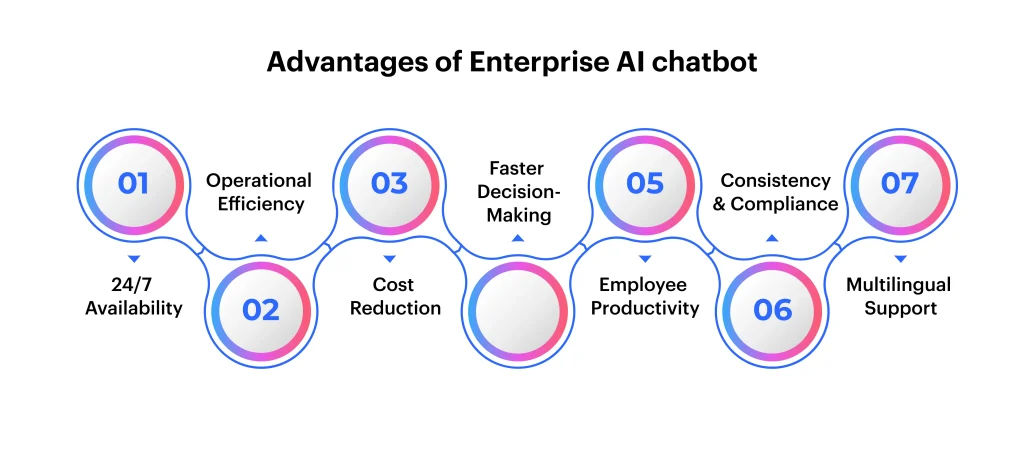
In this digital environment, organizations want a solution that not only improves communication but also improves operational performance in all departments. Enterprise chatbots give these advantages by combining AI intelligence, automation, and easy integration, empowering enterprises to achieve higher efficiency, agility, and accuracy in daily operations.
Below are some of the most impactful benefits businesses experience while adopting an enterprise AI chatbot solution.
1. 24/7 Availability
Enterprise chatbots operate around the clock, guaranteeing customers and employees receive instant support anytime, anywhere. This continuous availability reduces the response time, enhances customer satisfaction, and eliminates downtime caused by human shift limitations.
2. Operational Efficiency
By automating routine processes like data entry, ticket management, and internal queries, these chatbots free up valuable human resources. This resulted in faster task completion, improved accuracy, and smoother interdepartmental workflows.
3. Cost Reduction
Enterprises can significantly reduce support and operational costs by replacing repetitive manual work with automated interaction. One chatbot can handle the workload of dozens of agents, making it a cost-effective solution for a digital workforce.
4. Faster Decision-Making
Chatbots give real-time data access, performance insights, and analytics to managers and teams. This immediate flow of information enables quick, more informed decision-making across departments.
5. Employee Productivity
By assisting employees with instant answers, document retrieval, and automated scheduling, chatbots minimize the time spent on repetitive tasks, allowing the team to focus on more creative, strategic, and high-value work.
6. Consistency & Compliance
Enterprise chatbots ensure consistent messages and adherence to compliance standards for users by providing approved, policy-aligned responses, thereby minimizing the risk of misinformation or human error.
7. Multilingual Support
With built-in language recognition and translation capabilities, these chatbots can communicate fluently in multiple languages, making global support accessible and inclusive for different users and customers.
Pro Tip: “Enterprises using AI chatbots see up to a 30–40% improvement in customer satisfaction scores”
Real-World Use Cases of Enterprise Chatbots
Across all industries, enterprise chatbots are becoming indispensable tools for automating workflows, enhancing customer experience, and supporting internal operations.
The ability to integrate with enterprise systems, understand natural language, and deliver instant responses makes them a valuable asset for each department, from HR to finance, etc. Here are some real-world use cases that showcase their impact across business functions.
1. Customer Support Automation
Many platforms, like banks, telecom companies, and eCommerce use AI-powered chatbots to handle nearly 90% of tier-1 customers’ queries. These bots resolve issues like account updates, order tracking, password resetting, etc, improving satisfaction and reducing agent workload.
2. HR & Employee Assistance
Enterprise chatbots easily streamline HR functions by automating onboarding, explaining leave policies, and answering employee FAQs. It serves as an always available assistants that guide staff through procedures and ensures smooth internal communication.
3. IT Helpdesk
From password resets to system troubleshooting, chatbots automate ticket creation and incident resolution. It also reduces response time, allowing IT teams to focus on complex technical issues instead of repetitive tasks. When integrated with IT ticketing systems, enterprise chatbots can automatically log, prioritize, and route incidents, ensuring faster resolution and seamless coordination across IT support teams.
4. Sales & Marketing
Chatbots greatly qualify leads, schedule demos, and engage prospects with personalized recommendations, empowering sales teams to focus on high-value opportunities while improving conversion rates.
5. Healthcare & Insurance
Hospitals and insurers utilize chatbots for appointment booking, claim tracking, and patient support, providing 24/7 assistance, while also maintaining data privacy and compliance.
6. Finance & Compliance
Chatbots simplify verifications, generate compliance reports, and assist with financial data retrieval, enhancing transparency and accuracy. With the right enterprise AI chatbot development service, businesses can tailor these capabilities to meet the specific operational and regulatory needs.
Case Study: AI Chatbot for Travel & Health
Openxcell built an AI-powered travel and healthcare chatbot that helps users manage health concerns while traveling. It provides real-time health alerts, destination-based risk insights, and access to nearby medical support.
Key Outcomes:
- Personalized wellness guidance for travelers
- Faster access to local healthcare services
Improved user safety and experience through automation
Challenges and Ethical Considerations
Enterprise AI chatbots give immense value to organizations; their implementation isn’t without challenges. As enterprises increasingly rely on these intelligent systems for important operations, it is important to address the potential risks and ethical implications that accompany large-scale AI deployment.
1. Data Security & Privacy
Handling sensitive customer or business data poses major privacy concerns. Without proper encryption and governance, chatbots can become vulnerable to data breaches or unauthorized access.
2. Bias in AI Responses
AI models might unintentionally reflect biases present in their training data, leading to unfair or inaccurate responses. This can impact users’ trust and brand reputation if not monitored properly.
3. Integration Complexity
Integrating chatbots with existing enterprise systems such as CRMs, ERPs, or HR tools can be technically challenging, requiring strong API management and data synchronization.
4. Over-Reliance on Automation
Excessive automation without human oversight can lead to errors, miscommunication, or loss of empathy in interactions, especially in sensitive business scenarios.
5. Compliance (GDPR, HIPAA)
Enterprises operating in regulated industries must ensure their chatbot systems adhere to data protection laws and compliance frameworks such as GDPR, HIPAA< and SOC 2.
How to Overcome These Challenges
To mitigate these issues, businesses should adopt secure on-premises LLMs, conduct regular bias and fairness testing, and maintain a human-in-the-loop validation process for critical decisions. A designed and monitored responsibility, and enterprise AI solution can deliver automation, intelligence, and trust without compromising security, compliance, or ethics.
Related Read: AI Chatbots for Ecommerce: A Game-Changer for Online Stores
The Future of Enterprise Chatbots
The next generation of enterprise chatbots is evolving far beyond simple automation. As organizations continue to embrace AI-driven transformations, these intelligent assistants are expected to become more proactive, predictive, and personalized.
With the rise of multimodal AI, advanced integrations, and emotion-aware interactions, chatbots will play a central role in shaping the future of digital workplaces and customer experiences.
Emerging Trends Shaping the Future:
1. Multimodal Interaction:
Future chatbots will combine text, voice, and vision capabilities, helping users to interact through images, documents, or voice commands for a more natural and intuitive experience.
2. Predictive & Proactive AI:
Chatbots will transition from reactive responses to proactive assistance, anticipating user needs, sending reminders, and suggesting actions before they are requested.
3. Deep Personalization:
By utilizing behavioral analytics and real-time data, chatbots will deliver hyper-personalized conversations tailored to each user’s preferences, habits, and context.
4. Industry-Specific Intelligence:
Sectors like finance, retail, and healthcare are adopting domain-focused chatbots, which help to understand industry-specific regulations and workflows. For instance, healthcare chatbots will help patients book appointments, access their records, and monitor their well-being securely and efficiently.
5. Enhanced Human-AI Collaboration:
Instead of replacing humans, future chatbots will work alongside them, augmenting decision-making, streamlining operations, and reducing cognitive load through intelligent recommendations.
As AI technology continues to mature, enterprise chatbots will become the digital backbone of organizations, blending human-like understanding with real-time business intelligence to drive smarter, faster, and more connected enterprises.
Transforming Business with Enterprise Chatbots
Enterprise chatbots are a trendy concept right now; they are essential tools that empower organizations to enhance efficiency, streamline operations, and deliver exceptional customer and employee experiences.
By utilizing advanced AI technologies, integrating seamlessly with enterprise systems, and offering real-time, personalized interactions, businesses can transform routine tasks into intelligent workflows. With the right enterprise AI chatbot development service, organizations can deploy secure, scalable, and highly effective solutions that drive growth, compliance, and innovation.
The future of enterprise communication and automation lies in intelligent, adaptable, and data-driven enterprise AI chatbot solutions that align with evolving business needs.
Frequently Asked Questions (FAQs)
1. What is an enterprise chatbot?
An enterprise chatbot is an AI-powered virtual assistant designed to handle complex, large-scale business operations, customer support, and internal workflows efficiently.
2. How does an enterprise AI chatbot differ from regular chatbots?
Enterprise AI chatbots use advanced NLP, LLMs, and integrations with enterprise systems, enabling contextual understanding, scalability, and secure interactions.
3. Which industries benefit the most from enterprise AI chatbot solutions?
Industries like finance, healthcare, retail, travel, and IT greatly benefit, as chatbots automate processes, enhance customer engagement, and ensure compliance.
4. How do I implement an enterprise AI chatbot solution?
Organizations can implement it through a tailored enterprise AI chatbot development service, integrating the bot with existing systems and training it for domain-specific use cases.
5. Can enterprise chatbots handle multilingual and global operations?
Yes, modern enterprise chatbots support multilingual communication and can operate across regions, providing consistent, reliable, and context-aware responses globally.

Manushi, a former literature student, now crafts content as a writer. Her style merges simple yet profound ideas. Intrigued by literature and technology, she strives to produce content that captivates and stimulates.