How to Become an AI Engineer: Skills, Career Path & Opportunities
 Last updated:November 5, 2025
 14 Min Read
- How to Become an AI Engineer: Understanding the Role
- How Does AI Engineering Work?
- Why Choose a Career as an AI Engineer?
- High Demand Across Industries
- Opportunities for Innovation
- Job Security and Future Relevance
- Educational Pathways & Prerequisites for AI Engineering
- Essential Skills You Need to Become an AI Engineer
- Step-by-Step Roadmap to Becoming an AI Engineer
- 1. Learn programming & mathematics fundamentals
- 2. Study machine learning & deep learning
- 3. Gain hands-on experience with projects
- 4. Build a portfolio
- 5. Contribute to open-source AI projects
- 6. Internships & networking
- 7. Apply for entry-level AI/ML roles
- 8. Keep upgrading Skills
- Real-World Applications of AI Engineering
- AI Engineer Salary Breakdown Across Roles and Regions
- Essential Tools & Technologies for AI Engineers
- AI Engineer vs Traditional IT Engineer
- The Road Ahead: Future of AI Engineering
- To Sum Up: Embracing the AI Engineering Journey
- Frequently Asked Questions About AI Engineering


| How to Become an AI Engineer: Snapshot -> AI engineering means building and deploying smart models. -> It powers tools like chatbots, fraud detection, and self-driving cars. -> There is a huge demand for skilled AI engineers. -> Learn coding, math, ML, and deep learning basics. -> Work on projects and build a strong portfolio. -> AI careers offer high salaries and job security. -> Entry roles start around $90K. Senior experts earn $200K+. |
“Did you know that the global AI market is projected to reach $407 billion by 2027, and the roles of AI engineers are among the fastest-growing tech careers worldwide?”
AI engineers are the brains behind transforming technology, such as self-driving cars and detecting fraud in fintech apps, which improve our daily lives.
AI engineering is all about building, training, and deploying models that can analyze data, learn patterns, and make intelligent decisions. Many industries like healthcare, logistics, eCommerce, and finance are rapidly adopting AI, and the demand for skilled professionals is skyrocketing.
In fact, companies that are offering AI development services are struggling to fill positions fast enough to keep up with innovation.
If you have been wondering how to become an AI engineer and step into one of the most future-ready careers, this guide will walk you through everything you need to know.
Before embarking on the step-by-step journey of becoming an AI engineer, it is necessary to understand their work and role.
How to Become an AI Engineer: Understanding the Role
An AI engineer is a technology professional who designs, develops, and implements AI models that enable machines to mimic human intelligence. Their work is more than writing code; it builds algorithms, processes massive datasets, and creates systems that make decisions, adapt, and improve with time.
AI engineer responsibilities mainly overlap with other roles in the data ecosystem, but with key differences.
- Data scientists focus on analyzing data and extracting insights, and AI engineers take those insights to build practical AI applications.
- Machine Learning Engineers specialize in model building and optimization, where AI engineers manage the entire lifecycle from model design to deployment.
- AI Researchers explore new theories and breakthroughs, while AI engineers apply them to real-world problems across industries like fintech, e-commerce, logistics, and healthcare.
In short, AI engineers bridge the gap between innovation and application, making AI a powerful tool for solving business and societal challenges.
How Does AI Engineering Work?
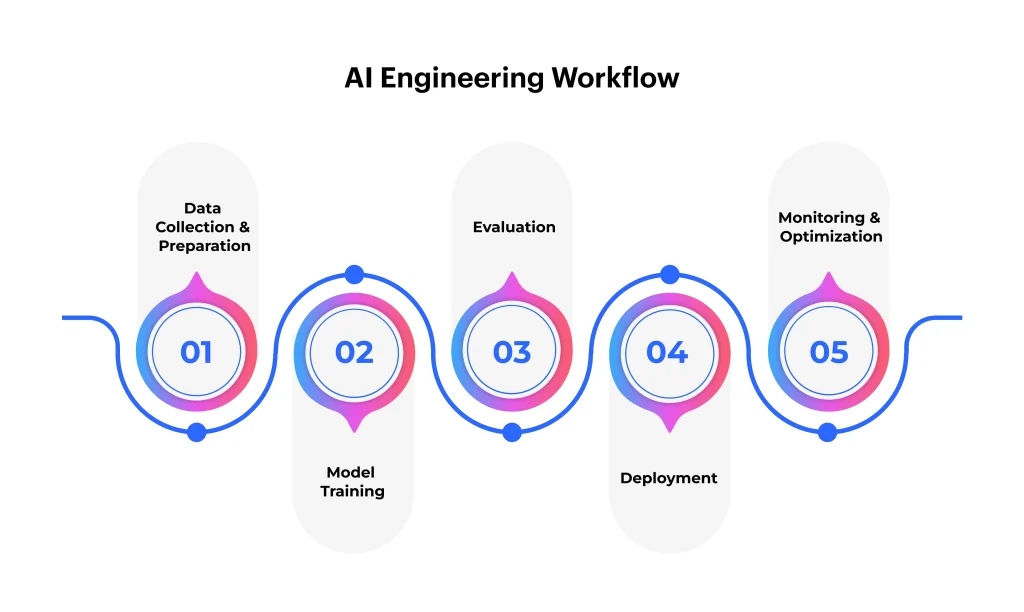
AI engineering may sound complex, but at its core, it is about transforming raw data into intelligent real-world solutions. With the correct AI engineer skills, professionals can easily transform business challenges into automated systems that can think, learn, and adapt.
Today, companies are increasingly using Gen AI services to build next-generation tools that solve problems and generate creative outputs like text, images, or even software code. Here’s the typical AI engineering workflow:
- Data Collection & Preparation
The process starts by gathering structured and unstructured data, cleaning it, and making sure it is ready for model training. High-quality data is the foundation of any successful AI project.
- Model Training
Engineers use machine learning and deep learning algorithms to train models that can recognize patterns, classify information, and predict outcomes.
- Evaluation
The trained model is tested against unseeded data to measure accuracy, stability, and performance. This step makes sure that the system delivers consistent results.
- Deployment
Once validated, models are added into apps or platforms so they can be used in real-time environments like chatbots, fraud detection systems or recommendation engines.
- Monitoring & Optimization
AI systems need ongoing monitoring to track performance, reduce model drift, and fine-tune algorithms as new data flows in.
Scaling with MLOps
To manage the entire cycle efficiently, AI engineers mainly rely on MLOps. It automates testing, deployment, and monitoring pipelines, making AI models scalable, maintainable, and production-ready.
Ethical AI Practices
More than technical workflow, engineers need to ensure fairness, transparency, and accountability in the models. Building explainable AI reduces bias, and following responsible practices is now as important as technical accuracy.

In short, AI engineering is about both science and responsibility, combining technical expertise with ethical awareness to build solutions that truly benefit businesses and society.
Why Choose a Career as an AI Engineer?
Artificial intelligence is no longer a new and futuristic concept; it’s here, known by all of us, shaping how businesses and individuals interact with technology every day.
For professionals wondering how to become an AI engineer, the bigger question is often: Why choose this career in the first place? The answer lies in its growing demand, long-term career stability, and limitless innovation.
High Demand Across Industries
In this day and age, AI engineers need to be everywhere, from healthcare companies developing diagnostic tools to fintech firms building fraud detection systems.
Logistics relies on AI for supply chain optimization, and eCommerce giants use it for personalized recommendations. This widespread adoption means skilled AI professionals are in demand worldwide.
Opportunities for Innovation
There are few careers that offer as much room for creativity as AI engineering.
Imagine building self-driving cars that navigate through traffic safely, medical AI systems that detect diseases early, or smart financial solutions that prevent fraud in seconds.
These innovations make AI engineer roles and responsibilities both challenging and advantageous.
Job Security and Future Relevance
AI is projected to add trillions to the global economy over the next decade, making sure that AI engineers remain indispensable.
Unlike traditional IT jobs that come with risk automation, AI engineering thrives because it powers automation. It makes one of the most future-proof careers available today.
In essence, choosing AI engineering means stepping into a role that combines cutting-edge technology, real-world impact, and career growth. It is not just a job, it is a chance to shape your future.
Now that we have explored the opportunities, growth, and scope of AI engineering, let’s break down the foundation you need to enter this field. A strong educational background and the correct prerequisites are the first stepping stones toward becoming a more successful AI engineer.
Educational Pathways & Prerequisites for AI Engineering
Stepping into AI engineering requires a blend of academic grounding and practical skills. Whether you pursue a traditional degree or opt for alternative routes, understanding the prerequisites is crucial for anyone exploring how to become an AI engineer.
The right foundation equips you not only to enter the field but also to handle complex AI engineer responsibilities effectively.
1. Formal Degrees
The most common path involves a strong academic background in computer science, mathematics, statistics, information technology, or engineering.
These disciplines provide the required knowledge in algorithms, data structures, and quantitative reasoning, which are cornerstones of AI development.
2. Alternative Learning Paths
Not everyone follows the traditional route. Many AI engineers begin with:
- Bootcamps specializing in machine learning and AI.
- Certifications from tech leaders like Google, AWS, or Microsoft.
- Self-learning through platforms like Coursera, edX, Udacity, etc, which offer AI-focused courses tailored for beginners to advanced learners. Platforms like Coursiv provide structured AI curriculums that help learners build job-ready skills through hands-on projects and industry-aligned training.
These flexible options allow career changers or fresh learners to gain industry-relevant expertise without a full degree.
3. Essential Prior Knowledge
Regardless of your chosen path, a few technical fundamentals are non-negotiable:
- Linear Algebra & Probability – the backbone of machine learning algorithms.
- Programming Basics – especially Python, R, or Java.
- Problem-Solving Mindset – critical for building and fine-tuning AI models.
By mastering these prerequisites, you lay a strong foundation to transition smoothly into advanced AI concepts and practical applications.
Essential Skills You Need to Become an AI Engineer
While degrees and certifications lay the foundation for jobs, skills are what truly shape AI engineers’ roles and work.
To excel in this career, aspiring professionals must master a mix of technical expertise, mathematical knowledge, and soft skills that ensure practical applications of AI in real-world scenarios.
Here’s what you need:
Technical Skills
- Programming (Python, R, Java, C++) – Core language for building and optimizing AI solutions.
- AI/ML Frameworks (TensorFlow, PyTorch, Keras) – Important for designing and deploying machine learning models.
- Big Data Tools (Hadoop, Spark) – Give the easy handling of massive datasets.
- Databases (SQL, NoSQL) – Important for managing structured and unstructured data.
- Cloud AI Tools (AWS SageMaker, Azure AI, GCP AI) – Power up AI development, much like solutions pioneered by OpenAI.
Mathematical Skills
- Statistics, Probability, Calculus, Linear Algebra – Build the backbone for model accuracy, optimization, and predictive analysis.
Soft Skills
- Problem-Solving – Tackles the complex business and technical challenges.
- Communication & Collaboration – Working effectively with multidisciplinary teams.
- Ethical & Critical Thinking – Providing AI systems that are trustworthy, unbiased, and responsible.
In nature, blending strong technical and mathematical knowledge with ethical judgment and communication skills makes an AI engineer future-ready.
Step-by-Step Roadmap to Becoming an AI Engineer
To become an AI engineer, one needs a proper, clean, and structured approach. Here is the roadmap, which highlights the most essential step to start your journey:
1. Learn programming & mathematics fundamentals
Start with the pillars of AI concepts, such as programming languages like Python, R, or Java, and build a strong base in mathematics, covering linear algebra, probability, and statistics.
2. Study machine learning & deep learning
Study supervised, unsupervised, and reinforcement learning techniques, followed by deep learning architectures like CNNs and RNNs to understand advanced AI models.
3. Gain hands-on experience with projects
Practical application is key to working on real-world datasets, building small AI applications, and experimenting with tools like TensorFlow or PyTorch.
4. Build a portfolio
Showcase your AI engineer skills by maintaining repositories of your projects, participating in Kaggle competitions, and sharing solutions.
5. Contribute to open-source AI projects
Encounter with the AI community by contributing to open-source initiatives, sharpening your expertise, and boosting credibility.
6. Internships & networking
Apply for internships, attend AI events, and connect with professionals. Networking helps you gain insights and discover opportunities.
7. Apply for entry-level AI/ML roles
Start with junior roles in data science, ML, or AI to get industry exposure and practical problem-solving experience.
8. Keep upgrading Skills
AI is rapidly evolving, so staying updated with the latest research papers, new frameworks, and emerging trends is crucial for growth.
With this roadmap, you’ll have a clear understanding of how to become an AI engineer while mastering both theoretical and practical aspects to meet real-world challenges.
Also Learn: How to Become a Prompt Engineer: A Guide to AI Mastery
Real-World Applications of AI Engineering
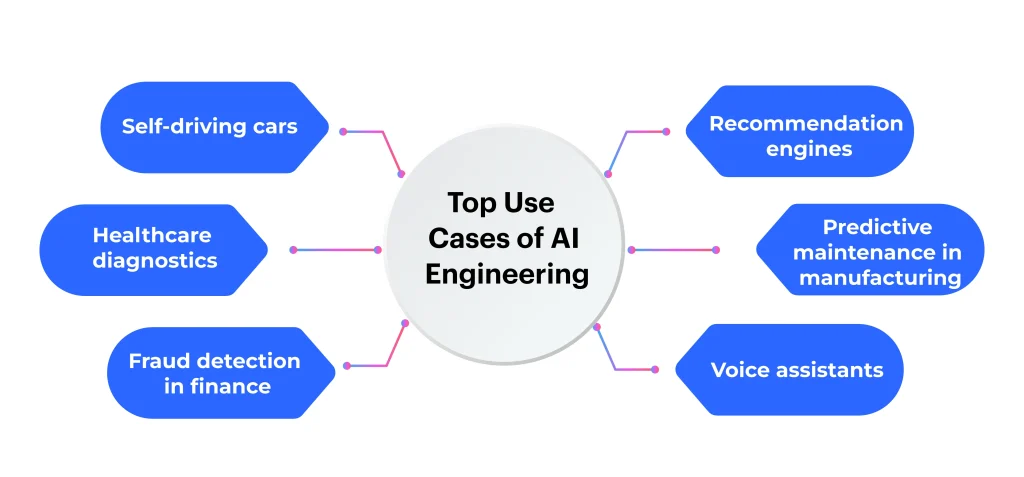
AI engineering is indeed shaping industries by providing automation, intelligence, and innovation at a great scale. From transforming how we commute to how we shop or learn, it has a significant impact everywhere. Here we have listed some of the top use cases:
- Self-driving cars – Allow autonomous navigation and safe decision-making on the road.
- Healthcare diagnostics – Helps doctors to predict accurate disease and personalize treatment.
- Fraud detection in finance – Recognize questionable activities and safeguard transactions in real time.
- Recommendation engines – The biggest example of this is power platforms like Netflix and Amazon to deliver custom user experiences.
- Predictive maintenance in manufacturing – Stop equipment failures by forecasting issues early.
- Voice assistants – Simplify daily tasks with NLP, such as Alexa, Siri, and Google Assistant.
From smart cars to AI’s role in education, these innovations highlight how AI engineering is changing everyday life.
AI Engineer Salary Breakdown Across Roles and Regions
There is a growing demand for AI engineers globally, and so are the opportunities. Compensation varies based on experience, geography, and industry, but overall, the field gives highly competitive packages. Here’s a closer look at the average salary of an AI engineer across different markets:
Salaries by Role & Region
| Role Level | India (INR/year) | US (USD/year) | UK (GBP/year) | Canada (CAD/year) |
| Entry-Level | ₹6 – 10 LPA | $90k – 120k | £40k – 55k | C$75k – 95k |
| Mid-Level | ₹15 – 25 LPA | $120k – 160k | £55k – 80k | C$95k – 120k |
| Senior-Level | ₹30 – 50+ LPA | $160k – 220k+ | £80k – 110k+ | C$120k – 150k+ |
Salary Variation by Industry
| Industry | Global Salary Range (USD/year) |
| Tech & Software | $110k – 200k |
| Finance & Banking | $120k – 220k |
| Healthcare & Pharma | $100k – 180k |
| Manufacturing & Robotics | $100k – 180k |
| Education & Research | $90k – 160k |
Freelance & Contract AI Engineers
Freelance AI engineers’ salary depends on expertise and project scope. On average, they earn $40-$120 per hour globally, with specialized AI/ML projects paying significantly higher.
Whether in startups or multinational companies, AI engineers’ salaries continue to reflect the growing value of their expertise in shaping the future of industries.
Essential Tools & Technologies for AI Engineers
To master AI engineering, excelling at the right set of tools and technologies is important.
These tools not only enhance productivity but also shape your journey on how to become an AI engineer and stay ahead in this field.
Along with these frameworks and programming languages, modern prompt tools also play a crucial role in AI-driven solutions.
- Python, R, SQL – It is used for core programming and data manipulation skills for AI problem-solving.
- TensorFlow, PyTorch, Scikit-learn – These are leading frameworks for machine learning and deep learning apps.
- Docker and Kubernetes – For scalable AI model deployment and containerized workflows.
- GitHub & CI/CD pipelines – Good for collaboration, version control, and continuous integration.
- Cloud platforms (AWS, GCP, Azure) – Provide flexible infrastructure and AI-specific services for deployment and development.
Related Read: 13 Best Prompt Engineering Tools to Boost Your AI Workflows
AI Engineer vs Traditional IT Engineer
As the role of AI rises, it is becoming increasingly distinct from that of a traditional IT engineer. While both are rooted in technology, their skills, career paths, and responsibilities diverge. Understanding these differences helps organizations hire the right talent and professionals to choose the correct career path. Mastering the right AI engineer skills is important to bridge the gap.
| Aspect | AI Engineer | Traditional IT Engineer |
| Core Skills | Expertise in machine learning, deep learning, neural networks, data science, and programming (Python, R, SQL). | Strong in networking, system administration, databases, cybersecurity, and programming (Java, C++, NET). |
| Responsibilities | Building, training, and deploying AI/ML models, working with big data, optimizing algorithms, and integrating AI solutions into business systems. | Designing, developing, maintaining IT infrastructure, managing servers, and ensuring software/applications run smoothly. |
| Salary Trends | Higher demand → Competitive pay. The average salary of AI engineers is significantly higher across global markets. | Stable salary growth varies by role and experience, generally lower than that of AI engineers. |
| Industry Demand | Growing rapidly across healthcare, fintech, e-commerce, and robotics. | Strong demand in IT support, enterprise systems, and traditional software development. |
| Challenges | Constantly evolving tech, need for continuous upskilling, and data dependency. | Legacy system maintenance, scalability issues, and keeping up with emerging IT frameworks. |
The Road Ahead: Future of AI Engineering
AI engineering is rapidly shifting beyond model building to shape industries’ strategies. With Generative AI and LLMs like ChatGPT, Claude, and Gemini, engineers are driving intelligent automation, smarter workflows, and business adoption through integrations like ChatGPT and more.
At the same time, there is also a growing focus on AI ethics and regulations demanding transparency, compliance, and fairness, reshaping the profession. Rather than eliminating jobs,
AI is creating new roles in monitoring, governance, and risk assessment. Increasingly, engineers are moving into AIOps and governance, guiding responsible adoption.
The future of AI engineering lies not only in coding, but it also strategically transforms businesses, societies, and everyday life.
To Sum Up: Embracing the AI Engineering Journey
AI engineering offers great opportunities, like driving enterprise automation to create ethical, responsible systems that transform industries. While challenges like compliance, governance, and balancing innovation with transparency remain, the field continues to open new doors for professionals.
At Openxcell, we help businesses and professionals embrace the AI future by building cutting-edge AI solutions and strategies. Now, it’s time to start learning, experimenting, and building projects.

Frequently Asked Questions About AI Engineering
1. How to become an AI engineer?
To become an AI engineer, one typically needs a strong foundation in computer science, programming (Python, R, Java), mathematics, and machine learning. Earning a degree in AI, data science, or related fields helps, but practical skills from online courses, projects, and internships are equally valuable.
2. What are the most important AI engineer skills?
Key AI engineer skills include expertise in machine learning, deep learning, data structures, cloud computing, natural language processing, and problem-solving. Strong knowledge of frameworks like TensorFlow and PyTorch is also essential.
3. What is the average salary of an AI engineer?
The average salary of an AI engineer varies by region, but globally, it ranges from $100,000 to $150,000 per year. Senior roles or specialized expertise in LLMs and AI Ops can earn significantly higher packages.
4. Is AI engineering a good career choice for the future?
Yes, AI engineering is one of the most in-demand careers. With industries adopting AI for automation, analytics, and decision-making, demand for AI professionals is expected to grow rapidly.
5. What industries hire AI engineers the most?
AI engineers are hired across industries like healthcare, fintech, e-commerce, logistics, and manufacturing. Increasingly, sectors like education, real estate, and retail are also adopting AI solutions.

Manushi, a former literature student, now crafts content as a writer. Her style merges simple yet profound ideas. Intrigued by literature and technology, she strives to produce content that captivates and stimulates.