What Is AI Workflow Automation and Why It Matters
 Last updated:May 7, 2026
 13 Min Read
- Understanding AI Workflow Automation: How It Works
- Traditional vs AI Workflow Automation: A Smarter Shift in Business Operations
- Key Benefits of AI Workflow Automation for Modern Businesses
- 1. Increased Operational Efficiency
- 2. Enhanced Decision-Making
- 3. Reduced Human Error
- 4. Real-Time Process Adaptability
- 5. Better Customer Experience
- 6. Cost Optimization
- 7. Scalability and Flexibility
- Core Components of AI Workflow Automation Systems
- 1. Data Input and Integration Layer
- 2. AI Engine (Machine Learning & NLP)
- 3. Workflow Orchestration Engine
- 4. Human-in-the-Loop Interface
- 5. Monitoring and Feedback Loop
- Types of AI Workflow Automation: Breakdown by domain
- 1. Customer Service Automation
- 2. Finance and Accounting Automation
- 3. Human Resources (HR) Automation
- 4. IT and Helpdesk Automation
- 5. Supply Chain and Logistics Automation
- How to Implement AI Workflow Automation Effectively
- 1. Identify Automation Opportunities
- 2. Define Clear Objectives
- 3. Choose the Right AI Workflow Automation Tools
- 4. Prepare and Clean Your Data
- 5. Design and Test the Workflow
- 6. Train Teams and Enable Human Oversight
- 7. Monitor, Optimize, and Scale
- Essential Tools and Resources for AI Workflow Automation
- Common Challenges in AI Workflow Automation Implementation
- Best Practices for Successful AI Workflow Automation
- The Future of Workflows is Intelligent and Automated
- FAQ on AI Workflow Automation


Do you know that many big enterprises complain that their team spends many hours every week manually sorting emails, entering data, and switching between tools, giving them little time for strategic work. According to McKinsey, up to 45% of work activities can be easily automated using advanced AI technologies, but many businesses still rely on outdated manual processes.
Enter AI workflow automation, a smarter way to organize repetitive tasks, reduce errors, and boost productivity. By integrating these systems into their operations, businesses can transform how work gets done, from customer service to internal approvals. Whether you are scaling fast or aiming for operational excellence, adopting an AI development service can give businesses the competitive edge they need, right now, not later.
Understanding AI Workflow Automation: How It Works
AI workflow automation is the process of integrating artificial intelligence technologies into business workflows to automate repetitive tasks, rule-based work, and data-driven tasks with minimum human intervention. Unlike traditional automation, which relies on static scripts and rules, AI adds adaptability, learning capabilities, and contextual decision-making to automated workflows.

At its core, AI workflow automation uses technologies like ML, NLP, and computer vision to analyze, understand, and act on data within a business process. Whether routing customer support tickets based on emergencies, predicting inventory, or processing invoices, AI enhances the speed, accuracy, and intelligence of these tasks.
The complete process of AI automation can be summed up in three stages:
- Capturing data from various sources like emails, databases, forms, etc..
- Processing data using AI models
- Initiating with appropriate actions like sending notifications, updating records, or escalating users.
These workflows can easily be fully automated or designed to include human review at important checkpoints.
By adopting AI for workflow automation, organizations not only reduce the manual work but also gain agility, a better customer experience, and unlock valuable insights from their operational data. It’s an automation that learns, adapts, and scales with your business.
Traditional vs AI Workflow Automation: A Smarter Shift in Business Operations
As we know, traditional automation has long helped businesses to organize operations, but often it falls short in dynamic, data-rich environments. That’s where AI workflow automation brings a significant edge by adding adaptability and intelligence. An AI-driven system can make real-time decisions, learn from data, and improve over time, something traditional automation cannot do.
Here’s a quick comparison:
| Feature | Traditional Automation | AI Workflow Automation |
| Logic | Rule-based, static | Data-driven, adaptive |
| Learning Capability | None | Learns from patterns and data |
| Input Handling | Structured only | Structured + Unstructured |
| Human Intervention | Frequent | Minimal |
| Scalability | Limited | Highly scalable |
| Use Cases | Repetitive, predictable tasks | Complex, dynamic processes |
Explanation of the Table:
- Logic: Traditional workflow systems follow predefined rules, whereas new-age AI systems adapt based on data insights.
- Learning Capability: AI automation can improve over time; traditional tools cannot evolve without reprogramming.
- Input Handling: AI workflow automation tools can interpret emails, images, voice messages, etc, not just numbers and forms.
- Human Intervention: AI systems greatly reduce dependence on manual oversight.
- Scalability: AI workflows scale with growing data and business complexity.
- Use Cases: AI enables automation in areas like customer service, finance, and HR, where decisions aren’t always black and white.
This shift from fixed to intelligent automation is transforming how modern enterprises operate. workflow management software now serves as the foundation for this transition, allowing organizations to orchestrate both structured data and unstructured content through a single AI-powered lens to ensure end-to-end process visibility. By moving beyond simple rule-based scripts, businesses can achieve continuous improvement and adaptive scaling.
Key Benefits of AI Workflow Automation for Modern Businesses
In today’s fast-paced digital world, accuracy, efficiency, and adaptability are important to stay ahead in this competitive business. That’s why businesses across industries are turning to AI-driven workflow automation, not just to automate tasks but to optimize end-to-end processes with intelligence.
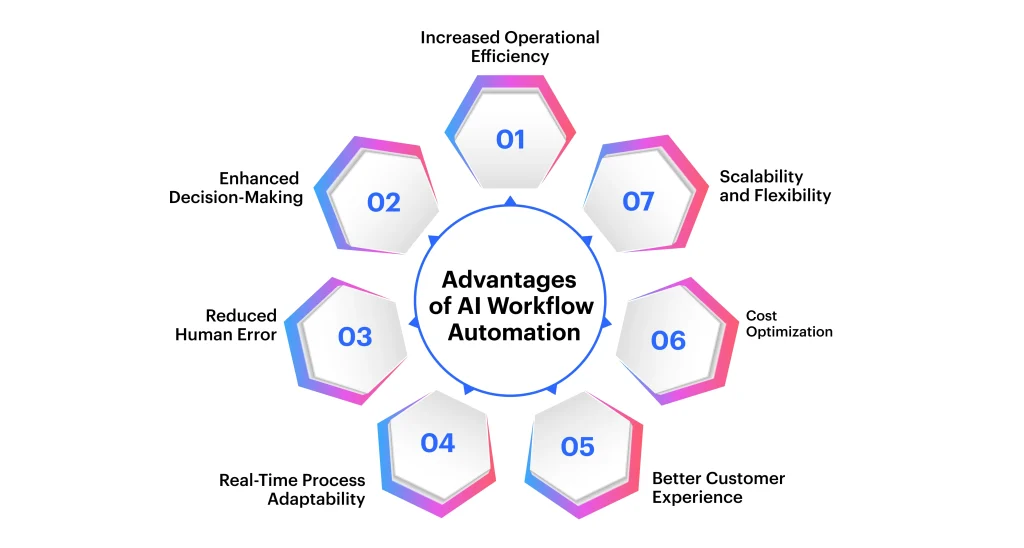
Here are the key advantages of adopting AI workflow automation.
1. Increased Operational Efficiency
AI organizes repetitive and time-consuming tasks, allowing teams to focus on high-value activities. It leads to faster turnaround times and improved productivity across departments.
2. Enhanced Decision-Making
By analyzing vast datasets in real time, AI provides actionable insights that help businesses make smarter, data-backed decisions. It reduces guesswork and adds strategic depth to everyday operations.
3. Reduced Human Error
Manual processes are prone to errors, especially when large volumes of data are used. The AI-driven systems give consistency, accuracy, and compliance, minimizing costly mistakes.
4. Real-Time Process Adaptability
AI doesn’t just automate, it learns and adapts easily. As conditions change, workflows can dynamically adjust based on real-time data, improving resilience and responsiveness.
5. Better Customer Experience
With AI handling service requests, routing tickets, or personalizing communication, businesses can offer faster and more relevant responses, improving customer satisfaction.
6. Cost Optimization
By automating redundant tasks and minimizing the need for manual oversight, companies can impressively reduce labor costs while maximizing output.
7. Scalability and Flexibility
AI-driven automation scales effortlessly with your business. Whether you are adding new processes or handling increased workloads, AI allows for growth without requiring proportional resources.
Eventually, AI solutions allow businesses to move beyond simple automation and into a realm of intelligent operations, where efficiency meets agility, and innovation drives measurable value.
Core Components of AI Workflow Automation Systems
To successfully implement AI workflow automation, it is important to understand the foundational components that power intelligent and adaptive workflows. These key components work together to organize the process, facilitate decision-making, and deliver continuous improvement across business operations.
Below are the major components that make AI for workflow automation truly effective:
1. Data Input and Integration Layer
The component gathers structured and unstructured data from multiple sources like emails, CRMs, ERPs, IoT devices, or databases. Easy integration provides a constant flow of relevant data into the workflow system.
2. AI Engine (Machine Learning & NLP)
At the heart of automation lies its AI engine, which processes data during machine learning algorithms, NLP, and computer vision. This helps the system to analyze patterns, interpret language, and make intelligent decisions in real time.
3. Workflow Orchestration Engine
Workflow orchestration defines the logic of task sequencing, routing, and process management. It determines how data works through the system, how steps are automated, and where human intervention may be needed.
4. Human-in-the-Loop Interface
Despite automation, many tasks still require human judgment. This component provides human oversight at key decision points and helps the user intervene, provide feedback, or approve actions when necessary.
5. Monitoring and Feedback Loop
To keep continuous improvement, it tracks workflow performance, gathers feedback, and feeds it back into the AI engine. Over time, it adds to the system’s ability to learn, optimize, and adapt to changing conditions.
Together, these components make AI for workflow automation an effective solution that not only automates tasks but also intelligently evolves with your business needs. Understanding each element helps secure and smooth implementation for long-term success.
A Must Read: AI Agentic Workflows: The Next Leap in Business Automation
Types of AI Workflow Automation: Breakdown by domain
AI for workflow automation is not a one-size-fits-all solution; it is easy to tailor to specific business domains, addressing unique goals and challenges across industries. From strengthening customer service to transforming operations, AI enables intelligent automation across a wide range of use cases.
Here are some key types of AI workflow automation categorized by domain:
1. Customer Service Automation
AI-powered chatbots, virtual assistants, and sentiment analysis tools handle customer inquiries, route tickets, and offer personalized responses. This improves resolution time and enhances customer satisfaction while reducing the load on human agents. When choosing a platform, check real user feedback like this Nextiva review to help you decide if it’s the right fit.
2. Finance and Accounting Automation
AI easily automates invoice processing, fraud detection, financial reporting, and budgeting. It provides accuracy, accelerates financial workflows, and helps organizations maintain compliance with minimal manual oversight.
3. Human Resources (HR) Automation
From resume screening and interview scheduling to employee onboarding, AI organizes HR operations. It reduces administrative overhead, helping HR teams focus on employee engagement and culture building. HR teams can also suggest that applicants use ATS resume examples from Rezi to structure their resumes in a way that makes their experience and skills easier to evaluate through applicant tracking systems.
4. IT and Helpdesk Automation
AI automates everyday support tasks like password resets, incident management, and system monitoring. It reduces downtime, gives quick resolution, and frees up IT staff for strategic work.
5. Supply Chain and Logistics Automation
AI forecasts demand, manages inventory, and optimizes delivery routes using real-time data. This improves accuracy, reduces delays, and provides better customer fulfillment across the supply chain.
By using domain-specific AI workflow automation, businesses can increase efficiency, lower costs, and drive innovation in their core processes. The key is to identify the right use cases that deliver measurable impact and align with business goals.
One real-world example of this can be seen in Openxcell’s AI-powered health assistant app, which automates patient intake and diagnostics using GPT-4 and speech-to-text technologies. It shows how AI workflow automation can organize healthcare processes and improve patient engagement through intelligent, automated interactions.
How to Implement AI Workflow Automation Effectively
Implementing AI workflow automation requires a complete strategic approach that aligns with business goals, processes, and data infrastructure. When done right, it unlocks efficiency, reduces manual work, and drives intelligent decision-making.
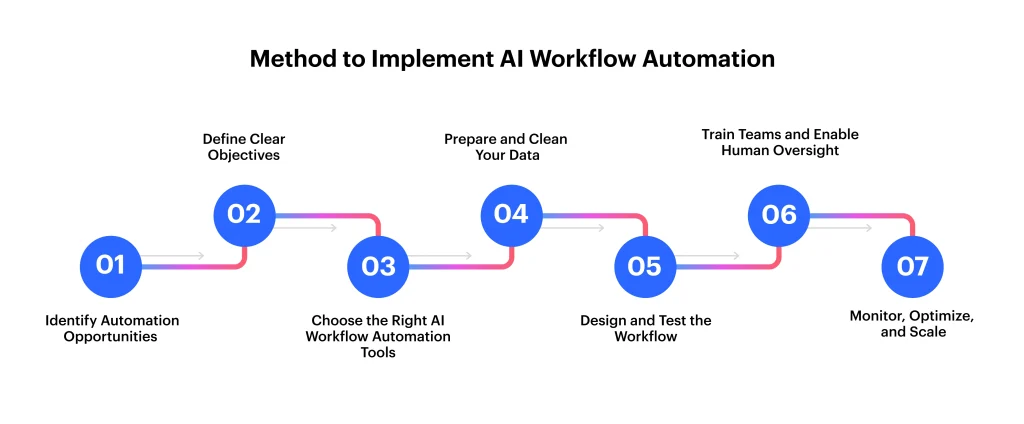
Here’s a step-by-step guide to implementing AI workflow automation.
1. Identify Automation Opportunities
First, start by mapping out the repetitive, time-consuming processes that can benefit from automation and have clear data inputs.
2. Define Clear Objectives
Then set measurable goals like reducing process time, lowering error rates, and improving customer response speed.
3. Choose the Right AI Workflow Automation Tools
Select the tools that integrate well with your existing systems, support AI capabilities like ML or NLP, and offer scalability.
4. Prepare and Clean Your Data
AI relies heavily on data quality, making sure that data is structured, accurate, and relevant to workflows.
5. Design and Test the Workflow
After building your AI-driven workflow in stages, run plot tests to validate performance and identify any gaps or risks.
6. Train Teams and Enable Human Oversight
Lastly, educate your teams on using the system effectively and include checkpoints where human judgment is required.
7. Monitor, Optimize, and Scale
Continuously track results, optimize workflows based on insights, and expand automation across different departments.
With the right AI-driven workflow automation strategy, businesses can transform operations with intelligence and speed.
Additional Read: Understanding AI Models: A Beginner’s Guide
Essential Tools and Resources for AI Workflow Automation
Choosing the correct tools is important to successfully implement AI workflow Automation. These platforms offer features such as drag-and-drop workflow builders, machine learning integration, NLP, and easy third-party integration to improve business operations.
Some widely used AI workflow automation tools include:
- UiPath – A leader in automation with AI-enhanced RPA capabilities for enterprise-grade workflows.
- Zapier with OpenAI – Ideal for no-code AI automation, connecting apps and automating tasks using GPT-powered workflows.
- Appian – Combines low-code development with AI to build complex, scalable enterprise workflows.
- Botpress – An open-source conversational AI platform suitable for automating customer support and internal communications.
- Pega – Provides intelligent automation tools with decision management and real-time analytics.
- Copy.ai Workflows – Allows users to build content and task automation pipelines using AI without coding.
Explore the correct mix of tools and vendor resources to create a tailored and scalable automation strategy that aligns with your business goals.
Common Challenges in AI Workflow Automation Implementation
While AI workflow automation offers many transformative benefits, its implementation isn’t without hurdles. Businesses must navigate technical, organizational, and strategic challenges to realize their full potential.
Here are some key challenges:
1. Data Quality and Availability
AI systems heavily rely on clean, structured data; inconsistent or incomplete data can lead to poor outcomes and inaccurate predictions.
2. Integration with Legacy Systems
Many organizations struggle to integrate AI tools with outdated infrastructure or siloed systems.
3. Lack of Skilled Resources
Implementing and managing AI workflows mostly requires expertise in AI, data science, and automation skills, which may be limited internally.
4. High Initial Costs
Though cost-effective in the long term, upfront investment in tools, training, and system changes can be substantial.
5. Resistance to Change
Employees may oppose AI adoption due to fear of job loss or unfamiliarity with the technology.
Overcoming these challenges needs careful planning, stakeholder alignment, and ongoing support.
Best Practices for Successful AI Workflow Automation
To utilize the complete power of AI for workflow automation, businesses must go beyond simply deploying tools; they need a clear strategy, a strong data foundation, and a continuous improvement mindset.
Implementing these best practices gives smoother adoption and long-term impact. Here are the key best practices to follow:
1. Align Automation with Business Goals
Make sure that every automated workflow directly supports operational priorities like reducing turnaround time, increasing accuracy, or improving customer satisfaction.
2. Standardize Processes Before Automating
Document and organize existing workflows before applying AI, so automation makes sure rather than complicates operations.
3. Prioritize Use Cases with Measurable ROI
Focused on repetitive, time-sensitive, and data-driven processes, where AI can clearly reduce cost or increase efficiency.
4. Integrate Seamlessly Across Systems
Select the tools that work with your existing tech stack ( ERP, CRM, HRMS) to avoid any silos and data loss.
5. Ensure Continuous Monitoring and Governance
Establish KPIs, monitor system performance regularly, and maintain human oversight where decisions impact compliance or customers.
These practices confirm that AI automation delivers meaningful, operational improvements across the organization.
The Future of Workflows is Intelligent and Automated
AI workflow automation is changing the way businesses operate, bringing speed, accuracy, and adaptability to everyday processes. From streamlining operations to improving customer engagement, AI gives unmatched efficiency while implementing it thoughtfully. But to unlock its full potential, businesses need the correct tools, strategy, and expertise to build sustainable, AI-driven workflow automation systems.
At Openxcell, we specialize in designing and deploying intelligent workflow automation solutions tailored to your industry needs. Our team of AI experts, data engineers, and domain consultants helps you automate smarter, faster, with measurable impact.
FAQ on AI Workflow Automation
1. What is AI workflow automation?
AI workflow automation involves using AI technologies such as NLP, machine learning, and more to automate repetitive, rules-based business processes. It creates smarter, faster, and more adaptive workflows with minimum human intervention.
2. How is AI workflow automation different from traditional automation?
Unlike traditional rule-based automation, AI automation adapts to data, learns over time, handles structured inputs, and makes decisions based on context, giving much higher flexibility and scalability.
3. Can AI automation work with our existing ERP or CRM systems?
Yes, most of the AI workflow automation tools support integration with popular platforms like SAP, Salesforce, and more through APIs and connectors.
4. Is AI workflow automation secure for sensitive business data?
Leading tools follow strict data security protocols, including encryption, role-based access, and compliance with regulations like HIPAA and GDPR.
5. Can Openxcell customize AI workflow solutions for my specific industry?
Yes, Openxcell specializes in building industry-specific AI workflow automation solutions tailored to your operational needs, compliance standards, and growth objectives.

Manushi, a former literature student, now crafts content as a writer. Her style merges simple yet profound ideas. Intrigued by literature and technology, she strives to produce content that captivates and stimulates.