AI in Construction: Its Need, Benefits, and Use Cases
 Last updated:October 14, 2025
 10 Min Read
- The Current State of AI in Construction
- 06 Key AI Applications in Construction Industry
- AI for Simulations & BIM Integration
- Effective Risk Management Using Predictive Analytics
- Autonomous Equipment & Robotics for Apt Performance
- Smart Supply Chain Management with AI
- Computer Vision-Based Quality Control
- IoT and AI in Construction Safety
- How is AI used in Construction Today?
- Preconstruction
- Construction
- Post-Construction
- Why There’s a Need to Integrate AI in Construction?
- Major Challenges Related to Integrating AI in Construction
- The Use of AI in Construction and What it Implies


Key pointers covered on AI in construction:
-
- 2020 augmented the need for AI integration in the construction industry.
-
- Various AI subdomains like ML, predictive analytics, computer vision, etc., can streamline the overall workflow.
-
- Artificial intelligence automates, improves, and transforms many on-site processes, which is a massive leap for a labour-intensive industry.
-
- AI’s versatility allows it to revolutionize processes at the preconstruction, construction, and postconstruction stages.
Artificial intelligence has taken over the digital transformation journey across domains. From coding to managing, there is an AI tool catering to all your use cases. But have you heard about using artificial intelligence in construction?
With the integration of AI in construction, the industry is going through a massive yet much-awaited digital transformation.
The 2020s started with industries and businesses realizing the importance of investing in digital infrastructure. This was not just to keep the business running during a pandemic, but also to maintain long-term relevance.
With artificial intelligence becoming a mainstream revolutionary technology, AI development companies have emerged as key stakeholders in this evolving landscape. As experts in the field, these companies are streamlining AI integration for businesses in varied non-IT domains. This is why they must practice an ethical, transparent, and quality development process.
This blog will focus on the use of AI in construction industry, its key applications, benefits, and more. So let’s dive in.
The Current State of AI in Construction
The current statistics and trends showcase how AI is adopted in the industry and to what extent. For instance:
- The global AI market in construction is valued to reach USD 22.68B by 2032. [source]
According to Businesswire:
- There is a need for safety, risk management, and automation, which will lead to massive-scale AI adoption in the industry.
- Predictive analytics will reduce project delays, and ML will improve quality control and accuracy.
- AI and robotics combined can mitigate labor shortages through construction automation.
- Construction sites are high-risk work environments, and with AI-powered safety protocols, those risks can be minimized.
But why is there a massive shift towards AI in the labor-intensive industry?
The construction industry is investing in artificial intelligence to overcome operational roadblocks such as delays, miscommunication, and wastage.
Due to their complex and large-scale projects, construction sites waste a lot of raw material due to the lack of proper planning, overordering, and execution. Predictive analytics and GenAI-based design tools allow the builders to assess and estimate material quantities, order accordingly, and avoid wastage.
Another operational gap is the labor shortage and weather disruptions. Being a labor-intensive industry, a lack of proper workforce planning becomes a major setback. AI’s smart algorithms provide accurate weather forecasts and patterns and help organize workforce availability. Integrating AI-based forecasting minimizes delays, ensuring a streamlined process.
There are a lot of people who collaborate on a single project, like architects, contractors, engineers, clients, etc. Such a setup increases the chances of miscommunication, unclear documentation, and gaps. AI’s NLP-based solutions offer real-time transcription, organized documentation, and transparency, which significantly help improve communication and collaboration.
These situations necessitate the integration of artificial intelligence to make processes smarter, more efficient, and streamlined. Many construction companies are realizing the negative gaps formed due to process inefficiencies and are investing in AI-powered solutions. So, let’s explore some AI solutions used in the construction industry.
06 Key AI Applications in Construction Industry
From proper risk management to reliable security protocols, there are many ways AI in construction proves to be beneficial. These use cases span across various sub-domains of the industry.
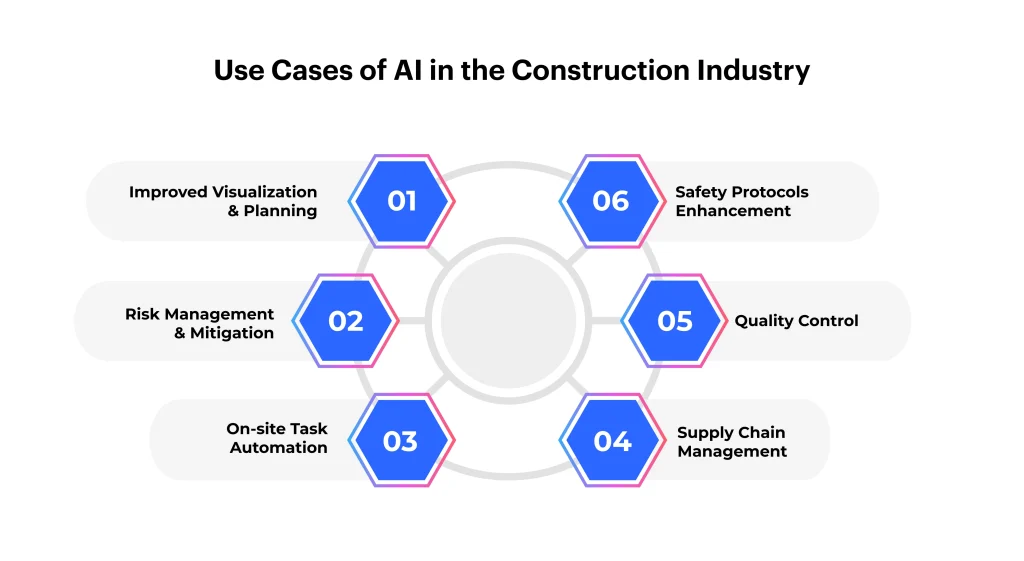
The six prominent applications of artificial intelligence in construction are:
AI for Simulations & BIM Integration
BIM, or Building Information Management, helps construction companies create 3D models for better planning and visualization. These models comprise insights on architecture, engineering, mechanical, electrical, and plumbing.
AI also stimulates multiple scenarios for the companies to adopt innovative construction methodologies that meet quality and sustainability goals. The BIM models also flag potential errors, inefficiencies, and construction inconsistencies, which augment proactive preventive methods.
Effective Risk Management Using Predictive Analytics
Construction projects often require different subcontractors to work simultaneously, thus increasing inconsistency, quality, and security risks. AI flags and addresses risks for smooth operations.
It monitors the data to report any issues in the longer term to ensure premium quality. Another use of AI in construction for risk mitigation is on-site 24/7 vigilance. The AI/ML algorithm’s real-time video surveillance and alert system prevent theft or vandalism.
Autonomous Equipment & Robotics for Apt Performance
Combining robotics with AI can yield fruitful results in the construction industry. The robots and autonomous equipment handle tasks that require high-level precision and evolve with the dynamic construction site environment.
AI robots automate tasks like bricklaying, painting, and welding, while self-driving vehicles improve the workflow. The robots also collaborate with humans to reduce physical strain and improve productivity.
Smart Supply Chain Management with AI
Fleet management is one of the overlooked aspects, but it is the primary cause of delays in construction projects. AI’s real-time insights and metrics help companies eliminate this challenge.
Managing fleet and in-house inventory in sync ensures minimal interruptions due to lack of materials or other resources. Integrating advanced tools such as contractor estimating software enables contractors to streamline estimates, management of invoices, and client payments, supporting more efficient project delivery. Investing in artificial intelligence in construction for fleet management will result in an accelerated, cost-efficient, and time-efficient process.
Related Read: AI in Demand Forecasting: Enhancing Accuracy & Efficiency
Computer Vision-Based Quality Control
Effective monitoring of construction sites is essential to maintaining quality development. Traditional inspection methodologies are time-consuming and might not be very accurate. AI-powered cameras, drones, and sensors continuously monitor and capture images for better assessment.
Integrating artificial intelligence in construction for quality control identifies potential issues and flaws through annotated images. These systems identify structural flaws, missing elements, and more to assist the construction company in taking proactive measures.
IoT and AI in Construction Safety
AI’s real-time hazard detection, worker fatigue monitoring, sensor-induced risk identification, accident-prone work environment alerts, etc. The sensors quickly identify signs of instability and issues, thus ensuring management takes appropriate preventive measures.
Additionally, investing in AI-powered wearable gear like helmets, vests, or smart bands can foster safer working conditions. These gears track workers’ health, fatigue, and energy levels, leading to better health and a safer work environment.
How is AI used in Construction Today?
The versatility of artificial intelligence in construction is visible in its use cases across different stages of the project lifecycle. To explain them briefly,
Preconstruction
At this stage, AI optimizes designing processes, helps select the appropriate contractor from hundreds of applications, schedules events (like site visits, meetings, etc), data organization, and risk analysis. Though AI is not perfect and still requires human supervision, it helps a lot in streamlining and documenting the whole process.
Construction
Once the planning is done, AI’s predictive analytics prevent setbacks and delays by foretelling potential issues and machine breakdowns so the team can take proper preventive actions. Additionally, real-time tracking aligns material delivery with existing resources to improve workflow. Devices like drones, IoT, etc., further enhance quality and security.
Post-Construction
After the project is completed, AI-powered monitoring can detect every form of energy consumption, building health, and carbon emissions. These insights help people improve their lifestyle, minimize energy consumption, choose sustainable options, and maintain building strength. Using AI simplifies post-construction maintenance, maintains accuracy, and fosters environment-friendly, top-notch AI-powered solutions.
As AI reshapes post-construction workflows, many contractors are also integrating trade-specific management software, such as roofing project tools, to manage maintenance schedules, inspections, and client reporting more efficiently.
What is the role of AI development companies?
An AI development company plays a huge role in the current scenario as they are the connecting bridge between the current workflow and the digitally transformed one. As the AI in construction market continues to grow and evolve, it is the service provider’s responsibility to educate their clients on the benefits and challenges of AI advancements.
From integrating to instructing on how to use AI in construction industry, a reliable service provider can significantly contribute to streamlined operations. The key is to find a company whose values and goals align with yours, and your AI solution development journey will be streamlined.
Why There’s a Need to Integrate AI in Construction?
For those still wondering why there’s a need for integrating AI in the industry, here are some key benefits. Artificial intelligence in construction makes it reliable, in sync with the current times, and future-proof.
Some of the key benefits of AI in construction are:
- AI provides ample insights for construction firms to predict safety risks, equipment health, resource wellbeing, etc., to mitigate delays and improve workflow quality.
- Using artificial intelligence in the construction industry also helps companies analyze everything thoroughly and plan well to avoid any loss of time or money.
- AI effectively allocates tasks and resources, helping companies avoid delays due to miscommunication or lack of resources.
- AI ensures quality during the planning stage by analyzing the designs and 3D models and flagging errors, potential quality issues, misaligned plans, etc.
- Post-construction management can be simplified with AI’s 24/7 monitoring and AI-based maintenance per requirements.
- AI also paves the way towards sustainable construction practices, like avoiding excessive wastage and reducing carbon emissions.
- Lastly, AI also improves the project lifecycle with the help of data-driven insights throughout the process.
Our team assisted a procurement company in streamlining its workflow for varied construction projects with a resilient e-Procurement software. Check out our case study to see how we made it happen.
Major Challenges Related to Integrating AI in Construction
Despite its benefits, many companies still hesitate to integrate advanced digital solutions into their workflow. This is because people encounter inevitable challenges when integrating artificial intelligence in the construction industry.
The first one is, without a doubt, a lack of proper data security infrastructure. With increased AI dependency, companies must understand the need to secure sensitive data under multiple layers of security. Protective measures against unauthorized access and adherence to proper privacy regulations are necessary in the digitally advanced world.
Next is related to integrating AI in construction into the existing system. Many companies already use an established project management system, which adds to the customization complications. The complex planning and execution make it a hindrance to AI adoption.
The challenge also revolves around initial cost. AI implementation requires a heavy investment with long-term gains. Though it does offer a sure success, the investment amount can become a massive roadblock for some companies.
Lastly, ethical considerations, with AI going mainstream, it is important to keep these regulations in mind. AI-powered solutions must comply with all the required legal and moral guidelines. From understanding legal jargon to handling various licensing issues, this makes AI another complication to deal with, hindering companies from investing.
Related Read: AI Integration: The Business’s Future is Here
The Use of AI in Construction and What it Implies
Artificial intelligence is and will continue to transform business processes across various sub-domains of the construction industry. Whether it is on-site work or document handling off-site, artificial intelligence’s versatility will continue to be a disruptive force in the industry.
It is time for businesses to understand the need for and adopt innovative technologies not just to stand out but also to make the work environment safer, efficient, and secure. Companies can connect with AI consulting service providers to simplify navigating through the complex AI-powered landscape with seasoned professionals.
This way, the experts will handle the digital integration while you upscale your business in a technology-intensive landscape.


A Philosophy student who knocked on the door of the technology, Vaishnavi is a writer who likes to explore stories, one write-up at a time. A reader at heart, she plays with words to tell the tales of the digital world.